The Last Night Of The World (from Miss Saigon) Sheet Music Preview

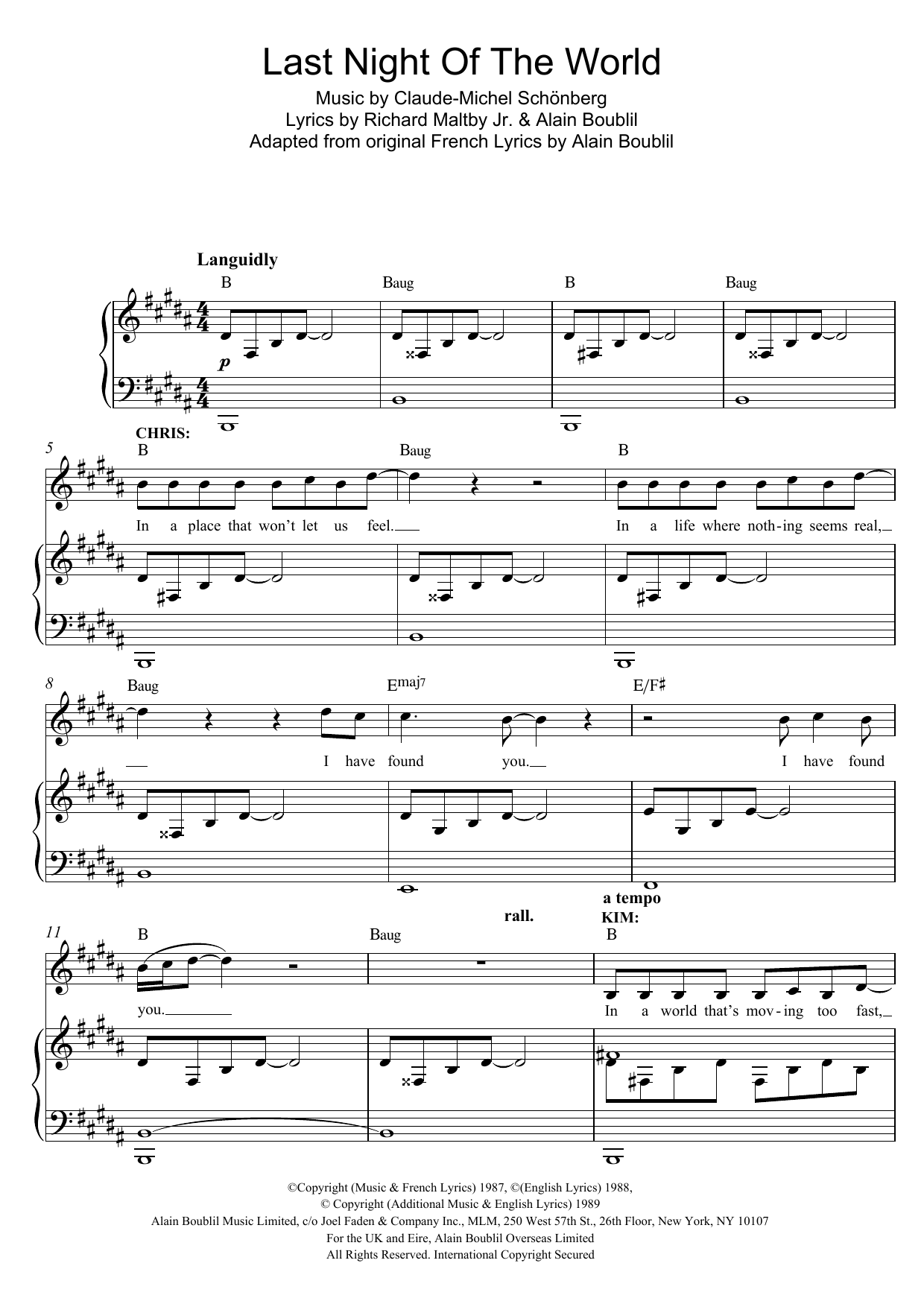
The Last Night Of The World (from Miss Saigon): Piano Vocal

By Claude-Michel Schonberg / As performed by Boublil and Schonberg

Item: 35-DS00331853

Digital Download
$5.99
Description

The Last Night Of The World (from Miss Saigon): Piano Vocal isn't in MakeMusic Cloud just yet...but it could be. Let us know you'd like to see it, and you'll help shape what comes next. In the meantime, start a free trial and dive into thousands of interactive titles your students can play along with today.

Sample Audio
No sample audio found.
Sample Video
Additional Details
Publisher: Hal Leonard
Page Count: 11
SKU: 35-DS00331853

More about this title

About the Composer: Claude-Michel Schonberg

Claude-Michel Schönberg is a French composer who fundamentally changed musical theater by combining operatic ambition with contemporary orchestration. His collaborations with lyricist Alain Boublil produced two of Broadway's most influential megamusicals: Les Misérables and Miss Saigon. Both works demonstrate his gift for writing soaring melodies that carry emotional weight without sacrificing theatrical clarity.

For music educators, Schönberg's work offers a masterclass in how melody can drive narrative. His songs sit comfortably for singers while demanding real vocal control and emotional maturity. The piano vocal reductions capture the sweeping quality of his orchestrations, making them accessible for teaching and performance outside a full orchestral context.

Why we love this

This duet captures one of musical theater's most devastating moments: two characters acknowledging their love while knowing they face impossible circumstances. The melody is gorgeous enough to showcase a strong vocalist, but the emotional restraint of the song makes it equally powerful when sung by developing singers who understand how to use stillness. It's the kind of piece that teaches singers the difference between technique and artistry.

What to expect

A moment of stillness before heartbreak. The melody unfolds with classical elegance, but beneath it runs an undercurrent of longing and resignation. The harmonic language is modern enough to feel theatrical, yet the piece never sacrifices the directness of the moment itself.

Who it's for

Singers with solid vocal fundamentals and the maturity to handle material with real emotional stakes. This works well for upper-level soloists, duet teams in solo competitions, and anyone preparing audition material that showcases both technique and interpretive sensitivity.

How to get the most out of it

  • The piano part carries much of the orchestral texture here, so commit to voice leading that clarifies the harmonic progression rather than simply striking chords. The accompaniment should breathe with the singers.
  • Resist pushing the tempo. This song needs space for the lyrics to land and for the silence between phrases to matter.
  • Balance the two vocal lines so that conversation feels genuine. If one voice dominates, you lose the intimacy of two people saying goodbye.
  • Mark your breath points carefully during rehearsal. There are long phrases that require planning, but breathing in the wrong place disrupts the line and the emotional arc.

How to use it

This fits beautifully in a program exploring contemporary musical theater as art song. It works as a concert finale when you want to leave the audience in a reflective emotional space, or as a centerpiece in a cabaret-style program pairing Broadway vocals with standards.

Skills your students will build

  • Sustaining long phrases while maintaining line and breath control
  • Balancing two vocal lines as dialogue rather than accompaniment
  • Interpreting contemporary theatrical text with emotional specificity
  • Reading and executing the piano vocal reduction style used in musical theater
  • Managing dynamics and tone to convey intimate moments on stage

You May Also Like