
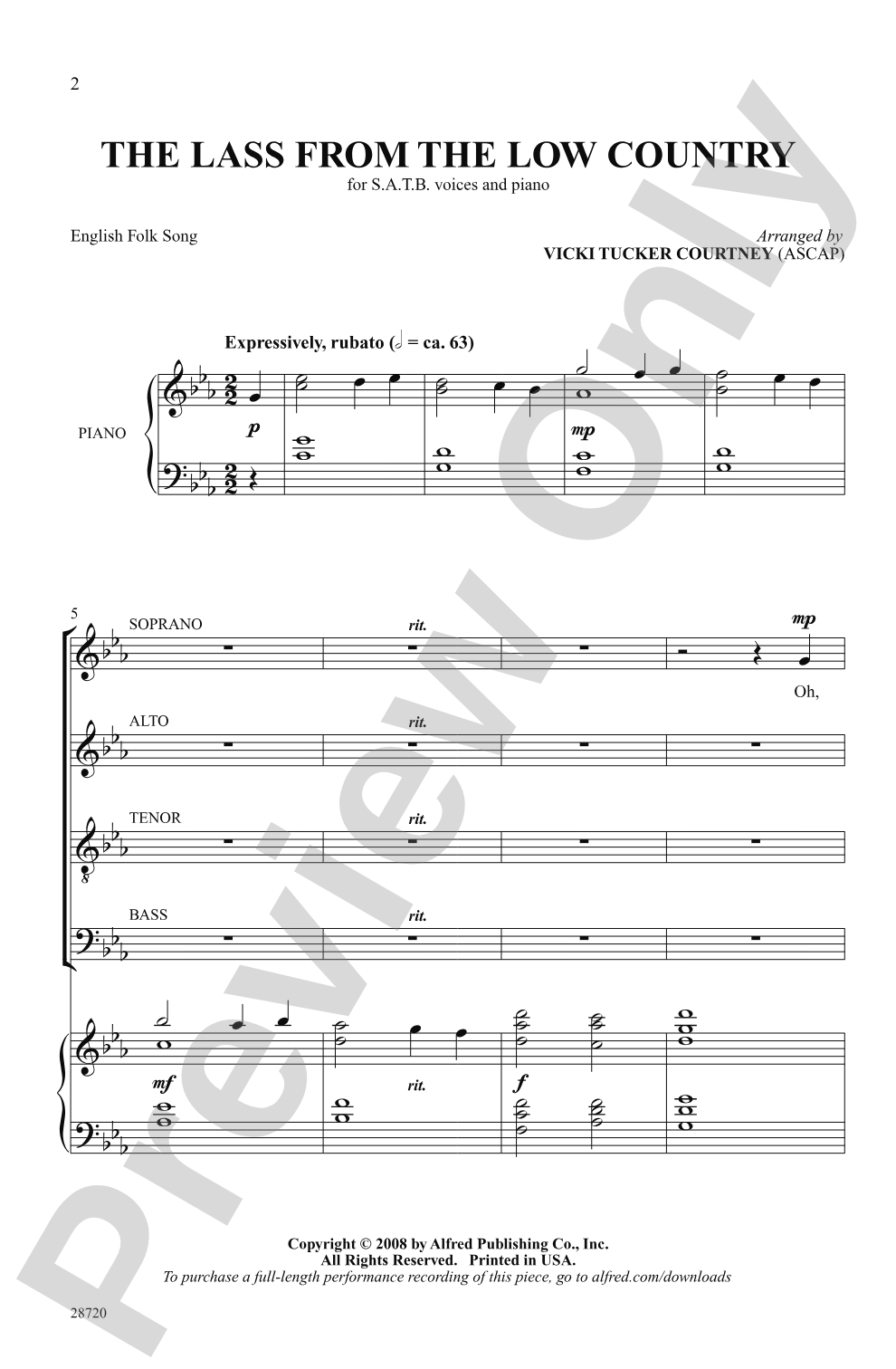
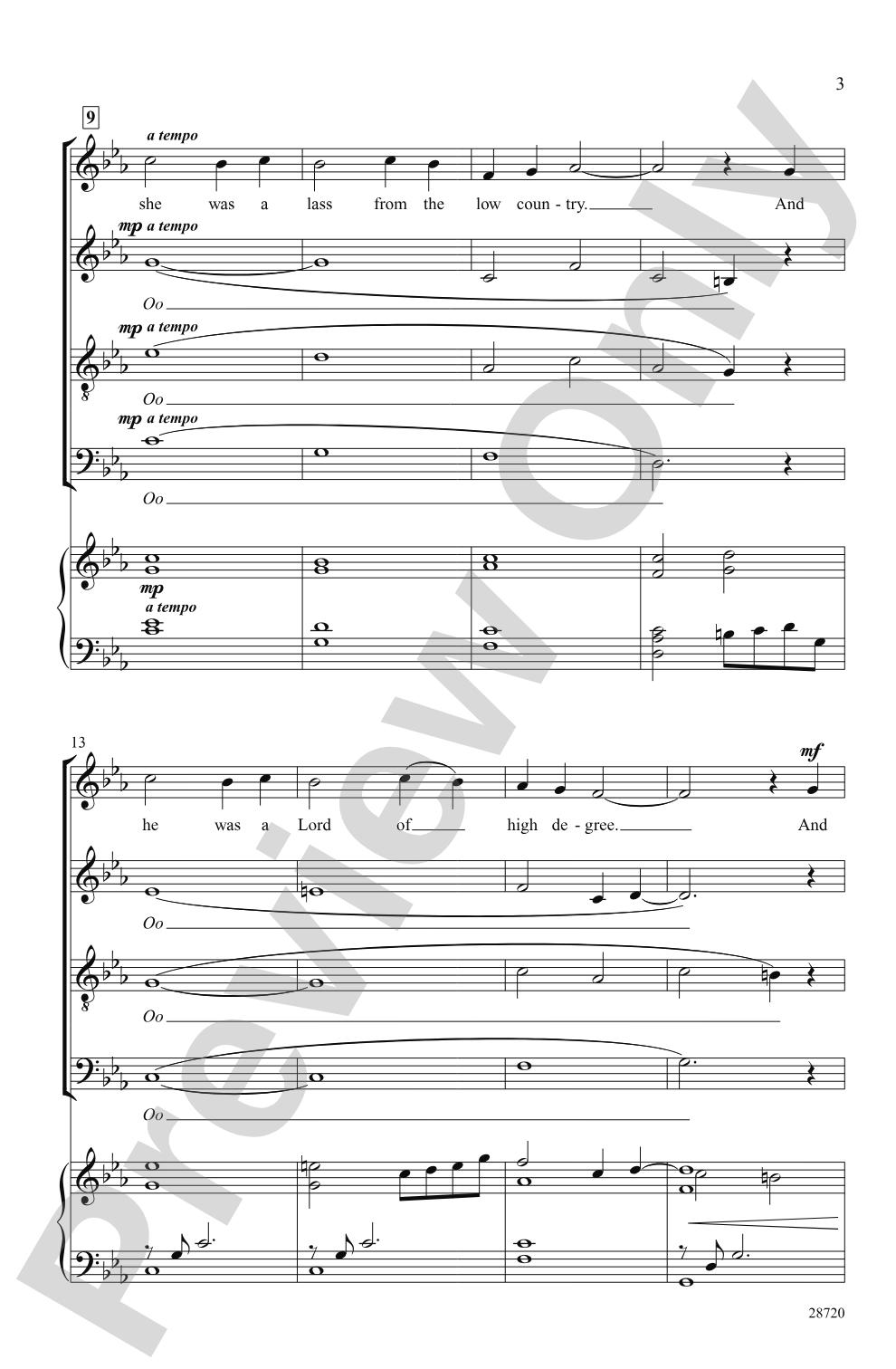
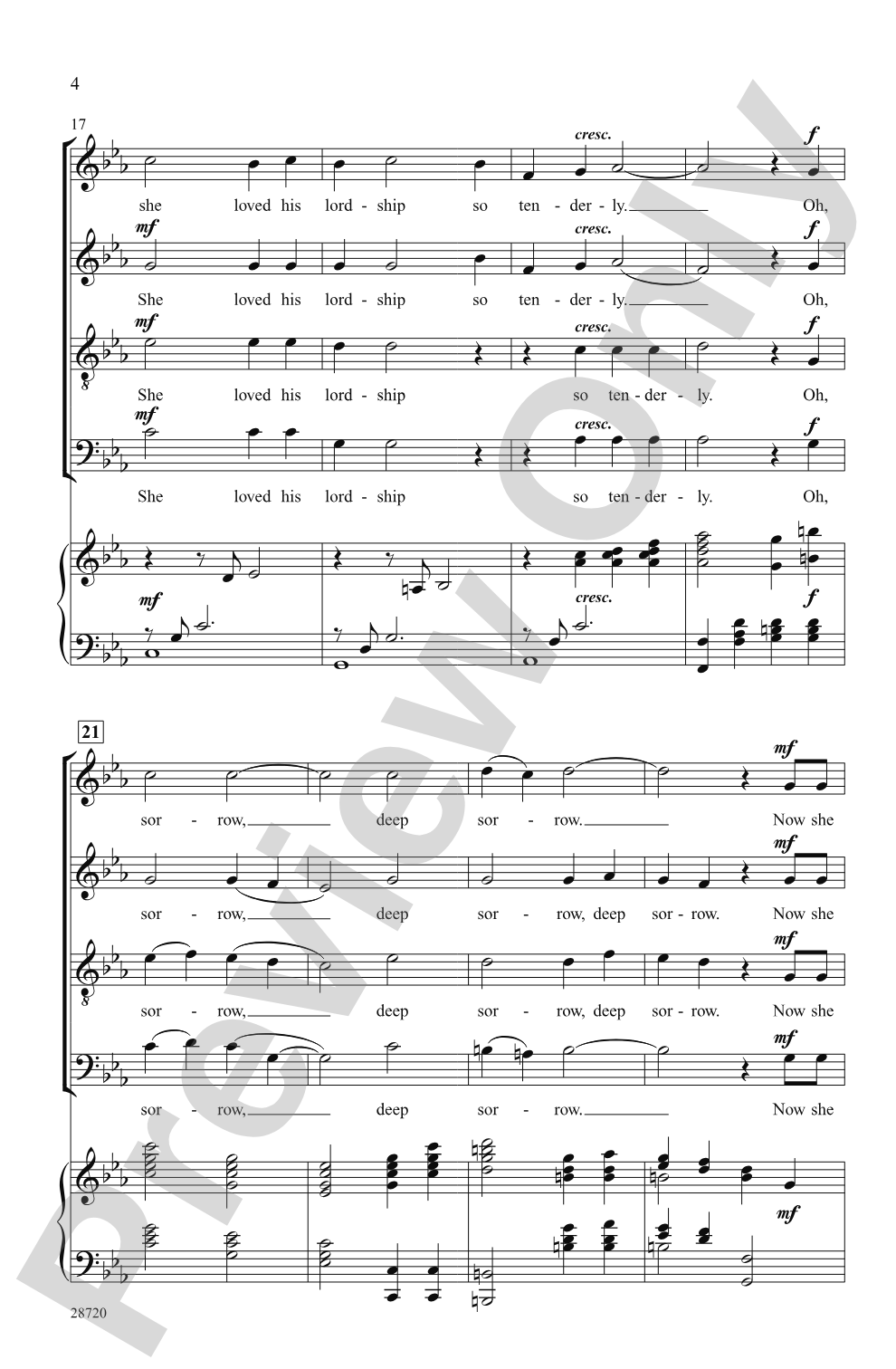

The Lass from the Low Country: SATB Choral Octavo
English Folk Song / arr. Vicki Tucker Courtney
Item: 00-PO-0000550

$1.95
Minimum order quantity: 20 copies
Pickup currently not available
Related Items
The Lass from the Low Country: SATB Choral Octavo |
$1.95
|
View |
Description
Classic choral writing and a dramatic piano accompaniment create a pensive moment in your concert program. Each temporary dissonance gracefully resolves in this well-crafted arrangement of the English folk song. A melancholy text, a sophisticated song.


Don't just read it, hear it, play along with it, and watch your students grow with it. In MakeMusic Cloud, The Lass from the Low Country: SATB Choral Octavo comes alive with professional accompaniment, adjustable tempo, and built-in practice tools that turn solo practice into real progress.
Open in the Player
Jump straight in and assign it today.
Start Your Free Trial
Open this title and explore the full library in minutes.
Sample Audio
1
Audio File
--:--
0:00
0:00
Sample Video
No sample videos found.
Additional Details
Series:
Lawson-Gould
Publisher:
Alfred Music
Page Count:
16
SKU:
00-PO-0000550
More about this title
About the Arranger: Vicki Tucker Courtney

Vicki Tucker Courtney began piano studies at age four and pursued classical training through her undergraduate years at North Texas State University, where she also gained substantial experience accompanying choral ensembles. This dual foundation in both performance and choral writing shaped a prolific career spanning composition, arrangement, and private instruction across piano, voice, handbells, and choral repertoire.
Courtney has earned multiple ASCAP Plus Awards throughout her career and studied composition under the mentorship of Dove Award winner Mark Hayes in 2002 and 2004. Her catalog now exceeds 350 published titles, a milestone she reached after publishing her first 100 works in 2009. She currently resides in Columbia, Tennessee, where she maintains a full-time writing practice and continues teaching piano and composition to students across all levels.
Why we love this
Courtney's arrangement honors the folk melody while introducing genuine sophistication through her piano writing and harmonic choices. The dissonances feel purposeful rather than decorative, resolving with the grace that distinguishes skilled arranging from merely setting words to melody. Programming this octavo signals to your audience that you're choosing repertoire with both heart and craft.
What to expect
The piece settles into a reflective, introspective space. The melody carries a quiet yearning while the piano weaves around it with restless harmonic motion, creating tension that resolves into moments of unexpected beauty. There's melancholy here, but it's the kind that feels necessary and honest.
Who it's for
Choirs seeking repertoire that moves beyond surface emotion; this is for directors who want their singers to experience how arrangement choices deepen meaning. The SATB voicing and manageable page count make it accessible to high school and collegiate ensembles, as well as volunteer community choirs with some rehearsal depth.
How to get the most out of it
- Balance the choir so the piano's dramatic accompaniment remains audible without overpowering the text. The accompaniment carries narrative weight, not just harmonic filler.
- Shape the phrase endings where temporary dissonances resolve; these moments anchor the emotional arc and deserve attention to voicing clarity and blend.
- Use the 16-page score to study how Courtney distributes the melody across voice parts. Soloists or section leaders should understand the arc so transfers between parts feel inevitable rather than arbitrary.
- Rehearse the choir and pianist separately first, then together with time for the accompanist to find balance between supporting the ensemble and bringing out the distinctive harmonic language.
How to use it
Position this as a concert centerpiece where listeners need quiet attention. It works powerfully as a standalone piece between higher-energy selections, or as the emotional anchor in a program exploring folk traditions. The dramatic accompaniment also makes it suitable for festival and competition programming where judges expect both musical substance and interpretive depth.
Skills your students will build
- Balancing voice parts with piano accompaniment in SATB texture
- Recognizing and performing non-functional harmonic dissonance and resolution
- Transferring melodic lines between voice parts while maintaining phrase continuity
- Interpreting text with attention to harmonic support and emotional pacing
- Blending in choir sections while maintaining individual line independence