
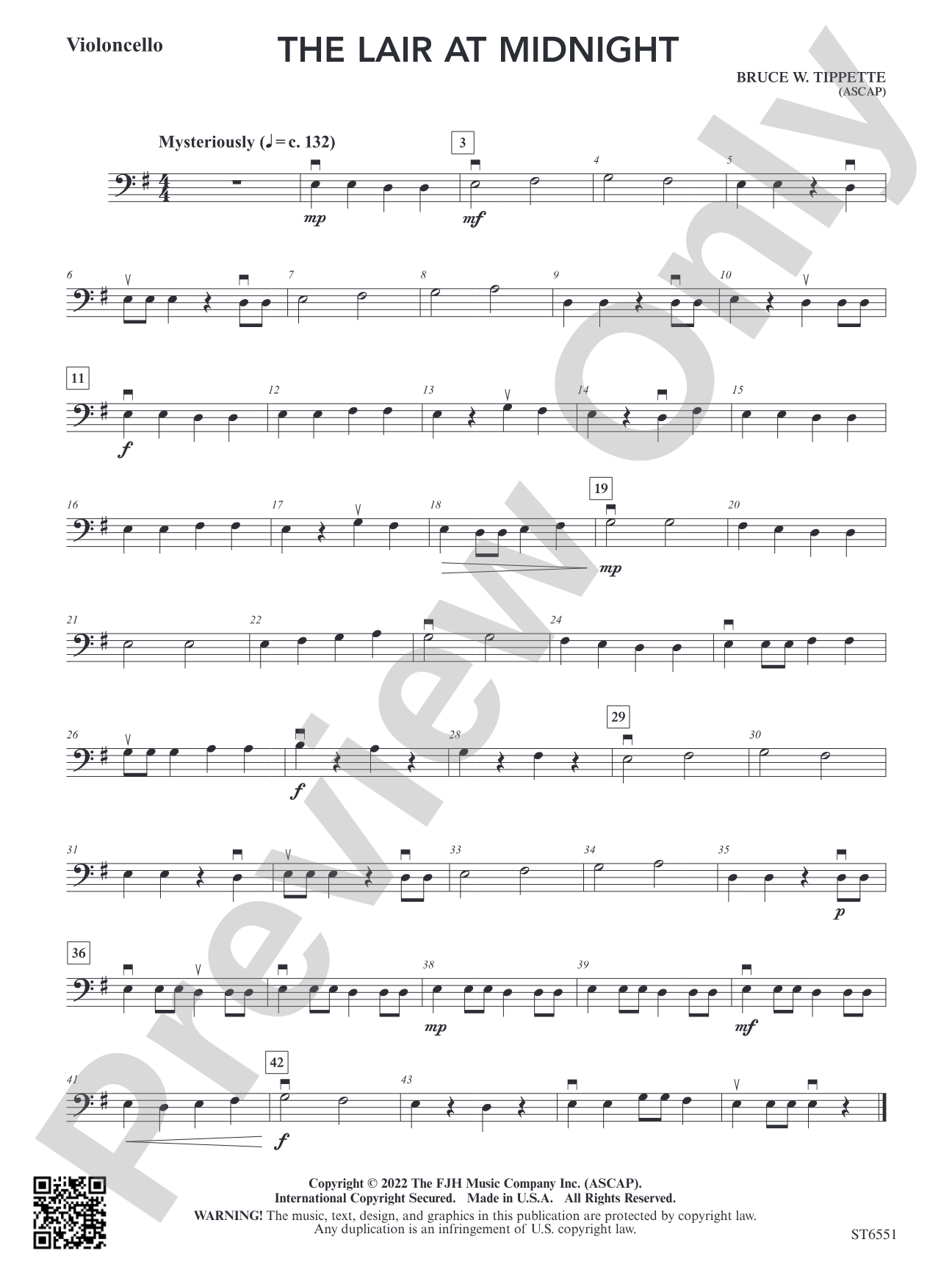

The Lair at Midnight: Violoncello
By Bruce W. Tippette
Level:.5
Item: 98-PC-DST6551_VC1
$7.00
Pickup currently not available
Description
What lurks in the lair at midnight? The answer is revealed in this engaging work for beginning string orchestra. Using only the first six pitches of the D major scale and based largely on step-wise motion, this piece evokes images of a night-time excursion into the unknown. Optional piano and low tom-tom are included to enhance and support the orchestra. (1:20)


Don't just read it, hear it, play along with it, and watch your students grow with it. In MakeMusic Cloud, The Lair at Midnight: Violoncello comes alive with professional accompaniment, adjustable tempo, and built-in practice tools that turn solo practice into real progress.
Open in the Player
Jump straight in and assign it today.
Start Your Free Trial
Open this title and explore the full library in minutes.
Sample Audio
1
Audio File
--:--
0:00
0:00
Sample Video
Additional Details
Series:
FJH Beginning Strings
Publisher:
The FJH Music Company, Inc.
SKU:
98-PC-DST6551_VC1
More about this title
About the Composer: Bruce W. Tippette

Bruce W. Tippette is a composer and educator whose work spans concert music, choreography, and film. He earned his Master of Music in composition from the University of North Carolina School of the Arts and dual undergraduate degrees in composition/theory and music education from Appalachian State University. His orchestral work Unconquered won the 2012 Mary Starling Composition Performance Award and has been performed multiple times by the Winston-Salem Symphony.
Tippette's commissions span choral and instrumental ensembles, and in 2012, 2013, and 2014 he was selected to compose works as part of an experimental partnership between Cirque du Soleil and UNC School of the Arts. Beyond his concert works, he has contributed original music for children's musical theater and received the Lynn Freeman Olson Composition Award for his solo piano piece Dance of Fire. In his teaching role at the Community Music School of UNC School of the Arts, he instructs composition, theory, piano, and voice, while also serving as Youth Music and Handbell Director at Augsburg Lutheran Church.
Why we love this
Tippette has crafted a piece that introduces narrative and imagination without overwhelming beginners with technical demands. By limiting the palette to the first six pitches of D major and emphasizing stepwise motion, the writing remains entirely accessible while still creating genuine musical atmosphere and tension. The optional piano and tom-tom parts give conductors flexibility to support early orchestras or create a richer sound for more experienced ensembles.
What to expect
A shadowy journey into the unknown, unfolding with deliberate calm before revealing what waits in the darkness. The stepwise motion creates an almost cautious quality, as if tiptoeing through unfamiliar territory, while the optional percussion adds an edge of anticipation. By the time answers emerge, the mood has shifted from mystery to discovery.
Who it's for
Beginning string orchestras and young string players who thrive with clear melodic material and accessible technique. This piece works well for orchestras in their first or second year of group playing, where students are solidifying fundamental intonation and ensemble balance without navigating complex rhythms or extended ranges.
How to get the most out of it
- Shape the stepwise lines with gentle dynamic swells to build suspense. Even in D major with simple motion, phrasing matters; avoid playing each passage flatly.
- If including the tom-tom part, keep the strikes sparse and resonant. The percussion should punctuate the mystery rather than drive the pulse.
- Let the optional piano part anchor younger players without overwhelming them. It can be a confidence builder while allowing strings to focus on intonation and phrasing.
- Emphasize contrast between sections. The reveal at the end should feel like a resolution, not an anticlimax. Bring the full ensemble sound forward as the piece concludes.
How to use it
Include this piece early in a concert to establish a narrative arc, or pair it with other programmatic works to create a thematic set. Its brief duration (1:20) makes it an ideal opener that engages audiences immediately while showcasing how effectively young orchestras can convey character and mood. The contest/festival designation also makes it a solid choice for competitions where descriptive works perform well.
Skills your students will build
- Reading and performing in D major scale patterns
- Stepwise melodic motion and phrase shaping
- Ensemble balance with optional accompaniment
- Sustaining focused intonation during lyrical passages
- Responding to simple but intentional dynamic shaping
- Coordination between string sections and optional percussion