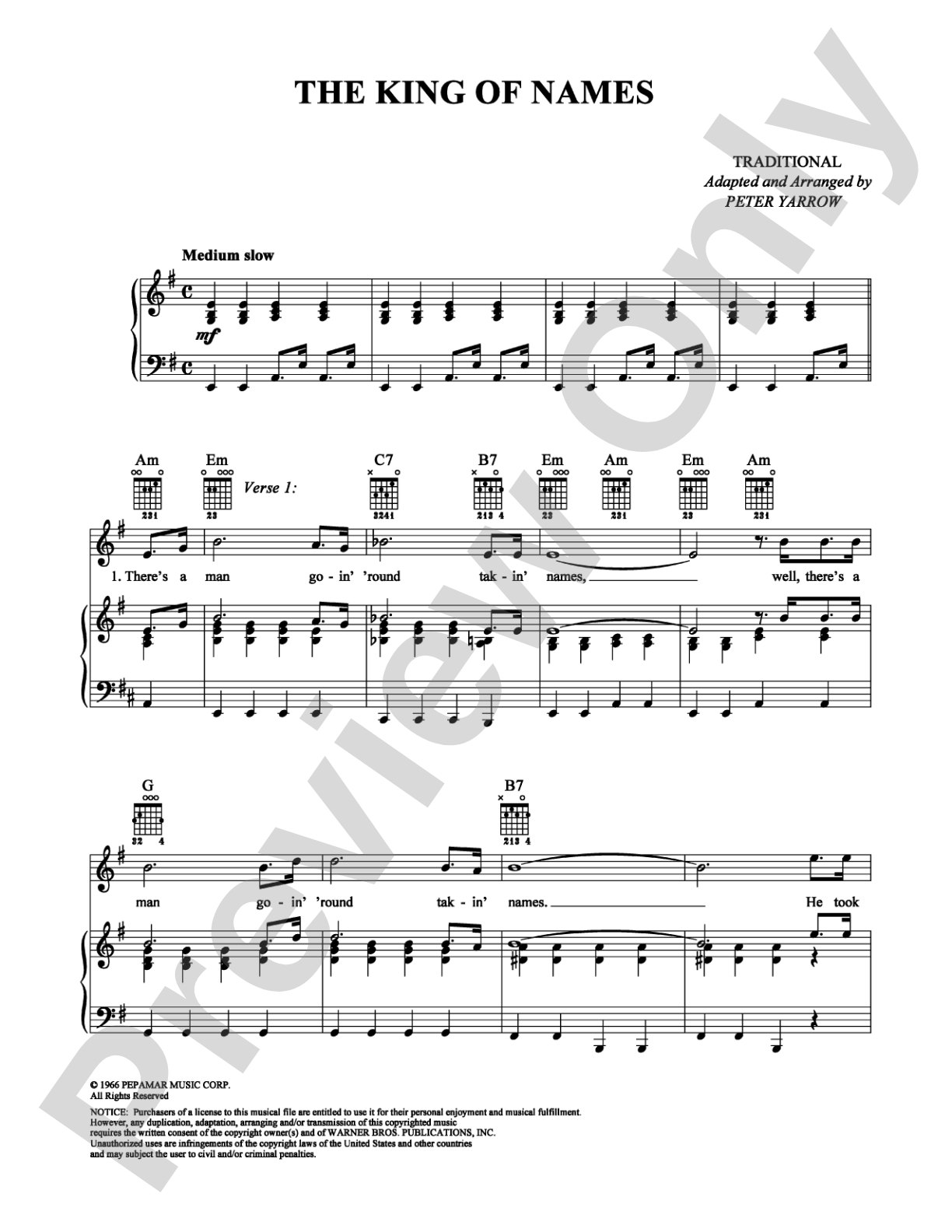
The King of Names: Piano/Vocal/Chords Digital Sheet Music

The King of Names: Piano/Vocal/Chords Digital Sheet Music

Traditional, Peter Paul & Mary

Item: 00-PS-0003941

Digital Download
$3.99
Description

The King of Names: Piano/Vocal/Chords Digital Sheet Music isn't in MakeMusic Cloud just yet...but it could be. Let us know you'd like to see it, and you'll help shape what comes next. In the meantime, start a free trial and dive into thousands of interactive titles your students can play along with today.

Sample Audio
No sample audio found.
Sample Video
Additional Details
SKU: 00-PS-0003941

More about this title

About the Artist: Peter Paul & Mary

Peter, Paul and Mary emerged in the early 1960s as one of the most influential folk revival groups in American music history. The trio of Peter Yarrow, Paul Stookey, and Mary Travers became known for their seamless vocal harmonies, acoustic instrumentation, and commitment to socially conscious songwriting that resonated across generations.

Why we love this

This arrangement captures the gentle sophistication that made Peter, Paul and Mary's sound so teachable and listenable. The piano/vocal/chords format gives singers and accompanists flexibility to explore the song's harmonic richness while preserving the intimate character that made the original a folk standard.

What to expect

The song carries a contemplative warmth, inviting listeners into a personal moment through its lyrical storytelling. There's an understated elegance in the melody and harmonic movement that feels both familiar and deeply expressive.

Who it's for

This arrangement works well for adult singers, college-level vocalists, and skilled high school performers exploring folk and singer-songwriter repertoire. Pianists accompanying vocalists will find the chord notation accessible while still offering room for interpretive accompaniment choices.

How to get the most out of it

  • Approach the vocal line with conversational phrasing rather than strict metronomic precision; the song breathes better when you prioritize the text and its natural cadence.
  • Use the chord symbols as a foundation for accompaniment variation. Experiment with fingerpicking patterns or gentle arpeggios that complement rather than overshadow the vocal melody.
  • Balance transparency in the piano texture with the vocal line so both elements remain audible in performance or rehearsal spaces of any size.

How to use it

This pairs naturally on recitals or concert programs celebrating folk and acoustic music traditions, or as part of a broader exploration of 1960s singer-songwriter literature. It also serves as excellent repertoire for accompaniment study, offering pianists practice in responsive, nuanced collaborative playing.

Skills your students will build

  • Interpreting chord symbols and creating varied accompaniment textures
  • Sustaining lyrical phrasing across longer melodic phrases
  • Balancing vocal and instrumental lines in ensemble settings
  • Navigating folk-influenced harmonic progressions

You May Also Like