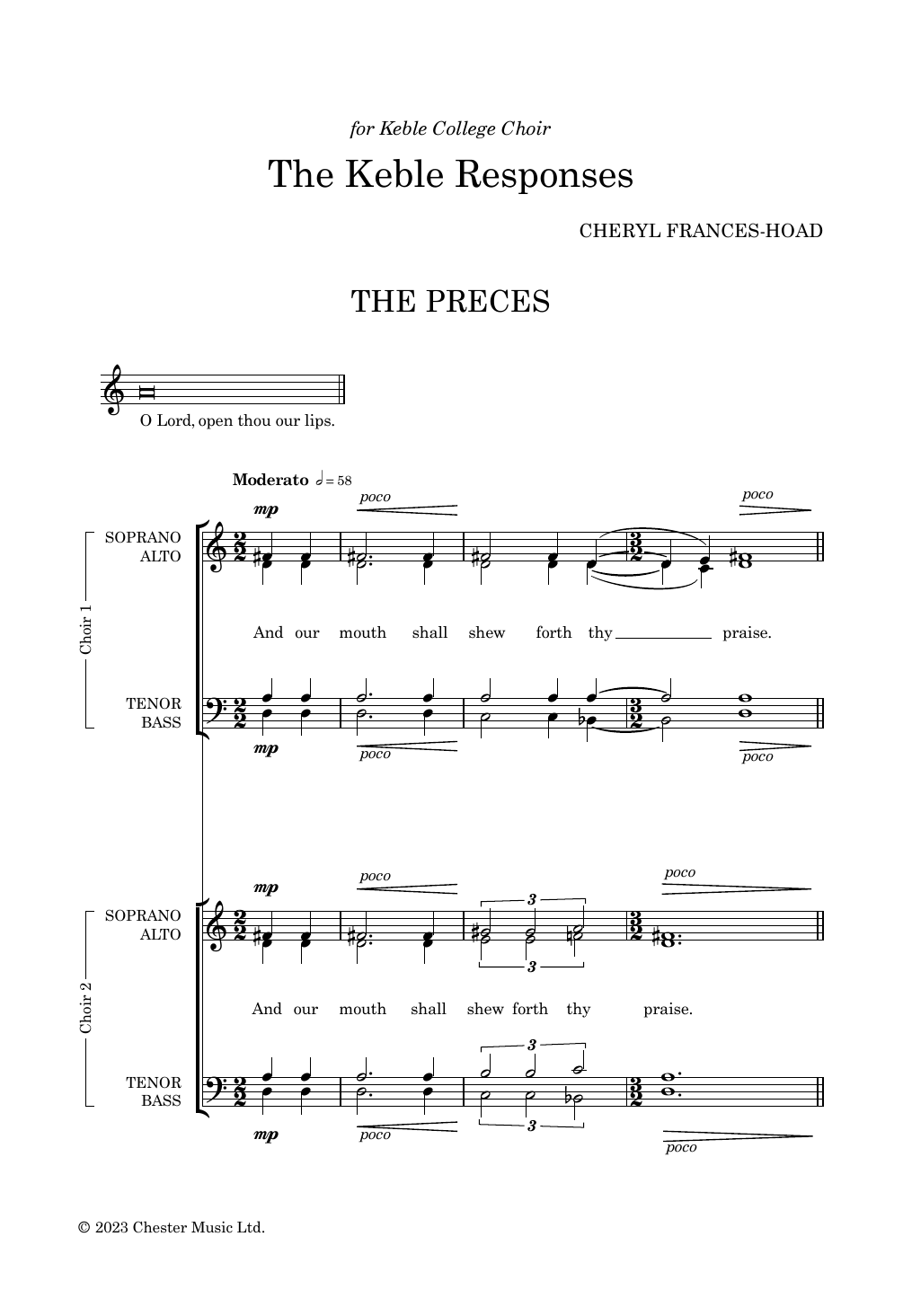
The Keble Responses (for Double SATB Choir): SATB Choral Octavo
By Cheryl Frances-Hoad
Item: 35-DS01977875
Digital Download
$4.95
Minimum order quantity: 10 copies
Please note: Under U.S. copyright law, you must purchase the exact number of copies needed for your ensemble. Printing, duplicating or sharing additional copies is strictly prohibited.
Pickup currently not available
Description
Discover MakeMusic Cloud: thousands of interactive titles your students can play along with today.
Cheryl Frances-Hoad is a British composer whose choral writing draws on liturgical and sacred traditions while embracing contemporary harmonic language. Her work for voices demonstrates a deep understanding of vocal writing across multiple registers and ensemble configurations, making her compositions both singable and musically substantial.
Why we love this
Frances-Hoad writes for double SATB with genuine architectural purpose rather than mere doubling. The antiphonal possibilities here are genuinely exciting, and the harmonic language is sophisticated enough to reward careful rehearsal without becoming inaccessible. A choir that masters this score will have built something real.
What to expect
The writing has a meditative yet carefully structured quality, with the double choir creating layers of harmony that feel both spacious and intimate. Singers encounter rich harmonic textures that demand focused listening to fellow singers and a commitment to precise intonation.
Who it's for
This score works for accomplished community choirs, collegiate ensembles, and upper-level high school programs comfortable with divisi writing and harmonic complexity. Directors seeking substantial a cappella repertoire that showcases vocal blend and ensemble control will find this particularly rewarding.
How to get the most out of it
Balance the two choirs carefully during passages where they sing different material; the SATB 1 and SATB 2 voices need equal presence even when one group carries the primary melodic line.
Attend to the text underlay throughout, as longer phrases can create tricky rhythmic alignments between the two choirs that require precision.
Experiment with spatial separation if your venue allows it; antiphonal writing often gains clarity and drama when the two groups are positioned distinctly.
How to use it
These responses work beautifully as a concert centerpiece for programs exploring sacred or liturgical themes, or as an anchor for an all-a cappella set. The 23-page score suggests either a single extended work or a suite of shorter movements; check the structure carefully when planning your rehearsal timeline.
Skills your students will build
singing with two independent SATB lines simultaneously
listening across four-part harmony in each choir
sustaining accurate intonation through complex harmonic progressions
coordinating ensemble entries and releases across spatial separation
interpreting antiphonal text placement and dramatic pacing
You May Also Like
Scan to Complete Your Purchase
Use your phone's camera to scan the code below
You'll log in on your phone and the order will be added to your account