
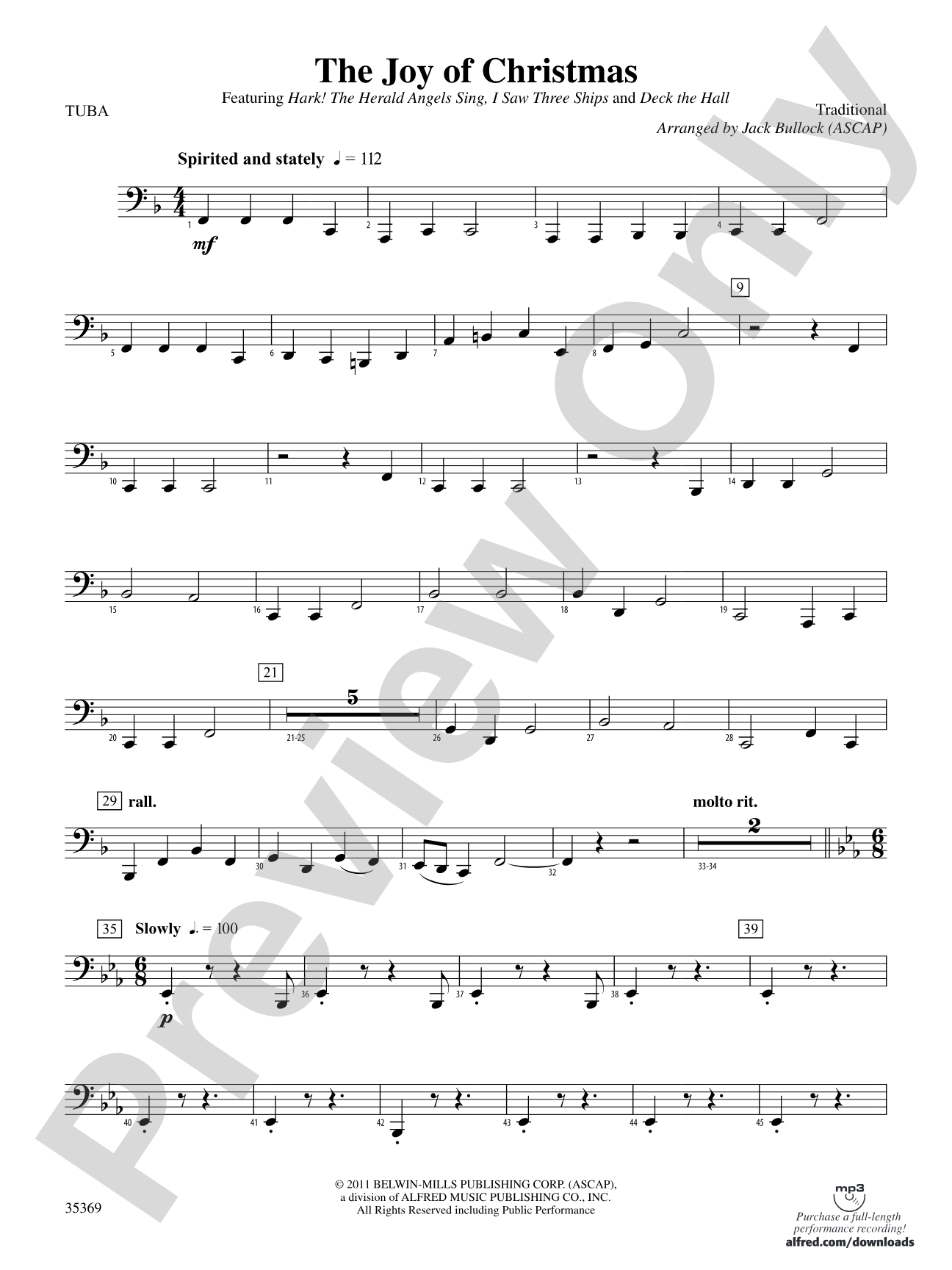

The Joy of Christmas: Tuba
Featuring: Hark! The Herald Angels Sing / I Saw Three Ships / Deck the Hall
Traditional / arr. Jack Bullock
Grade: 2 (Easy)
Item: 00-PC-0014920_TB1
$3.00
Pickup currently not available
Description
The performance of music is a significant part of the celebration of the holiday season with solemn and heartfelt songs and compositions. There are spirited works as well which exclaim the joy of the season. Three of these musical favorites, "Hark! The Herald Angels Sing," "I Saw Three Ships," and "Deck the Hall," are presented in a joyful medley of Christmas musical cheer.


Don't just read it, hear it, play along with it, and watch your students grow with it. In MakeMusic Cloud, The Joy of Christmas: Tuba comes alive with professional accompaniment, adjustable tempo, and built-in practice tools that turn solo practice into real progress.
Open in the Player
Jump straight in and assign it today.
Start Your Free Trial
Open this title and explore the full library in minutes.
Sample Audio
1
Audio File
--:--
0:00
0:00
Sample Video
No sample videos found.
Additional Details
Series:
Belwin Young Band
Publisher:
Alfred Music
Page Count:
236
SKU:
00-PC-0014920_TB1
More about this title
About the Arranger: Jack Bullock

Jack Bullock brings decades of practical experience to his work as a composer and arranger. A trained trumpet performer who worked with the Miami Philharmonic Orchestra and Miami Opera Company, he has also performed regionally and nationally with show bands and dance ensembles. His educational credentials include undergraduate, graduate, and doctoral degrees in Music Education.
With over 600 published works spanning concert band, orchestra, jazz ensemble, and marching band, Bullock has shaped music education through both his own compositions and collaborative projects. He taught instrumental music in classroom settings for 20 years, including seven years as an assistant band director at Ithaca College's School of Music, where he also chaired the Music Education Department. A member of ASCAP since 1980, he remains active in clinics and workshops across the United States, Canada, and internationally.
Why we love this
Bullock's three-carol medley strikes an ideal balance for early December programs: accessible enough for Grade 2 ensembles yet musically satisfying with its varied orchestration and harmonic color. The arrangement weaves together three beloved carols without losing the distinctive character of each, and the inclusion of both spirited and reflective moments gives your band something emotionally genuine to communicate rather than surface-level holiday decoration.
What to expect
The arrangement opens with brightness and optimism, moving fluidly between the solemn reverence of one carol and the spirited joy of another. These are familiar melodies rendered anew through clear, uncomplicated scoring that lets each voice part sing without pretense, creating a warm, approachable holiday sound.
Who it's for
This medley works perfectly for Grade 2 concert bands seeking holiday repertoire that doesn't require specialized voicing or extended ranges. Conductors programming their winter concert will find the Grade 2 difficulty level appropriate for bands still building fundamentals while the three-carol structure offers enough musical interest to engage both musicians and audiences.
How to get the most out of it
- Balance the melodic lines between sections across all three carols. The familiarity of these tunes can tempt students to play by ear; mark phrase entries clearly to ensure precise ensemble alignment.
- Shape the dynamic contours within each carol individually. Treat them as three distinct musical statements rather than one continuous piece, using slight releases between sections to refresh the listener's attention.
- Lock in the rhythmic foundation with your percussion and low brass; the simplicity of the arrangement means any wavering in the steady pulse becomes immediately apparent.
- Let the sustained voices breathe. Grade 2 arranging often leaves whole notes and half notes exposed, so encourage your winds to think about line and support the moving parts with grounded, consistent tone.
How to use it
Program this as the centerpiece of a holiday concert's first half or as a natural bridge between more substantial contemporary works and lighter closer selections. The three-carol structure also works well as a single substantial item rather than three shorter pieces, giving your band a complete musical arc within one number.
Skills your students will build
- Balancing melody against harmonic accompaniment
- Executing controlled dynamic changes across full sections
- Reading and performing exposed sustained notes with consistent tone
- Maintaining rhythmic ensemble precision within straightforward time signatures
- Transitioning smoothly between contrasting musical moods within a single arrangement