
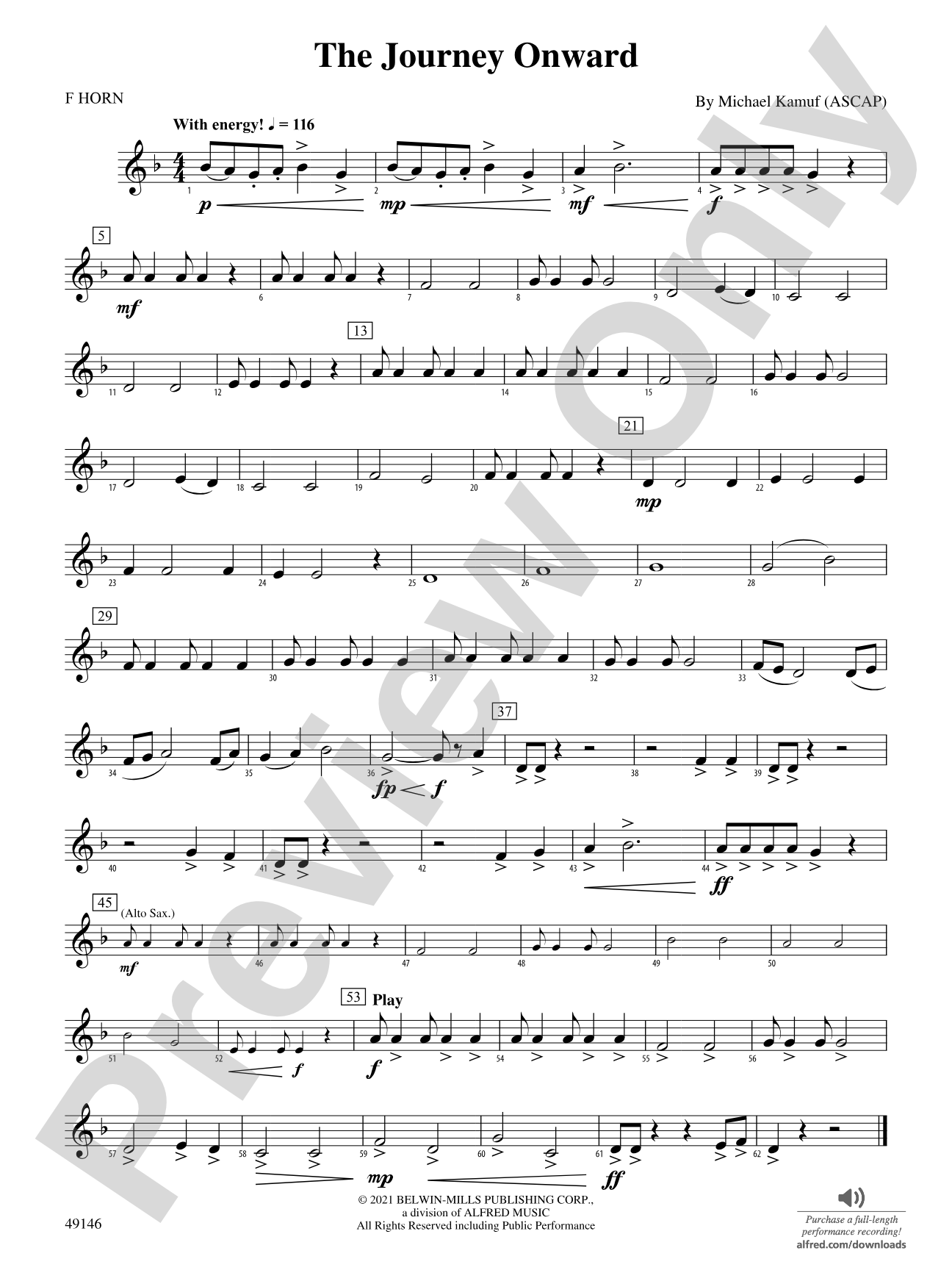

The Journey Onward: 1st F Horn
By Michael Kamuf
Grade: 1.5 (Very Easy)
Item: 00-PC-0018698_H1
$3.00
Pickup currently not available
Description
The Journey Onward was conceived by Michael Kamuf for beginning band students. It presents an opportunity to demonstrate mastery of the concepts of syncopation, phrasing, and slurs. Set in an ABA form, contrasting themes and driving rhythms are passed around the ensemble making this a solid choice for both concert and festival performances. (2:10)


Don't just read it, hear it, play along with it, and watch your students grow with it. In MakeMusic Cloud, The Journey Onward: 1st F Horn comes alive with professional accompaniment, adjustable tempo, and built-in practice tools that turn solo practice into real progress.
Open in the Player
Jump straight in and assign it today.
Start Your Free Trial
Open this title and explore the full library in minutes.
Sample Audio
1
Audio File
--:--
0:00
0:00
Sample Video
Additional Details
Series:
Belwin Beginning Band
Publisher:
Alfred Music
Page Count:
86
SKU:
00-PC-0018698_H1
More about this title
About the Composer: Michael Kamuf

Michael Kamuf earned Bachelor of Music degrees in Jazz Performance and Music Education from the Dana School of Music at Youngstown State University and a Master of Arts in Instrumental Conducting from George Mason University. His compositions and arrangements have been performed by ensembles including the Woody Herman and Glenn Miller Orchestras, the USAF Airmen of Note, the US Navy Commodores, and soloists such as James Moody, Eddie Daniels, and Sean Jones. He has recorded as a member of the Alan Baylock Jazz Orchestra and currently leads the Mike Kamuf Little Big Band in the Baltimore and Washington, DC area.
Kamuf began teaching instrumental music in 1991 and spent thirty years with Montgomery County Public Schools in Maryland, serving as Director of Bands and Orchestras and Music Department Chairperson at John T. Baker Middle School for twenty-seven of those years. Under his leadership, the Baker ensembles earned consistent high festival ratings and commissioned several works for young concert bands. As an exclusive writer for the Belwin Division of Alfred Music, with additional publications through UNC Jazz Press, Neil A. Kjos Music, and FJH Music Company, he has over 100 titles in print, many of which have become standard repertoire for developing jazz and concert ensembles.
Why we love this
Kamuf has crafted an accessible Grade 1.5 piece that doesn't sidestep real musical concepts. Syncopation, phrasing, and slurs receive genuine attention here rather than token treatment, allowing students to build legitimate musicianship while the ABA structure and rotated thematic material keep the ensemble engaged and distributed across the band.
What to expect
The piece carries forward momentum with its driving rhythms while offering moments of clarity in its contrasting B section. Thematic material passes around the ensemble like a conversation, creating a sense of collaborative storytelling rather than one section carrying the weight.
Who it's for
This score and parts set serves beginning band directors and their ensembles at the middle school or early high school level who are ready to tackle genuine musical vocabulary without complexity overload. Students need foundational note-reading and rhythmic independence but will find the material rewarding rather than punitive.
How to get the most out of it
- Isolate the syncopated rhythms in sectionals before bringing them together. Have each section tap the pulse while another section plays their syncopated line to lock the interdependence.
- Shape the contrasting themes by varying dynamics and articulation between A and B sections; resist the temptation to play them all the same way.
- Conduct the phrase arcs clearly so students understand where to breathe and release, especially when slurs span multiple measures.
- Balance the driving rhythms by ensuring lower voices maintain steady support without overwhelming the main melody carriers.
How to use it
Program this as a festival selection where judges can hear focused musicianship on foundational concepts, or pair it with a slower ballad on a concert to showcase your ensemble's rhythmic precision and ability to shape phrases. Its energetic character and straightforward structure make it ideal for early-season programming when students are still building confidence.
Skills your students will build
- Reading and executing syncopated rhythms
- Shaping phrases with consistent breath and release
- Interpreting and performing slurs across multiple measures
- Balancing ensemble sound when thematic material rotates between sections
- Maintaining steady rhythmic support in lower voices