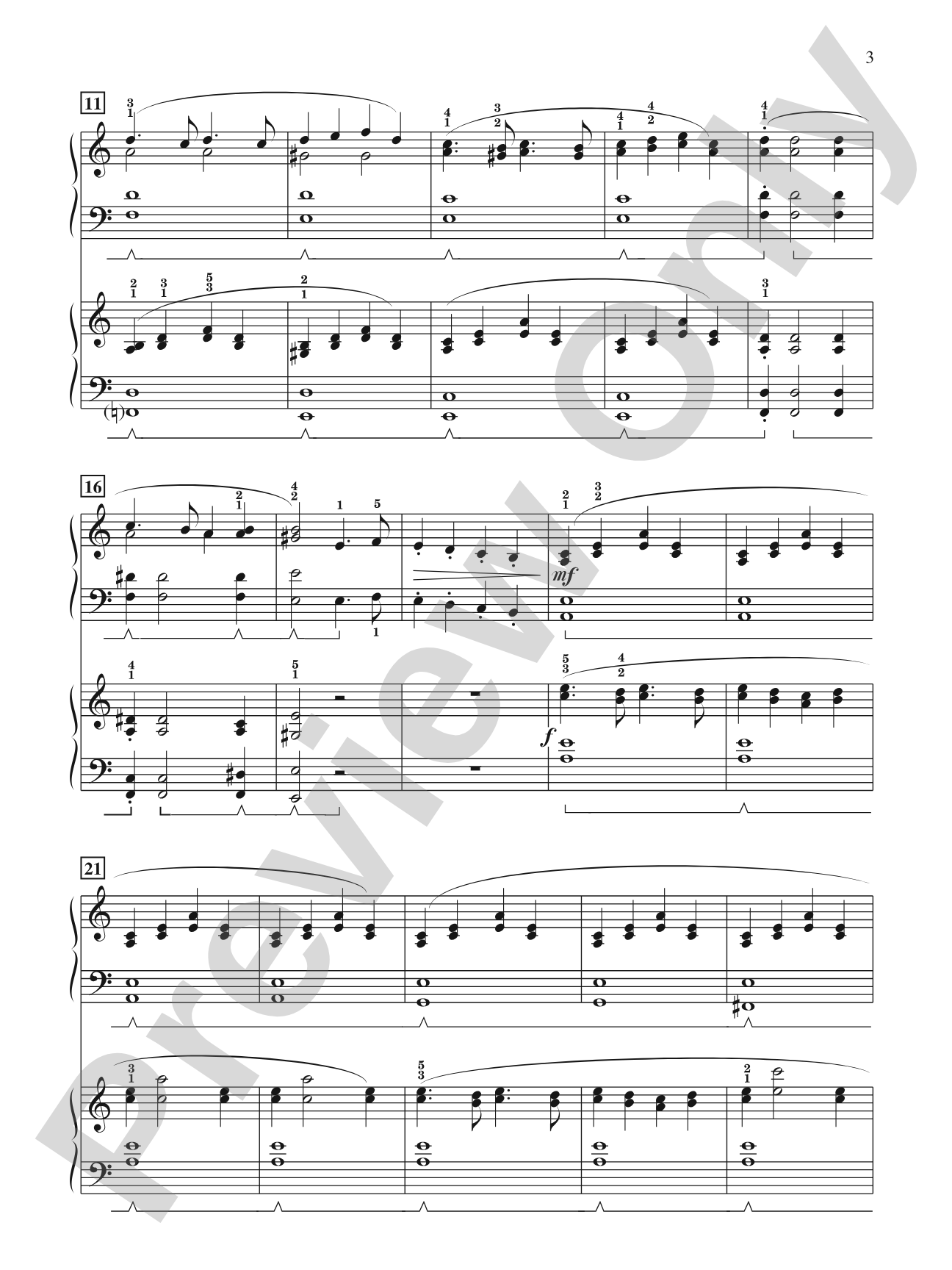
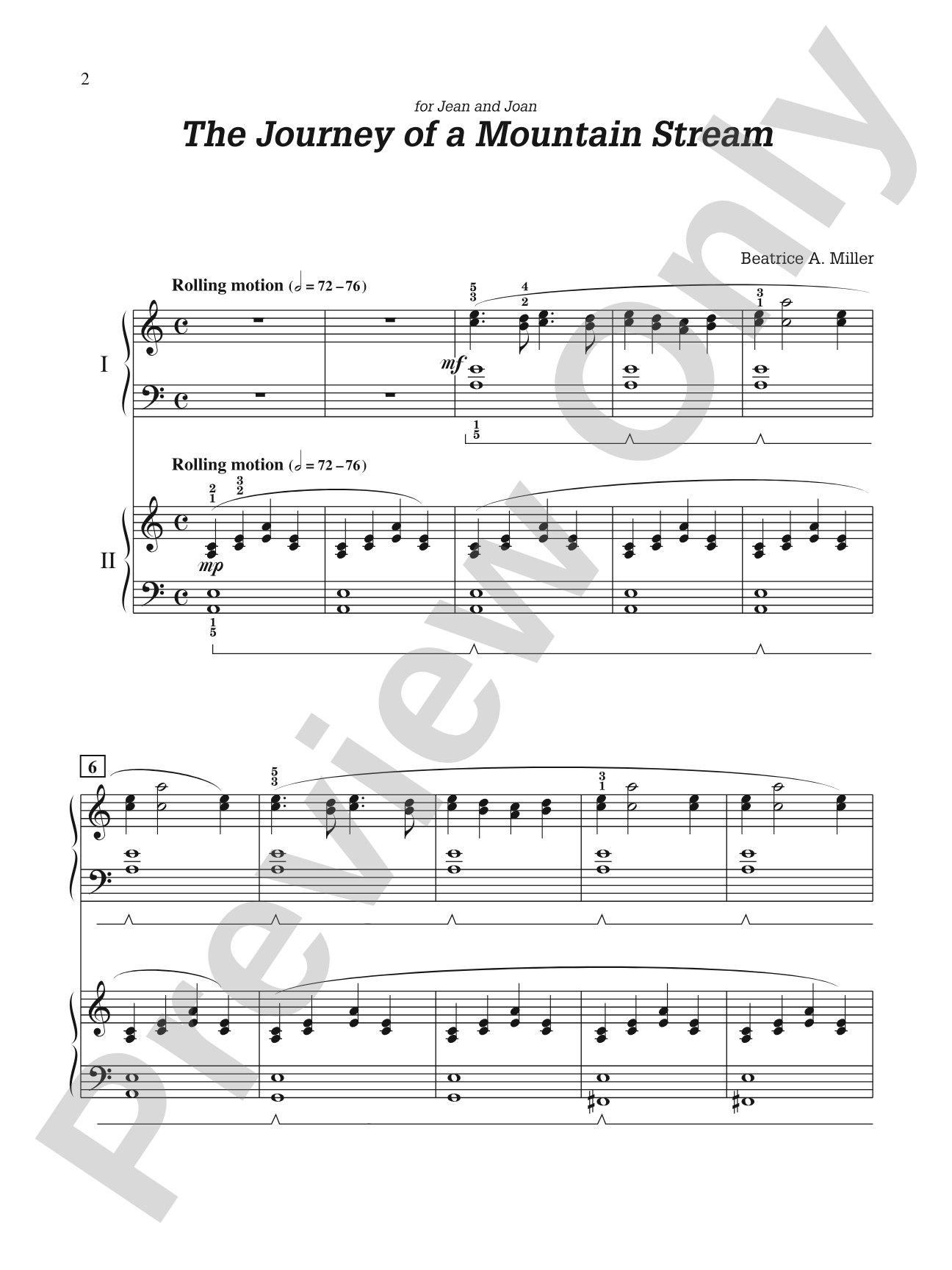
The Journey of a Mountain Stream - Piano Duo (2 Pianos, 4 Hands) Sheet Music Preview

The Journey of a Mountain Stream - Piano Duo (2 Pianos, 4 Hands): Piano Duo (2 Pianos, 4 Hands)

By Beatrice A. Miller

Level: Intermediate

Item: 00-PS-0017512

Digital Download
$4.99
Description
The rolling motion of a mountain stream is conveyed by repeated, undulating phrases in both parts of this piece for intermediate piano ensemble, two pianos, four hands. The piece begins in A minor and modulates to A major in the middle section. Two copies are included. A Federation Festivals 2024-2028 selection.

The Journey of a Mountain Stream - Piano Duo (2 Pianos, 4 Hands): Piano Duo (2 Pianos, 4 Hands) isn't in MakeMusic Cloud just yet...but it could be. Let us know you'd like to see it, and you'll help shape what comes next. In the meantime, start a free trial and dive into thousands of interactive titles your students can play along with today.

Sample Audio
No sample audio found.
Sample Video
Additional Details
Publisher: Alfred Music
Page Count: 8
SKU: 00-PS-0017512

More about this title

About the Composer: Beatrice A. Miller

Beatrice A. Miller

Beatrice A. Miller grew up in Detroit in a musical household where her father, a Lutheran pastor and accomplished musician, anchored the family's evenings in hymn singing. That early foundation in sacred music became the wellspring of her compositional voice. She earned her Master's degree in composition from Northwestern University and spent decades as a piano teacher, organist, and choir director in Corvallis, Oregon before committing fully to composition after her 1979 retirement.

Miller's body of work has earned national recognition; the Oregon Music Teacher's Association named her Composer of the Year in 1997. She began publishing in 1987 and has built a catalog that honors both the church music tradition of her childhood and the practical needs of music educators and their students.

Why we love this

Miller captures the literal motion of flowing water through musical means that never feel programmatic or gimmicky. The undulating phrases in both parts create genuine ensemble dialogue, and the shift from A minor to A major gives students a satisfying harmonic journey without requiring advanced theoretical knowledge. It's the rare intermediate duo that sounds like something musicians will want to play again.

What to expect

Watching water tumble over rocks and smooth stones in a riverbed. The piece has an organic, slightly hypnotic quality born from those repeated undulating phrases, with moments where the harmonic landscape shifts unexpectedly and opens into light.

Who it's for

Intermediate pianists ready to explore ensemble playing with a partner at the same level. This works beautifully for students who've developed solid technique but may still be building confidence in their reading and rhythmic independence.

How to get the most out of it

  • Balance the undulating lines so neither piano drowns out the other. The repeated phrases work best when both players commit fully to their rhythmic role.
  • Shape the modulation to A major as a genuine pivot rather than a sudden turn. Let the harmonic warmth emerge gradually in the middle section.
  • Record yourselves in rehearsal and listen back specifically to how the flowing motion reads. If it feels choppy, examine whether you're holding notes for their full value.
  • Mark breathing points together even though this is instrumental music. A shared sense of phrase will tighten the ensemble sound.

How to use it

Consider this for a chamber recital alongside other duo or small ensemble repertoire. Its eight pages make it substantial enough to anchor a program segment without overwhelming younger musicians, and the Federation Festivals selection offers a natural performance goal if that pathway appeals to your students.

Skills your students will build

  • Maintaining independent rhythmic patterns while tracking a partner's part
  • Ensemble balance and blend at the piano
  • Harmonic awareness through listening to modulation (A minor to A major)
  • Sustaining musical character across repeated figures without mechanical repetition
  • Collaborative interpretation and phrasing with another performer

You May Also Like