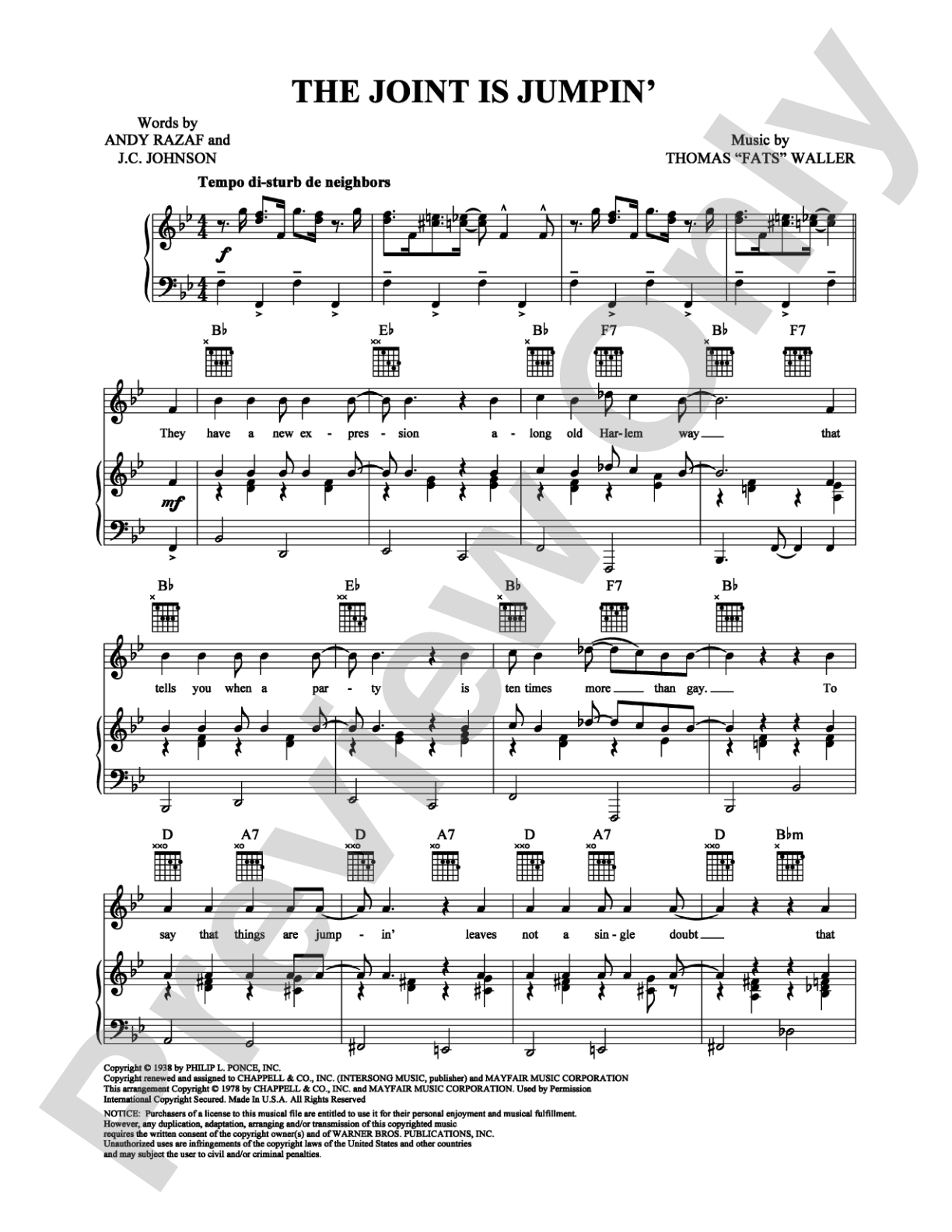
The Joint Is Jumpin': Piano/Vocal/Chords Digital Sheet Music

The Joint Is Jumpin': Piano/Vocal/Chords Digital Sheet Music

Fats Waller

Item: 00-PS-0004467

Digital Download
$3.99
Description

The Joint Is Jumpin': Piano/Vocal/Chords Digital Sheet Music isn't in MakeMusic Cloud just yet...but it could be. Let us know you'd like to see it, and you'll help shape what comes next. In the meantime, start a free trial and dive into thousands of interactive titles your students can play along with today.

Sample Audio
No sample audio found.
Sample Video
Additional Details
SKU: 00-PS-0004467

More about this title

About the Artist: Fats Waller

Thomas Wright Waller (1904, 1943) was a pianist, organist, and composer who became one of jazz's most influential voices during the swing era. Known for his virtuosic left hand, infectious humor, and prolific output, Waller wrote and performed standards that remain central to jazz repertoire and vocal pedagogy. His ability to blend sophisticated harmony with entertainment and accessibility made him a model for musicians who understand that technical skill and joy are not mutually exclusive.

Why we love this

This is the kind of tune that reminds students why jazz standards matter. The melody sits naturally for singers, the harmonic language is accessible yet sophisticated enough to teach real voice-leading, and the sheer personality of the piece makes it genuinely fun to rehearse and perform. Waller's impeccable craft means every measure does something, there's nothing filler, and students absorb good writing habits by osmosis.

What to expect

Energy without aggression, wit without cynicism. The tune bounces with the confidence of a musician who knows exactly what he's doing and invites you into the joke. There's warmth underneath the sass, and the harmony, though grounded in blues and popular song, has sophistication that keeps revealing itself.

Who it's for

Vocalists preparing jazz standards repertoire and pianists building their jazz accompaniment skills will find this direct and practical. Advanced high school singers and college-level music students exploring American songbook material can use it as a foundation for interpretation and improvisation.

How to get the most out of it

  • Study the original recording to internalize Waller's phrasing and rhythmic placement. His timing sits slightly behind the beat in ways that won't show up in written rhythm alone.
  • Voice the piano chords with attention to the jazz voicings implied by the chord symbols. Root position and traditional classical voice leading will flatten the swing.
  • Keep the tempo buoyant but never rushed. The groove relies on clarity and space, not velocity.

How to use it

Program this in a jazz or American standards concert to anchor a section on Waller's compositions and influence. It works equally well as a solo number or paired with other Waller standards to showcase his range as a composer and performer. For educational settings, it serves as an excellent introduction to stride piano and jazz swing for students who may only know classical contexts.

Skills your students will build

  • Reading and realizing jazz chord symbols
  • Understanding stride piano technique and swing rhythms
  • Interpreting swing phrasing and rhythmic displacement
  • Balancing technical accuracy with performance personality

You May Also Like