
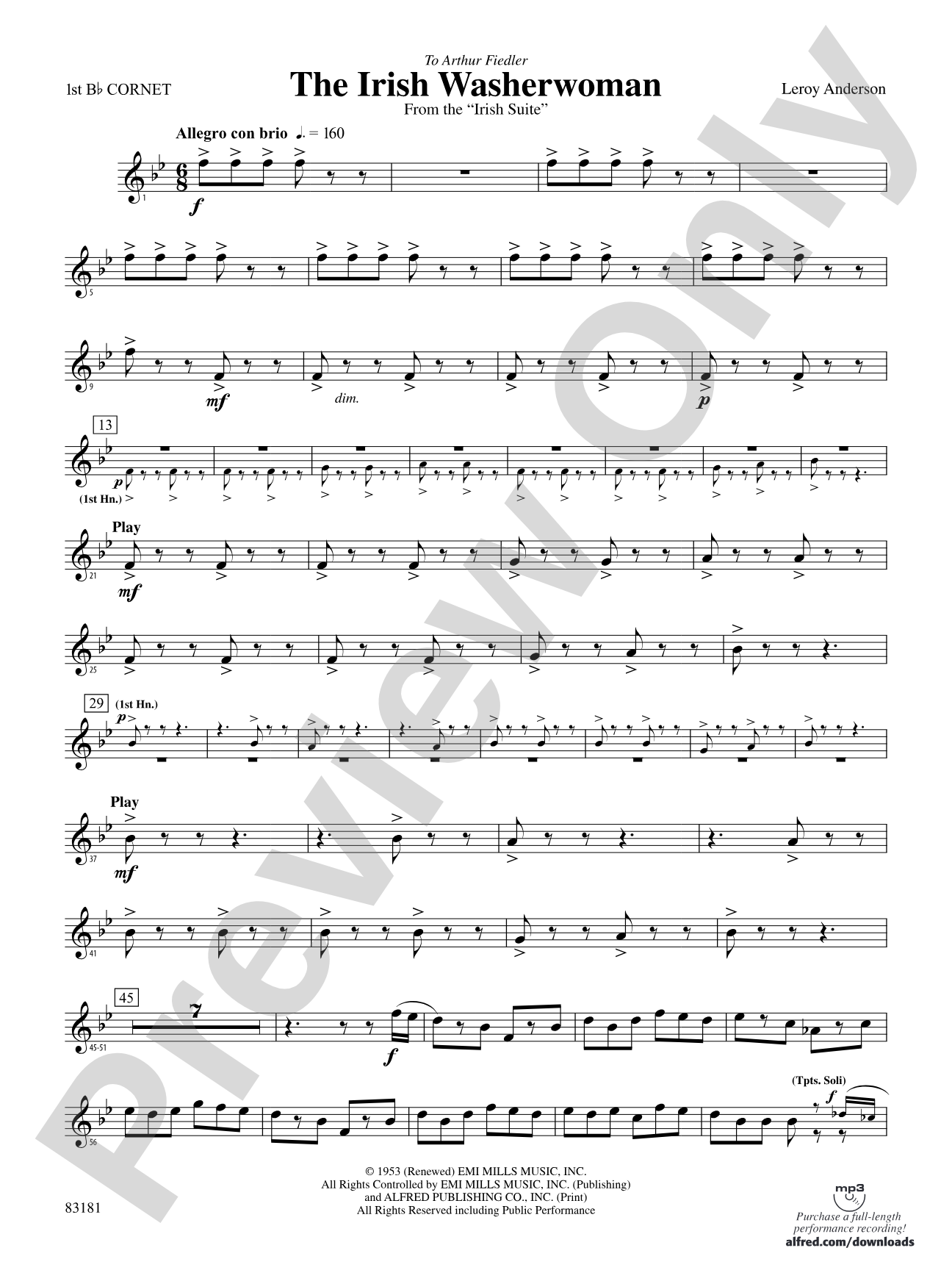

The Irish Washerwoman (from the Irish Suite): 1st B-flat Cornet
By Leroy Anderson
Grade: 3 (Medium Easy)
Item: 00-PC-0001939_CO1
$3.00
Pickup currently not available
Description
"The Irish Washerwoman," the first movement of Leroy Anderson's Irish Suite, combines folk material with the composer's own whimsicality. The score was commissioned by the Eire Society of Boston and carries a dedication to Arthur Fiedler, who conducted its first performance on June 6, 1947 at Symphony Hall in Boston. The complete suite includes six melodies which range from the nostalgic to the humorous, from the plainly sentimental to the purely exuberant. Although the melodies come from overseas, the brilliant Irish Suite is typical of Anderson's nimble orchestration, ingenious charm, and happy inventiveness. This opening movement is a jig; brisk in tempo and gay in mood.
This new edition has been freshly re-engraved with a full-score for the first time, permitting articulation uniformity throughout the work.


This new edition has been freshly re-engraved with a full-score for the first time, permitting articulation uniformity throughout the work.
Don't just read it, hear it, play along with it, and watch your students grow with it. In MakeMusic Cloud, The Irish Washerwoman (from the Irish Suite): 1st B-flat Cornet comes alive with professional accompaniment, adjustable tempo, and built-in practice tools that turn solo practice into real progress.
Open in the Player
Jump straight in and assign it today.
Start Your Free Trial
Open this title and explore the full library in minutes.
Sample Audio
1
Audio File
--:--
0:00
0:00
Sample Video
No sample videos found.
Additional Details
Series:
Leroy Anderson Classics
Publisher:
Alfred Music
Page Count:
222
SKU:
00-PC-0001939_CO1
More about this title
About the Composer: Leroy Anderson
Leroy Anderson (1908-1975) built his career on a simple but powerful idea: that concert music could be both sophisticated and entertaining without sacrificing either quality. Trained at Harvard, he became one of America's most performed composers, writing over 150 works that sparkle with orchestral color, rhythmic vitality, and wit. His gift for melody and orchestration made him a favorite of Arthur Fiedler and the Boston Pops, and his music remains a staple of band and orchestra repertoires worldwide.
Anderson's approach to composition prioritized clarity and accessibility. He drew inspiration from everyday life, folk traditions, and classical forms, weaving them together with impeccable craftsmanship. His scores demand precision from musicians but reward that precision with music that audiences find immediately joyful and engaging.
Why we love this
Anderson's orchestration in this opening movement is a masterclass in clarity and color. The freshly re-engraved full score reveals details that make this jig a delight to conduct: articulation is now uniform throughout, and the interplay between sections sparkles with purpose. This is the kind of piece that reminds students why concert band arranging matters.
What to expect
Gay and exuberant, this jig bubbles with Irish character and Leroy Anderson charm. The brisk tempo and dance-like rhythm create instant momentum, while the folk melodies carry a nostalgic warmth that audiences recognize immediately. There's lightness here, but never frivolity; the writing is skilled and purposeful throughout.
Who it's for
This Grade 3 movement serves ensembles that can execute clean articulation and maintain buoyancy under tempo. Your second-year and mature first-year musicians will engage with the jig's rhythmic drive and the conductor will appreciate score clarity that makes preparation straightforward.
How to get the most out of it
- Maintain the jig's characteristic lift and buoyancy. The brisk tempo should feel sprightly, not rushed; think "dance" rather than "march." Slight separation between phrases helps the folk melody breathe.
- Balance the melodic voices carefully. Anderson layers his melodies so that the primary tune stays in focus even when supporting parts add harmonic or rhythmic interest. Clarify who sings and who accompanies in each section.
- Pay attention to the articulation uniformity that this new engraving provides. Consistent tonguing and separation across all parts creates the crispness that makes Anderson's writing dance. Lazy articulation flattens the whole effect.
- Shape the folk melodies with gentle rubato where appropriate. These are borrowed tunes with character; they shouldn't sound mechanical or overly strict, even at a quick tempo.
How to use it
Open a concert with this piece to establish an energetic, approachable tone. It pairs well with other Anderson works or with program segments devoted to American light music and folk-inspired repertoire. The movement's brevity and crowd-pleasing character make it ideal for community concert settings or pops-style programming.
Skills your students will build
- Executing clean articulation at brisk tempos across mixed ensemble sections
- Balancing layered melodies and inner voices without obscuring the primary tune
- Playing with rhythmic lift and buoyancy in jig-style figures
- Reading freshly engraved full scores and parts with uniform notation
- Responding to lyrical phrasing within an energetic, dance-based tempo