
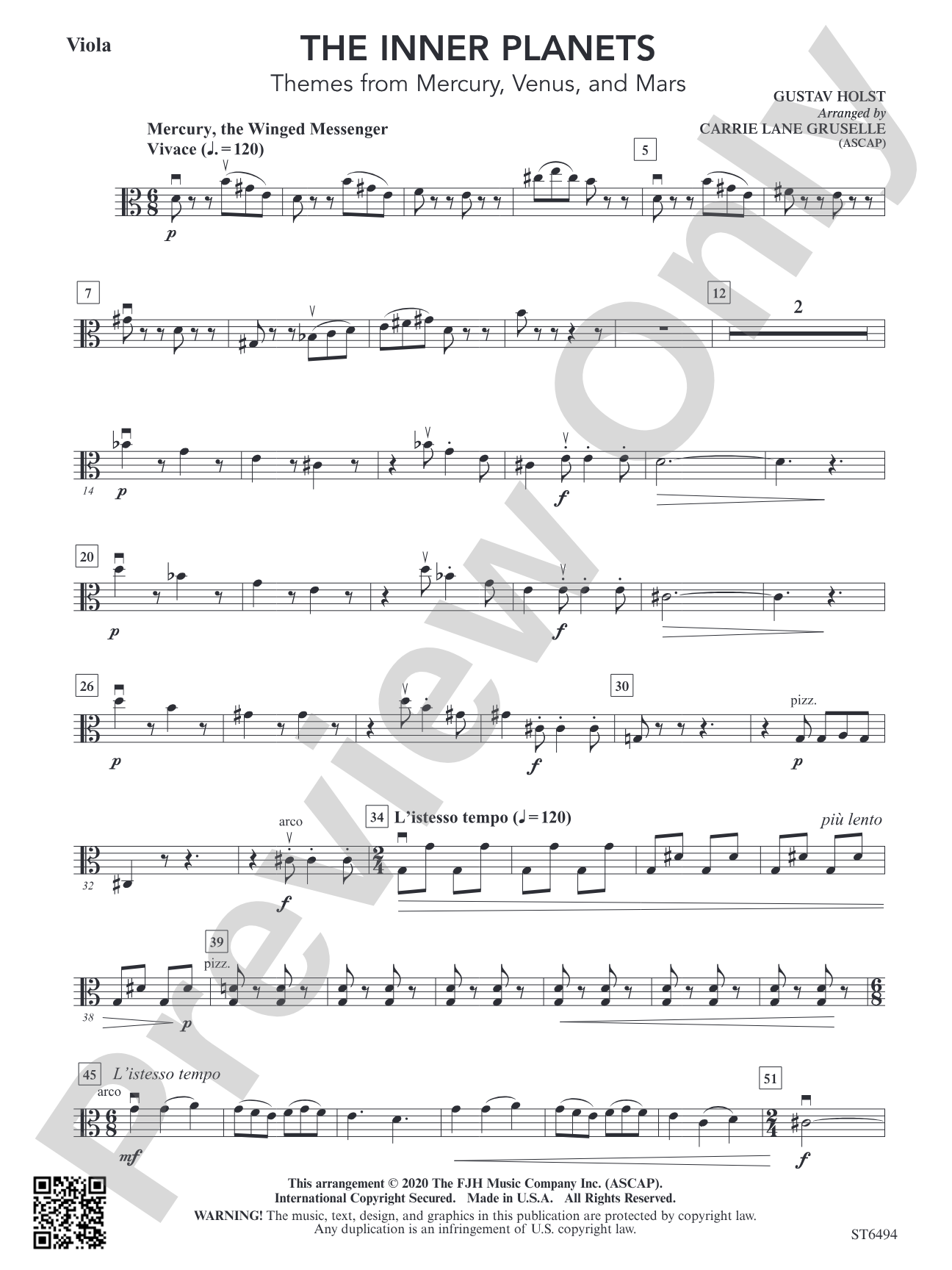

The Inner Planets (Themes from Mercury, Venus and Mars): Viola
Themes from Mercury, Venus and Mars
By Gustav Holst / arr. Carrie Lane Gruselle
Grade: 4
Item: 98-PC-DST6494_VA1
$7.00
Pickup currently not available
Description
This cleverly titled work includes three famous themes from The Planets. The swooping and fluttering sounds of Mercury, the Winged Messenger give way to the mystical tone clusters and serenity of Venus, the Bringer of Peace. The arrangement closes with the iconic militant ostinato and extreme dissonance of Mars, the Bringer of War. An exceptional arrangement.


Don't just read it, hear it, play along with it, and watch your students grow with it. In MakeMusic Cloud, The Inner Planets (Themes from Mercury, Venus and Mars): Viola comes alive with professional accompaniment, adjustable tempo, and built-in practice tools that turn solo practice into real progress.
Open in the Player
Jump straight in and assign it today.
Start Your Free Trial
Open this title and explore the full library in minutes.
Sample Audio
1
Audio File
--:--
0:00
0:00
Sample Video
Additional Details
Series:
FJH String Orchestra
Publisher:
The FJH Music Company, Inc.
SKU:
98-PC-DST6494_VA1
More about this title
About the Composer: Gustav Holst
Gustav Holst (1874-1934) was an English composer whose orchestral suite The Planets stands as one of the most performed and instantly recognizable works in the classical canon. Written between 1914 and 1916, The Planets showcases Holst's mastery of orchestration, harmonic innovation, and programmatic writing. His gift for creating vivid musical imagery through unconventional harmonies and instrumental color made him a pioneer of twentieth-century compositional technique.
Holst spent much of his career as a conductor, educator, and composer-in-residence at various British institutions. His influence on music education was profound; he believed in the transformative power of music and wrote extensively for amateur and student ensembles. The Planets remains his most celebrated work, but his output also includes choral music, band arrangements, and works for educational settings that continue to inspire musicians worldwide.
Why we love this
This arrangement distills three of Holst's most visceral movements into a single, propulsive concert work without sacrificing the harmonic daring and orchestrational brilliance that make The Planets enduring. Carrie Lane Gruselle has captured the essential character of each planet while making the material accessible to Grade 4 ensembles, meaning your students will perform genuine masterwork orchestration rather than simplified pastiche. The dramatic arc from Mercury's fluttering energy through Venus's lush calm and into Mars's relentless brutality gives programmers a major-league showpiece that audiences recognize and musicians love to play.
What to expect
You will feel the quicksilver energy of Mercury darting through crystalline upper-string passages, then sink into the hushed, shimmering mystery of Venus where sustained tones create weightless suspended chords. The final movement plunges into stark, driving militarism as Mars stamps its relentless ostinato across the full orchestra, building tension through dissonance and rhythmic inevitability.
Who it's for
This arrangement serves Grade 4 string orchestras with technical facility and musical maturity. It suits ensembles that have developed secure double stops, comfortable shifting, and the ability to sustain complex harmonic textures over longer phrases.
How to get the most out of it
- Balance the tremolo texture in Mercury against any melodic material so the sense of fluttering momentum never feels muddy; clean articulation in the upper strings is essential to clarity.
- Shape the tone clusters in Venus with warmth and blend rather than attempting perfect intonation; these sonorities gain beauty through unified color and sustained breath support across the section.
- Lock the rhythmic precision of the Mars ostinato across all sections before addressing dynamics; the power of that movement depends entirely on relentless metrical cohesion, particularly in the lower strings and cellos.
How to use it
Program this as a festival or contest entry where you want to showcase your orchestra's range and maturity in a single work. The three-movement structure and dramatic variety make it equally effective as a concert opener or closer, and its recognizable themes give audiences an immediate connection to the music while respecting the integrity of Holst's original vision.
Skills your students will build
- Sustaining dense harmonic textures and tone clusters with unified intonation and blend
- Executing rapid note patterns and tremolo effects with rhythmic precision and textural clarity
- Balancing contrasting layers of melodic and accompaniment material across the ensemble
- Maintaining rhythmic integrity in complex ostinato patterns under harmonic and dynamic change
- Interpreting twentieth-century compositional techniques including dissonance, extended harmonies, and non-traditional chord voicings