
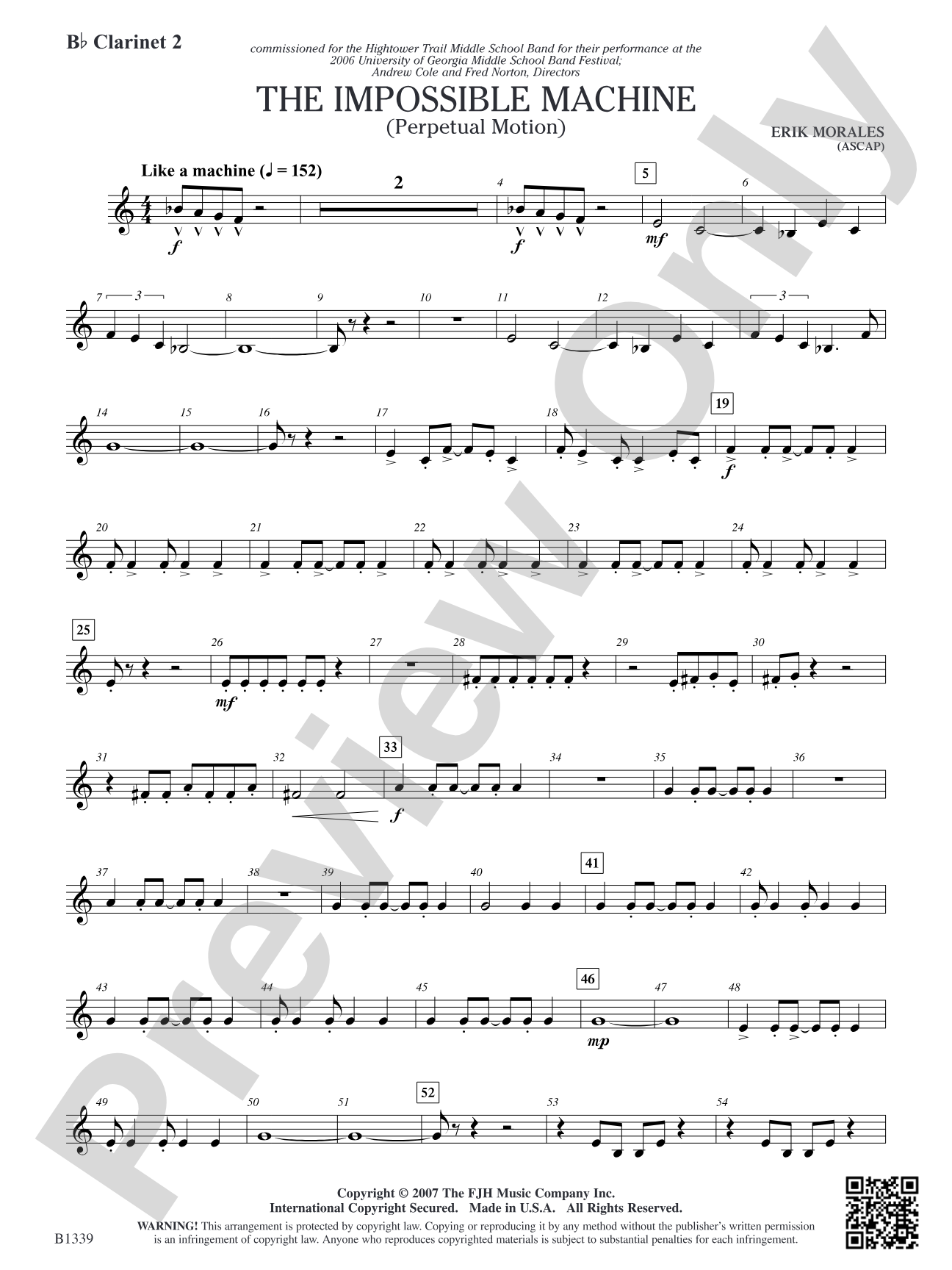

The Impossible Machine (Perpetual Motion): B-flat Clarinet 2
Perpetual Motion
By Erik Morales
Grade: 2.5;3
Item: 98-PC-DB1339_C2
$7.00
Pickup currently not available
Description
Experience boundless energy from the "impossible machine" that inspired this aggressive work! For centuries, mankind has searched for a way to develop a machine that can operate by producing its own energy. This exciting concept is harnessed in this tour de force for young band that will keep your audience on the edge of their seats. Great writing for all instruments, including a large battery of percussion.


The Impossible Machine (Perpetual Motion): B-flat Clarinet 2 isn't in MakeMusic Cloud just yet...but it could be. Let us know you'd like to see it, and you'll help shape what comes next. In the meantime, start a free trial and dive into thousands of interactive titles your students can play along with today.
Request This Title
Tell us you want it.
Start Your Free Trial
Explore everything that's ready to play right now.
Sample Audio
1
Audio File
--:--
0:00
0:00
Sample Video
No sample videos found.
Additional Details
Series:
FJH Young Band
Publisher:
The FJH Music Company, Inc.
SKU:
98-PC-DB1339_C2
More about this title
About the Composer: Erik Morales

Erik Morales began composing at a remarkably young age, landing his first professional arranging assignment in 1985 when his high school band director commissioned him to write for the marching program. He earned his bachelor's degree from the University of Louisiana, Lafayette in 1989 and went on to study composition at Florida International University. Since 2002, when his educational works first reached international audiences, Morales has become a prolific voice in wind, jazz, orchestral, and chamber music.
With over 150 published compositions to his name, Morales has built a reputation for balancing artistic integrity with pedagogical effectiveness. His work as a trumpet player informs much of his writing for the instrument; his trumpet ensembles have earned first-place honors at the National Trumpet Competitions, and his Concerto for Trumpet in C and Piano premiered at the 2009 International Trumpet Guild conference. In 2016, he was inducted into the Louisiana Association for Jazz Education's Hall of Fame. Schools and organizations across the country regularly commission new works from him, recognizing his gift for creating music that serves both the performer and the listener.
Why we love this
Morales writes perpetual motion that actually stays musical. The relentless energy never feels gratuitous because every section of the band gets moments to shine, and the rhythm section work is genuinely inventive rather than just repetitive. Young musicians find the driving momentum deeply satisfying to execute, and audiences respond to the sheer kinetic excitement without any sense of musical substance being sacrificed.
What to expect
Relentless forward propulsion meets carefully orchestrated excitement. The music hums with perpetual energy; once it begins, there is almost no break in the momentum. Despite the aggressive title and driving character, there is genuine musicality within the velocity, creating a piece that feels both thrilling and surprisingly substantial.
Who it's for
Young bands at the Grade 2.5 through Grade 3 level who are ready for the technical and endurance demands of exciting contemporary repertoire. Directors seeking a contest or festival piece that showcases the full ensemble with substantial work for all instrumental families will find a natural fit here.
How to get the most out of it
- Shape the rhythmic figures into distinct melodic shapes rather than treating all sixteenth-note passage work as neutral. Even in the whirlwind sections, small dynamic swells or slight articulation changes create forward momentum.
- Balance the large percussion battery carefully so that the battery enhances texture without drowning the winds. Use rehearsal time to establish clear dynamic targets for each percussion layer.
- Anchor tempo consistency through the rhythm section; if the pulse wavers even slightly, the perpetual motion effect collapses. Lock in the conductor's beat early and maintain it through all tempo changes.
- Take full advantage of contrasting sections to breathe with the ensemble. These moments of relative rest build listener anticipation for the next explosion of energy.
How to use it
This work functions beautifully as a concert opener that immediately engages an audience or as a finale that sends them out energized. It also serves effectively as a festival selection where judging panels specifically seek music that demonstrates technical control, balanced scoring, and the ensemble's ability to sustain forward momentum over an extended form.
Skills your students will build
- Sustained rhythmic accuracy across rapid passagework
- Balancing individual lines within a thick orchestration
- Building and controlling energy through long phrases
- Executing articulation patterns that enhance perpetual motion effect
- Endurance and mental focus during extended sections of high activity