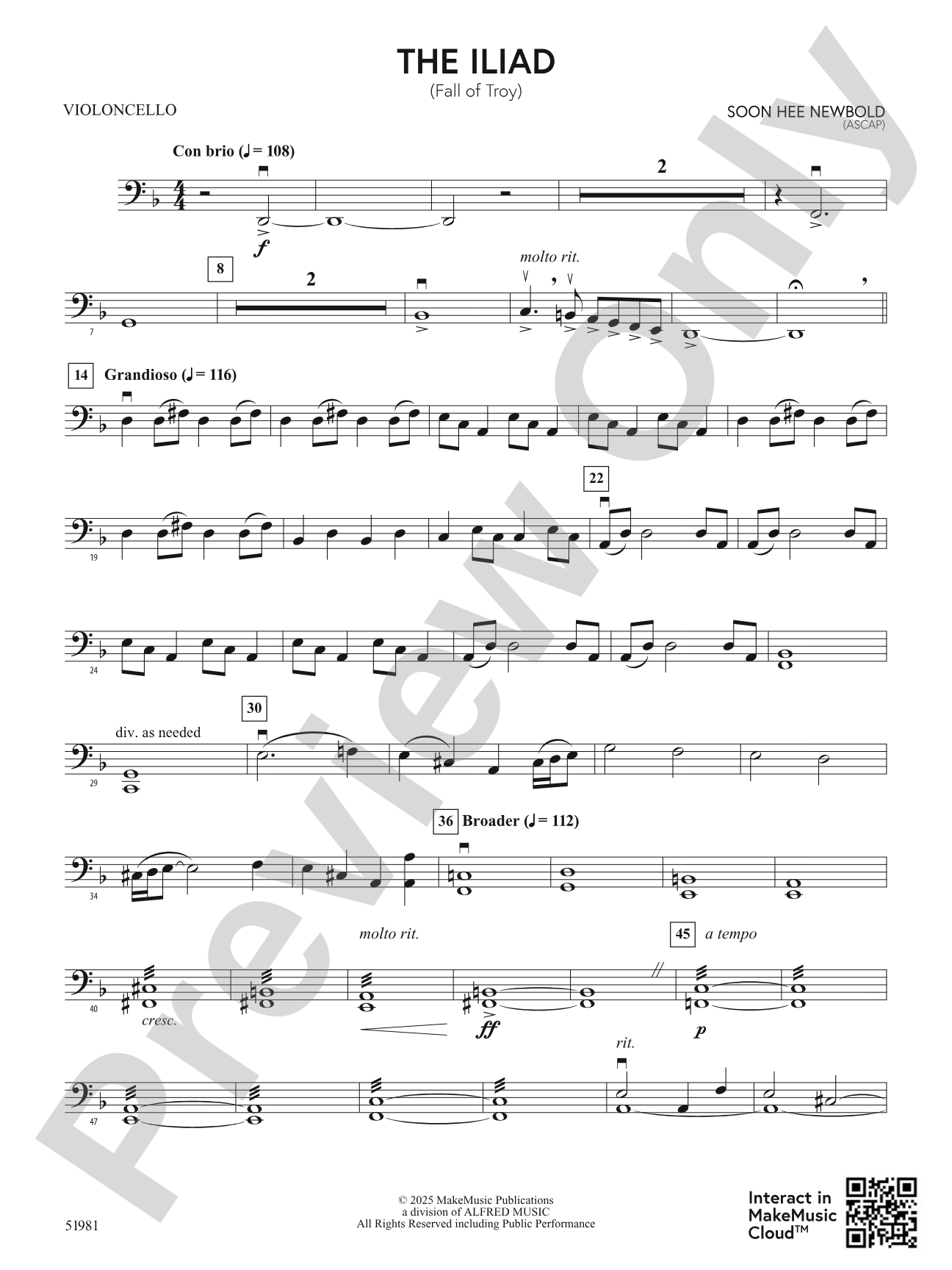
This prequel and companion work to Soon Hee Newbold's The Odyssey is a powerful, cinematic work. The Iliad takes players through the battle scenes of the Trojan War and the story of the legendary Achilles. Also available for string orchestra, and every bit as epic! (5:45)
Discover MakeMusic Cloud: thousands of interactive titles your students can play along with today.
Soon Hee Newbold began her musical training at age five on piano, adding violin at seven, and went on to perform as a concert artist with professional ensembles across the globe. Her compositional voice draws deeply from the cultural and ethnic traditions she has encountered through extensive travel and lived experience, creating works that resonate across performance levels and venues including Carnegie Hall, the Kennedy Center, Lincoln Center, and major international stages.
Beyond the concert hall, Newbold maintains an active presence as a conductor, clinician, and keynote speaker, having worked with orchestras and bands throughout North America, Europe, Asia, and Australia. Her film and recording work in Hollywood has expanded her reach into media composition, while her catalog spans from professional symphony orchestras to elementary ensembles, demonstrating her gifts as a writer for diverse musical communities.
Why we love this
Newbold's gift for narrative orchestration shines here: she uses the full orchestra's colors to unfold Homer's greatest conflicts without losing the human drama at the center. Grade 4 orchestras rarely get music this cinematically ambitious yet playable, making it an ideal choice for programs seeking serious musical substance with genuine student appeal. The fact that it exists as both a full orchestra and string orchestra version gives you flexibility in casting while maintaining the same epic scope.
What to expect
The Iliad plunges you into the clashing bronze and blood of ancient warfare while honoring the ache of its hero. Newbold's orchestration moves from contemplative character moments to visceral battle sequences, creating a soundscape that feels both intimate and monumental, familiar to cinema yet rooted in orchestral tradition.
Who it's for
Grade 4 full orchestras ready to tackle programmatic music with dramatic scope and orchestrational sophistication. This works equally well for festival competition, concert programming, or as a capstone piece for ensembles that have built strong intonation and rhythmic control.
How to get the most out of it
Balance the brass sections carefully during the battle sequences; they should drive the narrative forward without overwhelming the melodic lines in strings and woodwinds.
Invest time in the tempo relationships across sections. Newbold's pacing shifts mirror the action on the battlefield, and precision here lifts the entire performance.
Give soloists (principal woodwind and string lines) permission to phrase expressively within their marked passages; the Achilles material in particular responds well to slight rubato.
Shape the dynamic arcs in longer phrases over multiple measures rather than hitting each marking as a target; let the story breathe.
How to use it
Program this as a centerpiece work on a concert devoted to storytelling through music, pairing it with a shorter character piece or overture that contrasts in scale. Its five-and-a-half-minute arc works beautifully as a competition selection or as the climactic work on a festival concert; if you've performed The Odyssey previously, returning to this prequel offers a compelling narrative arc for your audience.
Skills your students will build
Sustaining dynamic intensity across extended passages
Responding to rapid orchestration shifts that mirror programmatic content
Balancing multiple melodic lines across different instrumental choirs
Executing tempo changes that serve narrative rather than technical display
Reading and executing syncopated rhythmic figures in mixed meter contexts
You May Also Like
Scan to Complete Your Purchase
Use your phone's camera to scan the code below
You'll log in on your phone and the order will be added to your account