
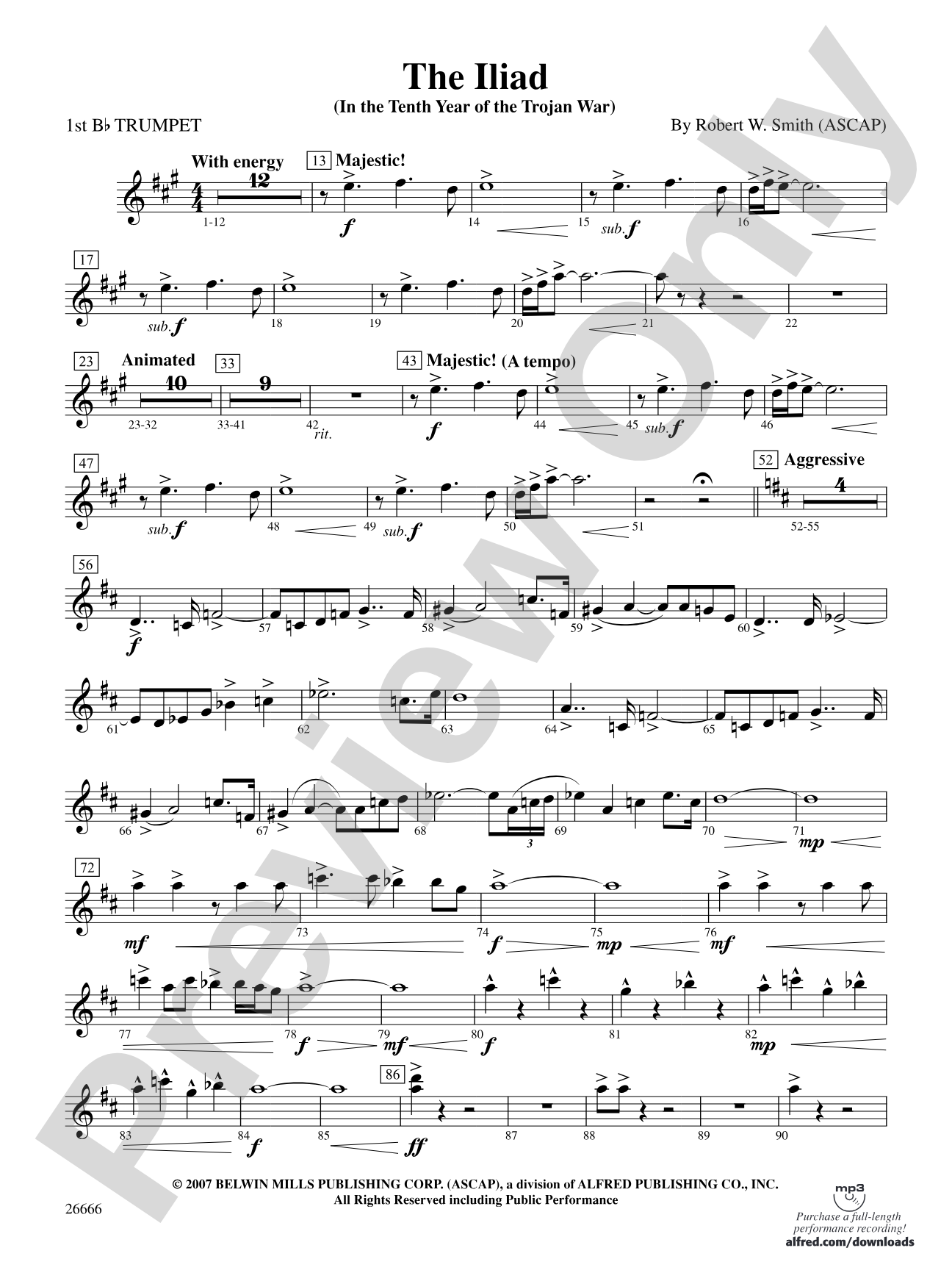

The Iliad: 1st B-flat Trumpet
By Robert W. Smith
Grade: 5
Item: 00-PC-0001159_T1
$3.00
Pickup currently not available
Description
Calls to war introduce the triumphant first movement of Robert W. Smith's Second Symphony based on the classic story of The Odyssey. The squeaky wheels of the Trojan horse, a burning forest, and a sword fight are all part of the aural drama of this programmatic work. The ocean's presence is evident in the optional transition to the second movement of his symphony, "The Winds Of Poseidon."


Don't just read it, hear it, play along with it, and watch your students grow with it. In MakeMusic Cloud, The Iliad: 1st B-flat Trumpet comes alive with professional accompaniment, adjustable tempo, and built-in practice tools that turn solo practice into real progress.
Open in the Player
Jump straight in and assign it today.
Start Your Free Trial
Open this title and explore the full library in minutes.
Sample Audio
1
Audio File
--:--
0:00
0:00
Sample Video
No sample videos found.
Additional Details
Series:
Belwin Concert Full Orchestra
Publisher:
Alfred Music
Page Count:
204
SKU:
00-PC-0001159_T1
More about this title
About the Composer: Robert W. Smith

Robert W. Smith has established himself as one of the most frequently performed composers in American orchestral and concert band music, with over 400 published works distributed primarily through Alfred Music. He holds a Bachelor of Music Education from Troy State University and a Master of Music from the University of Miami, credentials that inform both his compositional voice and his work as a clinician and guest conductor across the United States, Canada, Japan, Australia, Italy, Austria, and the United Kingdom.
Smith's symphonic works, particularly his first two symphonies (The Divine Comedy and The Odyssey), have gained international recognition and are performed by ensembles throughout North America, Europe, Australia, and Asia. Beyond concert hall settings, his music has appeared in major television broadcasts, Olympic ceremonies, the Macy's Thanksgiving Day Parade, and other high-profile events, demonstrating the broad appeal and accessibility of his orchestral writing.
Why we love this
Smith's programmatic storytelling in The Iliad creates visceral musical imagery that motivates student musicians without sacrificing orchestral craft. The Grade 5 scoring balances technical challenge with clear emotional arc, making it equally rewarding for a developing ensemble and an engaged audience. This work justifies its place on a concert program not through complexity alone, but through dramatic narrative that players can perform with conviction and pride.
What to expect
Smith's orchestration captures the sweep and violence of ancient warfare alongside the beauty of the Mediterranean. The score moves between explosive energy (war calls, the sword fight) and quieter moments that allow space for reflection, with the ocean as a constant presence beneath the human drama.
Who it's for
Conductors programming a Grade 5 full orchestra concert or festival need ambitious but achievable repertoire that engages both musicians and audiences. This work appeals to orchestras seeking programmatic pieces with genuine musical substance, where the story doesn't substitute for compositional skill.
How to get the most out of it
- Shape the opening calls to war with deliberate dynamic control and clear articulation; the impact depends on precision rather than volume alone.
- Balance the programmatic sound effects (the squeaky wheels of the Trojan horse, the burning forest) so they enhance rather than overshadow the orchestral fabric. These moments work best when integrated into the surrounding texture.
- If you program the optional transition to 'The Winds of Poseidon,' establish a clear sonic distinction in color and character to mark the shift in the narrative.
- Allow the sword fight passage to breathe rhythmically; don't rush the action. Clarity of line and rhythmic precision in the ensemble will communicate the drama more effectively than speed.
How to use it
The Iliad works powerfully as a centerpiece or opener on a concert program, anchoring a theme around classical mythology or world literature. If you include the optional transition to 'The Winds of Poseidon,' you can program both movements as a multi-movement suite, or use The Iliad alone as a standalone dramatic statement.
Skills your students will build
- Sustaining ensemble cohesion across rapid dynamic and textural shifts
- Interpreting programmatic cues (depicting action, environment, and emotion through orchestral color)
- Executing precise articulation and rhythmic clarity in ensemble passages
- Balancing technical and musical demands across all orchestral sections simultaneously
- Responding to conducting gesture that communicates narrative arc and dramatic intent