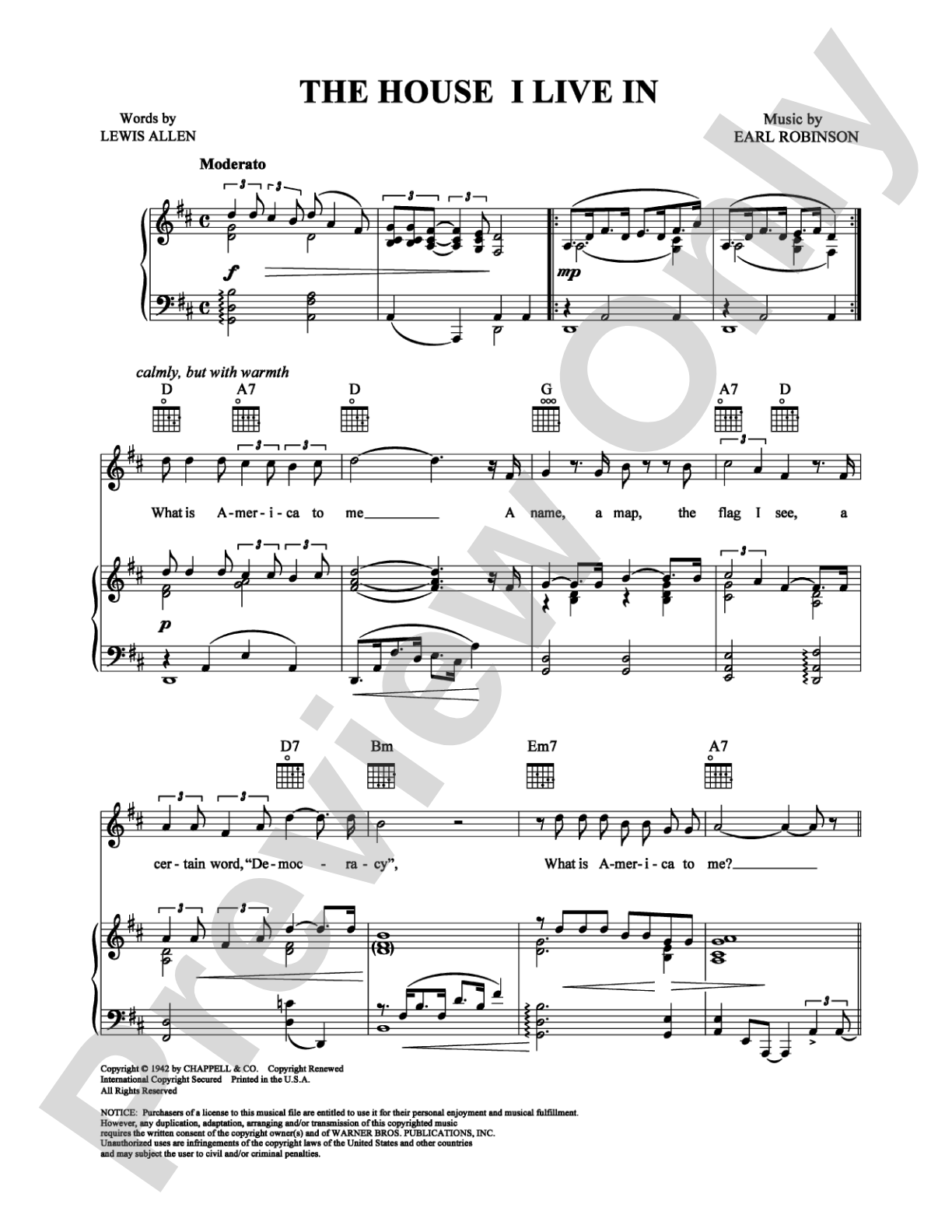
The House I Live In: Piano/Vocal/Chords Digital Sheet Music

The House I Live In: Piano/Vocal/Chords Digital Sheet Music

Frank Sinatra, Earl Robinson

Item: 00-PS-0004507

Digital Download
$3.99
Description

The House I Live In: Piano/Vocal/Chords Digital Sheet Music isn't in MakeMusic Cloud just yet...but it could be. Let us know you'd like to see it, and you'll help shape what comes next. In the meantime, start a free trial and dive into thousands of interactive titles your students can play along with today.

Sample Audio
No sample audio found.
Sample Video
Additional Details
SKU: 00-PS-0004507

More about this title

About the Artist: Frank Sinatra

Frank Sinatra (1915, 1998) shaped American popular song through his interpretive gifts and technical command of phrasing. His approach to the American Songbook, treating each lyric with dramatic intention and shaping melodic lines through breath and dynamics, became the standard against which all singers still measure themselves.

For music educators, Sinatra's recordings serve as masterclasses in how to inhabit a song. His interpretations of standards like this one demonstrate what happens when a vocalist listens deeply to lyrical meaning and communicates it through subtle choices in timing, tone color, and dynamic shaping.

Why we love this

This standard offers a direct entry into meaningful American song literature. The melody sits well for developing singers, the harmonic progressions teach functional tonal writing, and the lyrical content—celebrating community and belonging—gives performers something genuine to sing about rather than abstract vocal exercises.

What to expect

Warm, conversational, and grounded in everyday humanity. The melody has a natural vocal quality that feels like someone speaking to you across a room rather than performing from a stage. There's optimism threaded through the harmonic movement, with moments of gentle reflection that invite performers to connect with the song's message about finding home in community.

Who it's for

Singers preparing audition material, jazz ensemble students exploring swing-era standards, and piano accompanists building their repertoire of popular song literature. It works equally well for high school choir students encountering the Great American Songbook and college-level vocal students refining their interpretation skills.

How to get the most out of it

  • Study how the melody phrases across the bar lines rather than within them; let the text guide your breath points rather than resting at obvious structural moments.
  • Listen to Sinatra's original recording to understand the subtle rhythmic flexibility he brings to the melody, particularly where the written note values don't quite capture the feel of the performance.
  • Balance the vocal line with the piano accompaniment so both instruments can breathe; the chord symbols give you room to voice harmonies in ways that support rather than compete with the singer.
  • Pay attention to dynamics suggested by the lyrical content; the song builds in emotional intensity and your interpretation should reflect that arc.

How to use it

This works as a solo feature within a jazz, pop, or standards-focused concert, or as part of a set celebrating American songwriting and cultural history. It pairs naturally with other period standards and bridges well between classical vocal repertoire and contemporary performance practices.

Skills your students will build

  • Interpreting swing-era phrasing and rhythmic flexibility
  • Reading piano/vocal chord charts and understanding lead sheet notation
  • Matching vocal inflection to lyrical meaning and emotional arc
  • Balancing melody with accompaniment in duo performance
  • Understanding functional harmony through jazz standard chord progressions

You May Also Like