
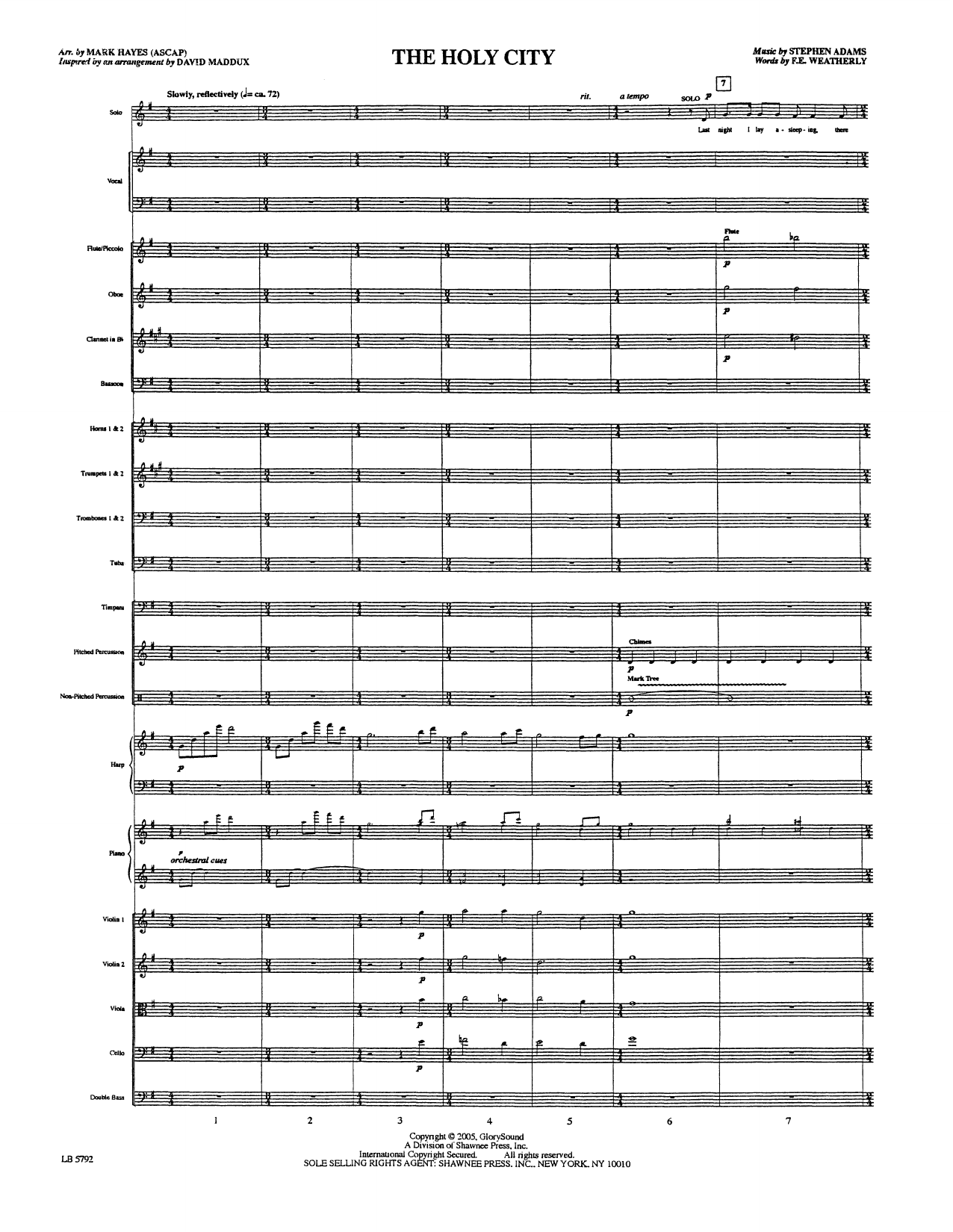

The Holy City (arr. Mark Hayes): Choral Instrumental Pak
By F. E. Weatherly and Stephen Adams / By Stephen Adams / Arranged by Mark Hayes
Item: 35-PK00503022
$75.00
Pickup currently not available
Buy Extra Parts (Digital PDF Download)
Parts Added to Cart!
Description
Mark Hayes does it again in his stellar adaptation of a true sacred evergreen. Mark's colorful orchestrations are highly imaginative and there is liberal use of solo voice making this piece not only a great choral moment, but a showcase for solo voice as well. "The Holy City" is destined to become an instant classic!


The Holy City (arr. Mark Hayes): Choral Instrumental Pak isn't in MakeMusic Cloud just yet...but it could be. Let us know you'd like to see it, and you'll help shape what comes next. In the meantime, start a free trial and dive into thousands of interactive titles your students can play along with today.
Request This Title
Tell us you want it.
Start Your Free Trial
Explore everything that's ready to play right now.
Sample Audio
No sample audio found.
Sample Video
No sample videos found.
Additional Details
Publisher:
Hal Leonard
SKU:
35-PK00503022
More about this title
About the Composer: F. E. Weatherly and Stephen Adams
Stephen Adams (1844-1922) was an English composer and baritone singer whose gift for melody made him a fixture in Victorian concert halls and churches alike. His most enduring work, "The Holy City," combines a soaring vocal line with text by lyricist F. E. Weatherly, creating a piece that has moved audiences for over a century. Adams understood the human voice intimately; his writing sits naturally in the passaggio and rewards singers who approach it with both technical control and genuine expression.
F. E. Weatherly (1836-1929) was a prolific English lyricist and poet whose words for "The Holy City" capture spiritual aspiration with directness and emotional clarity. Weatherly's texts were paired with some of the era's finest composers, and his collaboration with Adams produced one of the most recorded sacred songs in the English language. His gift was making profound sentiment feel accessible without sacrificing poetic integrity.
Why we love this
Mark Hayes's orchestration breathes new life into a piece that could easily feel dated in less thoughtful hands. The colorful instrumental writing doesn't overshadow the vocal line; instead, it creates a genuine dialogue between voice and accompaniment that keeps listeners engaged from start to finish. Programming this gives your ensemble a showstopper that audiences recognize and connect with immediately, while the solo voice feature transforms the piece into a genuine feature moment rather than just another choral number.
What to expect
Expansive and hopeful. The piece unfolds with hymn-like dignity but never settles into predictability; Hayes's orchestrations add shimmer and movement beneath a vocal line that feels both intimate and grand. There is genuine spiritual weight here without a hint of kitsch.
Who it's for
Directors who want a sacred standard that feels fresh and orchestrally interesting, and soloists who need a legitimate feature moment that sits well for many voice types. This works equally well for concert settings, sacred services, and competitive festivals.
How to get the most out of it
- Balance the solo voice prominently in early rehearsals so your ensemble hears how their accompaniment should support rather than compete with the featured singer.
- Shape the melodic phrases with long, supported lines rather than articulating every note; this music lives in legit singing, not precision rhythmic work.
- Take Hayes's orchestral colors seriously during sectional rehearsals. The arranging is detailed enough that brass and woodwind sections need to know their specific textural roles, not just the harmonies.
- Allow time in rehearsal for the soloist to develop interpretive choices (rubato, dynamic nuance) before locking tempos with the full ensemble.
How to use it
Position this as a centerpiece of a sacred or classical concert, either in the first half to establish emotional tone or in the final third as a powerful statement. It pairs well alongside other Hayes arrangements or with lighter choral fare, giving programming natural dynamic shape.
Skills your students will build
- Supporting a solo vocalist with appropriate dynamic restraint and textural clarity
- Following Hayes's sophisticated harmonic language and colorful voice leading
- Sustaining legit, connected singing across longer phrases without losing intonation
- Responding to orchestral accompaniment cues and maintaining ensemble cohesion with instrumental partners