
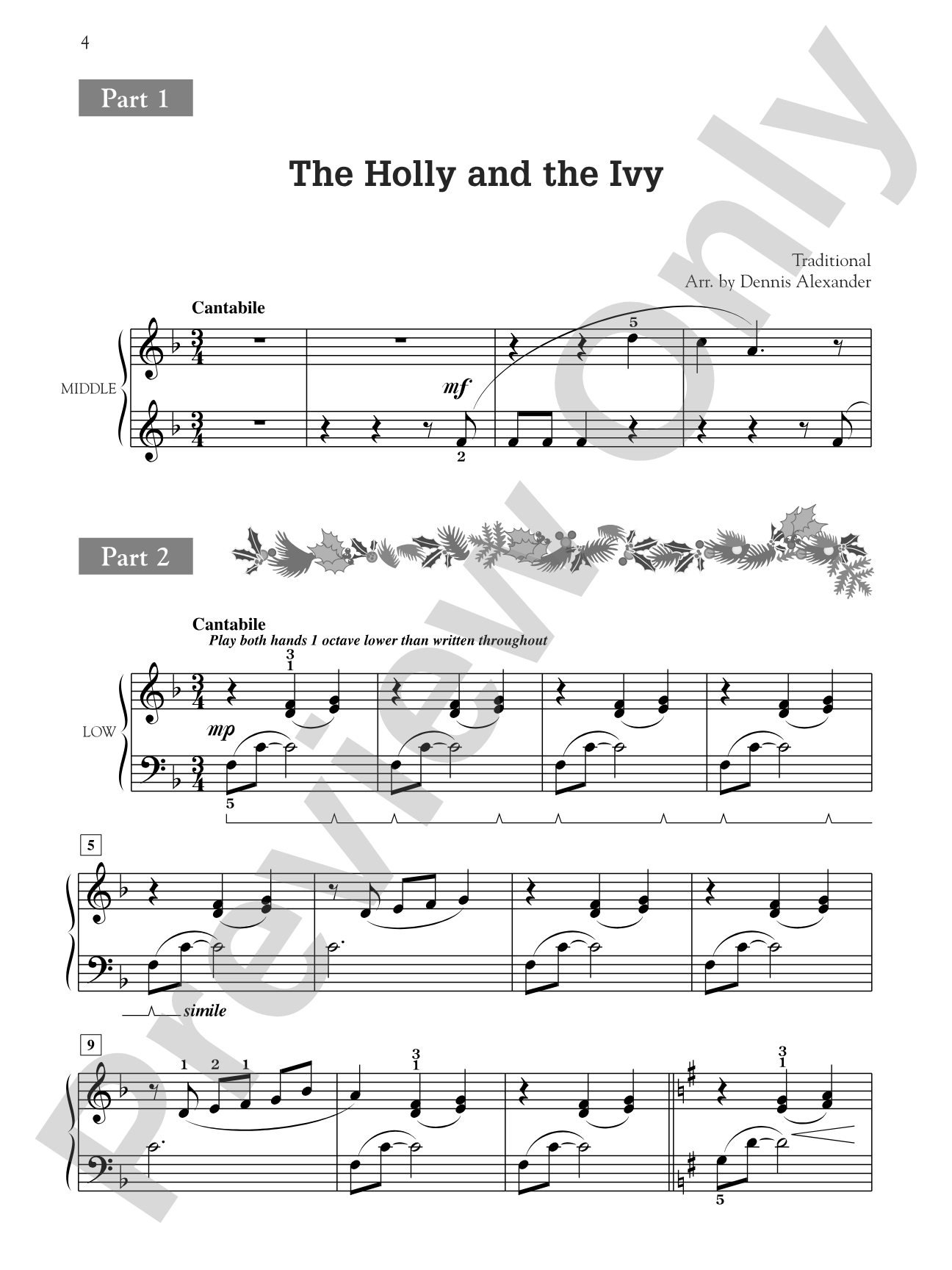

The Holly and the Ivy - Piano Trio (1 Piano, 6 Hands): Piano Trio (1 Piano, 6 Hands)
Arranged by Dennis Alexander
Level: Late Elementary
Item: 00-PS-0017578
$4.99
Pickup currently not available
Related Items
The Holly and the Ivy: Piano Trio (1 Piano, 6 Hands) Sheet |
$4.99
|
View |
Description
A Christmas arrangement designed for three players at one piano, this trio can also work as a duet with parts 1 and 2. Even though all three parts are easily accessible for late elementary pianists, the combined effect is sure to be both sophisticated and rewarding. Separate parts can also be easily performed on electronic keyboards for added interest and color. A Federation Festivals 2024-2028 selection.


The Holly and the Ivy - Piano Trio (1 Piano, 6 Hands): Piano Trio (1 Piano, 6 Hands) isn't in MakeMusic Cloud just yet...but it could be. Let us know you'd like to see it, and you'll help shape what comes next. In the meantime, start a free trial and dive into thousands of interactive titles your students can play along with today.
Request This Title
Tell us you want it.
Start Your Free Trial
Explore everything that's ready to play right now.
Sample Audio
No sample audio found.
Sample Video
No sample videos found.
Additional Details
Series:
Alfred's Premier Piano Solos
Publisher:
Alfred Music
Page Count:
8
SKU:
00-PS-0017578
More about this title
About the Arranger: Dennis Alexander

Dennis Alexander has shaped educational piano repertoire for nearly four decades through his work with Alfred Music Publishing, where he's contributed over 400 compositions and recordings since 1986. His career spans university teaching at Montana and California State institutions, private instruction, and an active performance schedule as soloist and chamber musician. Alexander maintains a national and international presence as a clinician and adjudicator, having judged competitions in India and toured extensively throughout Asia leading workshops and recitals.
A University of Kansas graduate and native Kansan, Alexander served as piano department chair at the University of Montana while teaching applied piano, class piano, and piano pedagogy for nearly a quarter-century. His versatility as a collaborative artist and his deep understanding of pedagogical progression have made his arrangements and original works trusted selections for festivals, competitions, and studio curricula across all proficiency levels.
Why we love this
Alexander's gift for creating piano music that sounds far more advanced than its technical demands shines throughout this arrangement. Three independent parts coexist without collision, allowing young players to experience genuine ensemble textures while staying comfortably within late elementary technique. The flexibility to perform this as a trio, duet, or with mixed keyboard colors means it adapts to whatever your studio or program needs.
What to expect
The familiar carol wraps around itself with warm countermelodies and gentle harmonic support, creating a piece that feels gathered and intimate rather than sparse. Even at a modest tempo, the three-part texture suggests the richness of a full ensemble, inviting the young performers into genuine musical expression.
Who it's for
Studio teachers and directors looking for accessible ensemble literature that doesn't sound like an etude will find this ideal for late elementary pianists ready to explore trio playing. It's equally suited to festival programs, holiday concerts, or collaborative studio performances where mixed ability levels need to make music together convincingly.
How to get the most out of it
- Establish a steady tempo in the first run-throughs; the carol's familiar melody carries the piece, so focus on rhythmic cohesion among the three parts before refining dynamics.
- Balance Part 1's melody so it sits above the supporting voices without the other pianists working harder than necessary to accompany.
- Consider assigning each player to a specific keyboard or section of the same piano before the first rehearsal; clear setup prevents scrambling at the bench during performance.
- If substituting electronic keyboards for any parts, do a full run-through with the actual instruments to confirm tone blending and ensure no surprises on concert day.
How to use it
Slot this into a December concert as a bridge between standard repertoire and lighter holiday fare, or use it as a showcase for ensemble playing without requiring full ensemble instrumentation. The Federation Festivals 2024-2028 selection status makes it a sensible choice for students preparing for competitive performance.
Skills your students will build
- Playing as a unified ensemble with independent part awareness
- Maintaining rhythmic accuracy while listening to two other pianists
- Balancing melody against harmonic accompaniment
- Reading and coordinating three separate piano parts on a shared instrument
- Interpreting a familiar tune through new harmonic context