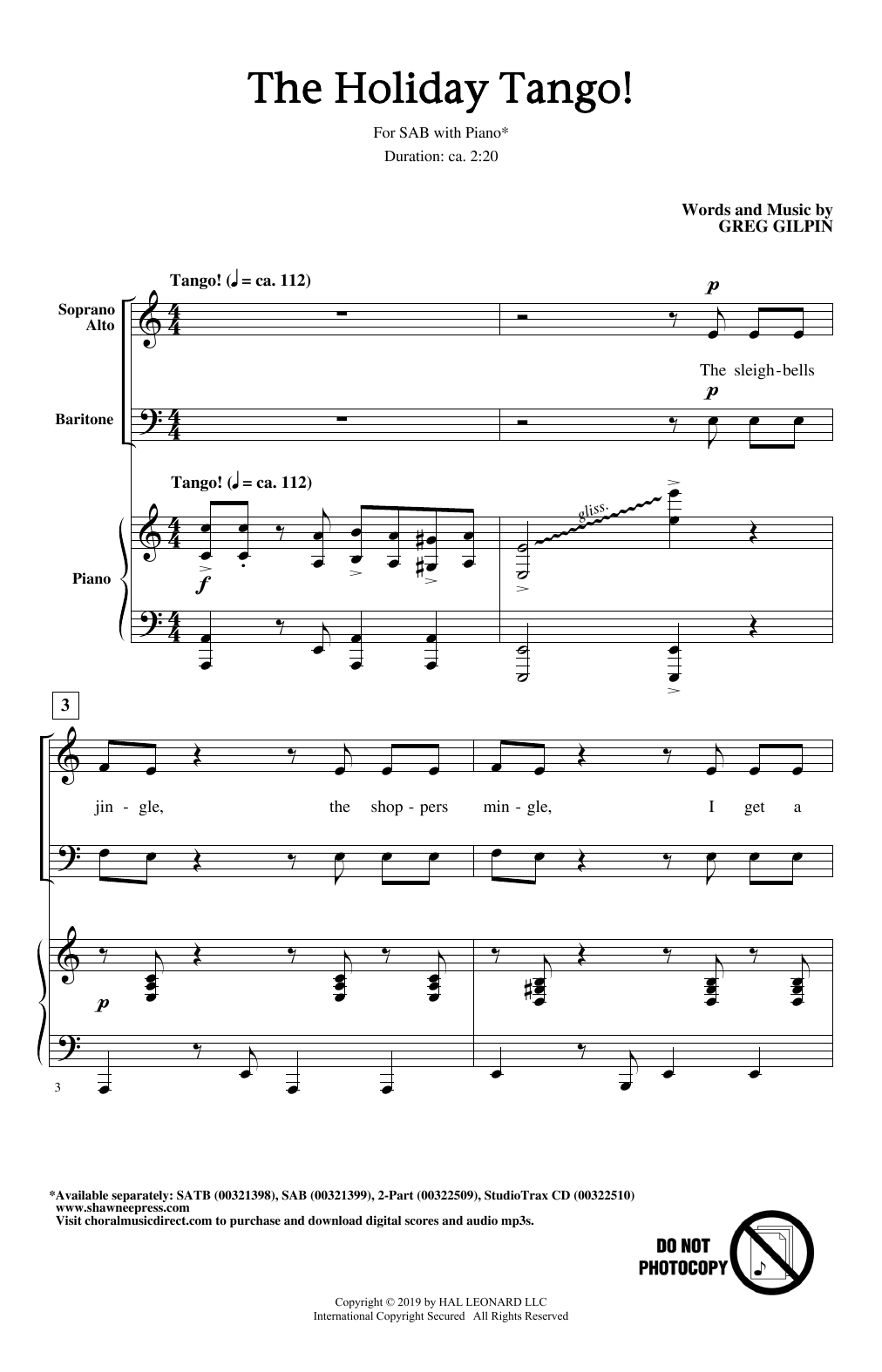
The Holiday Tango! Sheet Music Preview

The Holiday Tango!: SAB Choral Octavo

By Greg Gilpin

Item: 35-DS00452368

Digital Download
$2.99
Description

The Holiday Tango!: SAB Choral Octavo isn't in MakeMusic Cloud just yet...but it could be. Let us know you'd like to see it, and you'll help shape what comes next. In the meantime, start a free trial and dive into thousands of interactive titles your students can play along with today.

Sample Audio
No sample audio found.
Sample Video
Additional Details
Publisher: Hal Leonard
Page Count: 10
SKU: 35-DS00452368

More about this title

About the Composer: Greg Gilpin

Greg Gilpin

Greg Gilpin stands among America's most prolific and respected choral composers, with an ASCAP award-winning catalog that reflects decades of conducting and arranging experience. His work has graced some of the world's most prestigious stages, from Carnegie Hall and Lincoln Center in New York to the Sydney Opera House, Royal Festival Hall in London, and beyond. As Director of Educational Choral Publications for Shawnee Press, Gilpin shapes the repertoire that directors teach and students sing across the country.

Beyond the concert hall, Gilpin's creative energy extends into film scoring and professional organizing, demonstrating a restless artistic curiosity. He collaborated with opera singer Angela Brown on a contemporary arrangement of "What Child is This?" that premiered with the Indianapolis Symphonic Choir, and composed the award-winning score for the short film "Rosie's Rescue." Active in ACDA, NAfME, and Phi Mu Alpha Sinfonia, Gilpin remains deeply invested in the choral education community.

Why we love this

Gilpin brings the warmth and sophistication of his concert hall experience directly to your SAB ensemble. This arrangement avoids the thin, overly precious arrangements that plague holiday choral catalogs, instead offering genuine musicality that respects both the season and your singers' abilities. The writing is accessible without being condescending, which means your students will enjoy singing it as much as your audiences will enjoy hearing it.

What to expect

The tango brings sophistication and movement to the holiday season, trading jingling bells for rhythmic vitality and genuine dance energy. Gilpin's arrangement captures both the elegance of the form and the warmth of the season, creating a performance that feels fresh rather than obligatory.

Who it's for

This octavo works beautifully for high school choirs seeking contemporary holiday repertoire that moves beyond standards. Middle school singers with reasonable part independence will also find it within reach, particularly if your program has developed solid rhythmic foundation work.

How to get the most out of it

  • Attend to the Latin rhythmic character that threads through the piece; precision in the syncopated figures will sharpen the overall performance and prevent the tango from feeling sluggish or tentative.
  • Balance the three parts carefully so that the SAB texture feels blended rather than stratified; avoid letting the alto line disappear, as Gilpin's writing depends on its independence.
  • Use the recorded accompaniment as a rehearsal tool initially, but work toward confident a cappella singing in sections to deepen your ensemble's awareness of intonation and rhythmic togetherness.
  • Shape the phrase endings with genuine releases rather than letting them drift; even brief musical moments benefit from clear, intentional closure.

How to use it

Schedule this as a standout opening or closing number for a holiday concert, where it can provide contrast to more traditional material and show your audience the range of your ensemble's musicianship. The piece also works effectively in a program that explores global or Latin influences, allowing you to frame the holiday season through a broader cultural lens.

Skills your students will build

  • Tango rhythm and syncopation (authentic Latin feel rather than approximation)
  • Part independence in three-part mixed voicing
  • Phrase shaping and intentional release technique
  • Balancing ensemble blend across distinct voice ranges
  • Working with recorded accompaniment for stylistic accuracy

You May Also Like