
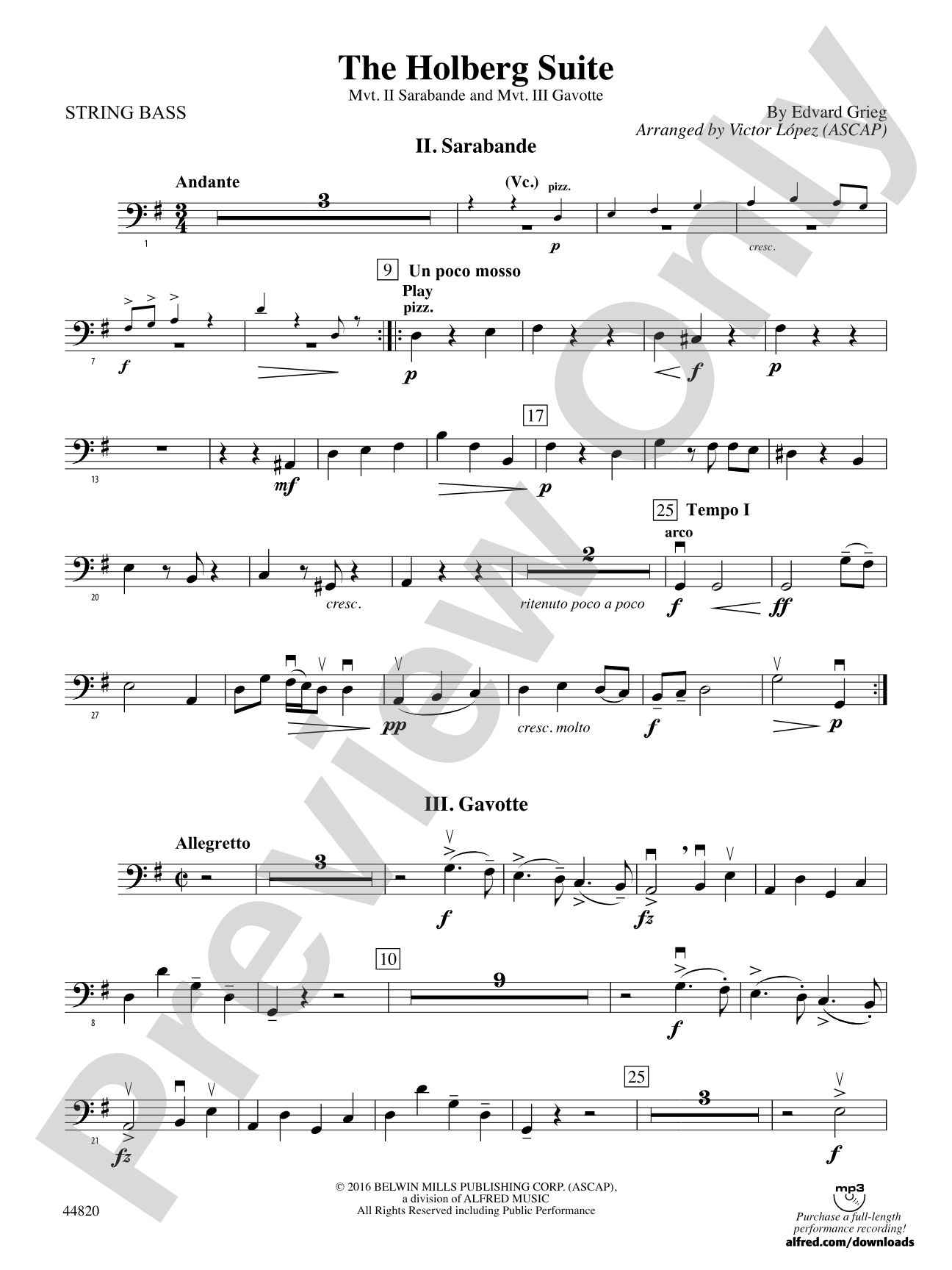

The Holberg Suite: String Bass
Mvt. II Sarabande and Mvt. III Gavotte
By Edvard Grieg / arr. Victor López
Grade: 3
Item: 00-PC-0017337_SB
$3.00
Pickup currently not available
Description
With string parts as close to the original as possible, this full orchestra arrangement of two movements from Grieg's Holberg Suite is a gem! It may be performed by string or full orchestra, and, for ultimate flexibility, each movement can be performed alone. Featuring the "Sarabande" and "Gavotte," careful attention has been paid to maintain the original intentions of the composer in this piece. Minimal accommodations were made by arranger Victor López to provide a more educationally-sound experience for the players. (8:10)


Don't just read it, hear it, play along with it, and watch your students grow with it. In MakeMusic Cloud, The Holberg Suite: String Bass comes alive with professional accompaniment, adjustable tempo, and built-in practice tools that turn solo practice into real progress.
Open in the Player
Jump straight in and assign it today.
Start Your Free Trial
Open this title and explore the full library in minutes.
Sample Audio
1
Audio File
--:--
0:00
0:00
Sample Video
Additional Details
Series:
Belwin Concert Full Orchestra
Publisher:
Alfred Music
Page Count:
218
SKU:
00-PC-0017337_SB
More about this title
About the Composer: Edvard Grieg
Edvard Grieg (1843-1907) stands as Norway's most celebrated composer, and his gift for melody shaped the Romantic era's character. His piano suite Holberg Suite, written to commemorate the 200th anniversary of Danish-Norwegian playwright Ludvig Holberg, demonstrates his ability to blend Baroque formal structures with 19th-century harmonic language. The work has become a staple of concert programming and music education, valued for its accessibility and compositional clarity.
Grieg's arrangements of his own works show his understanding of orchestral color and balance. He wrote with students and emerging ensembles in mind, believing that great music should reach players at all levels. His legacy in music education extends beyond individual pieces to a philosophy that technique and artistry develop together through worthy repertoire.
Why we love this
Victor López's orchestration preserves the string writing that defines Grieg's original while distributing the material accessibly across a full orchestra. Grade 3 ensembles rarely encounter genuine masterworks with this level of harmonic sophistication and Romantic-era charm, making this both a musical and educational win. The option to perform either movement independently or the suite as written gives directors real flexibility for concert programming.
What to expect
The Sarabande opens with quiet dignity, its stately 3/2 pulse evoking the formal dances of the Baroque, yet the harmonic language feels unmistakably Romantic and warmly nostalgic. The Gavotte sparkles by contrast, its rapid sixteenth-note figures and lighter orchestration creating a courtly grace that feels both elegant and genuinely fun to play. Together, these movements transport the ensemble to a place where historical gesture meets 19th-century sentiment.
Who it's for
Grade 3 full orchestras and string orchestras looking for substantial concert repertoire beyond student compositions. This works equally well for ensembles building toward festival competition or planning a concert that includes Romantic-era masterworks. Directors seeking material that challenges players musically without overwhelming them technically will find both movements rewarding.
How to get the most out of it
- Shape the melodic line in the Sarabande with subtle dynamic contours rather than rigid terracing; Grieg's baroque-inspired writing benefits from phrase-based breathing across the full orchestra.
- Balance the upper strings carefully in both movements so that inner voices remain audible without drowning the harmonic foundation in the lower sections.
- Maintain period-appropriate articulation in the Gavotte with light tonguing and bow articulation that respects the dance character without becoming overly fussy.
- Use the conductor score's detailed part writing to rehearse individual sections on their own before full ensemble rehearsals, allowing players to hear how their lines fit the contrapuntal texture.
How to use it
Open a concert with the Sarabande alone for an unexpected, contemplative beginning, or pair both movements as a single suite to showcase your orchestra's range across contrasting tempos and textures. This arrangement sits comfortably alongside other Romantic-era repertoire and provides a natural bridge between lighter entertainment music and more demanding symphonic works.
Skills your students will build
- Baroque dance forms (sarabande, gavotte) and their performance practice
- Lyrical string writing and phrase shaping across a full ensemble
- Reading complex conductor scores with multiple doubled parts
- Balancing independent inner voices within a harmonic texture
- Sustaining tone quality at soft dynamic levels while maintaining pitch accuracy
- Coordinating articulation across wind and string sections