
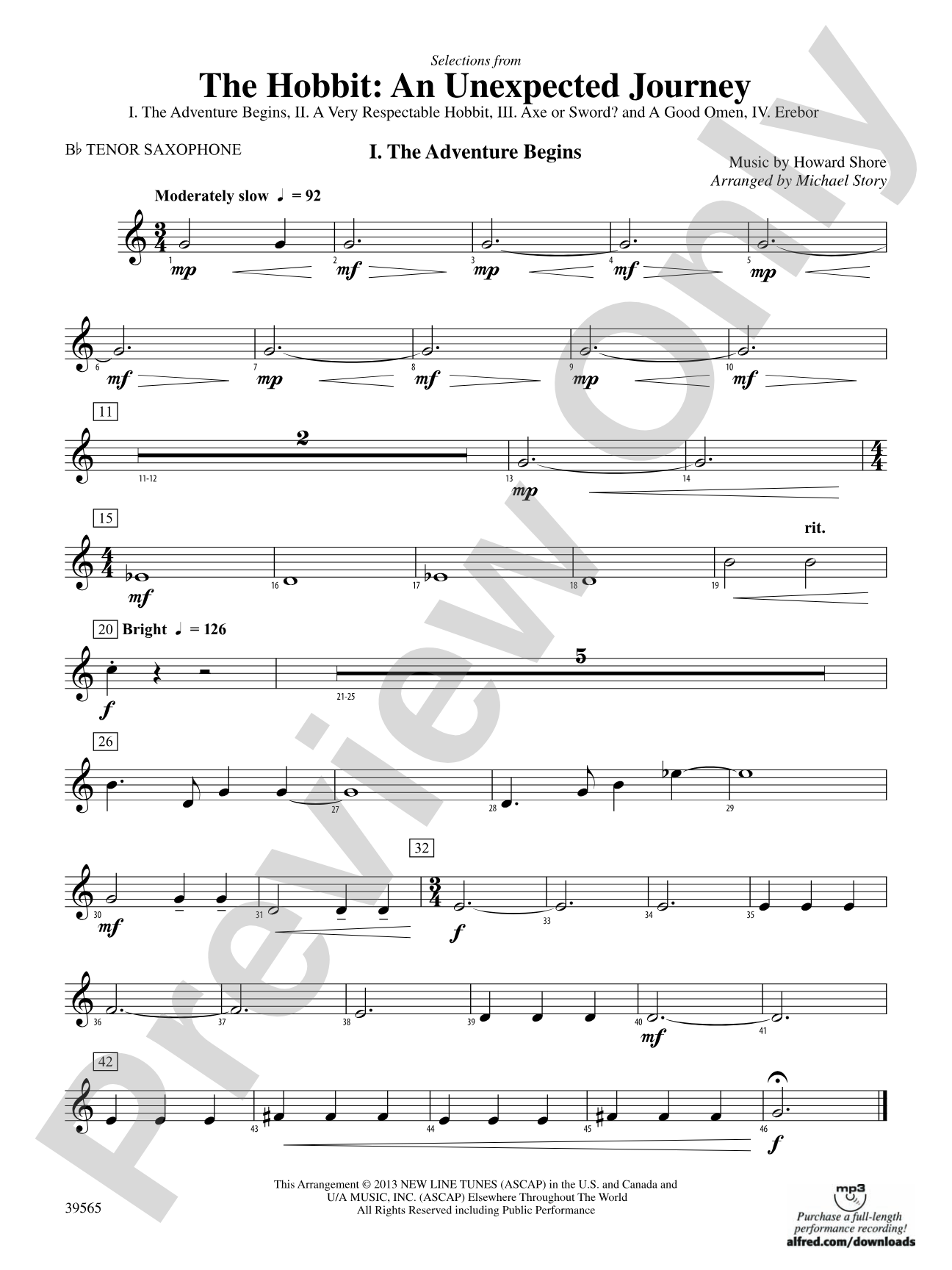

The Hobbit: An Unexpected Journey, Selections from: B-flat Tenor Saxophone
I. The Adventure Begins / II. Axe or Sword? and A Good Omen / III. A Very Respectable Hobbit / IV. Erebor
Music by Howard Shore / arr. Michael Story
Grade: 2 (Easy)
Item: 00-PC-0015873_TX1
$5.99
Pickup currently not available
Description
The spectacular music from this blockbuster Howard Shore film score is perfectly set for your developing band. Allowing the director a variety of programming options, the music is presented in suite format in four individual movements, which include "The Adventure Begins, "A Very Respectable Hobbit," "Axe or Sword?" "A Good Omen," and "Erebors." Scored especially for your junior high/middle school band, it's sure to be a favorite! (4:30)
For educational usage/non-profit performances only; for professional arrangements, visit our rental library at alfred.com/rental.


For educational usage/non-profit performances only; for professional arrangements, visit our rental library at alfred.com/rental.
Don't just read it, hear it, play along with it, and watch your students grow with it. In MakeMusic Cloud, The Hobbit: An Unexpected Journey, Selections from: B-flat Tenor Saxophone comes alive with professional accompaniment, adjustable tempo, and built-in practice tools that turn solo practice into real progress.
Open in the Player
Jump straight in and assign it today.
Start Your Free Trial
Open this title and explore the full library in minutes.
Sample Audio
1
Audio File
--:--
0:00
0:00
Sample Video
No sample videos found.
Additional Details
Series:
Pop Young Band
Publisher:
Alfred Music
Page Count:
252
SKU:
00-PC-0015873_TX1
More about this title
About the Composer: Howard Shore
Howard Shore is an Oscar-winning film composer whose work spans from the epic scale of Peter Jackson's Lord of the Rings and Hobbit trilogies to intimate character studies in drama and thriller. His approach to film music balances orchestral grandeur with melodic accessibility, making his scores natural fits for educational ensembles when thoughtfully arranged.
Shore's compositional voice emphasizes clear harmonic progressions, memorable themes, and textures that allow younger musicians to contribute meaningfully to the ensemble sound. His scores have influenced how contemporary film music is taught in schools, offering students the chance to engage with music they recognize while developing technical and ensemble skills.
Why we love this
This suite gives junior high bands access to music from a universally recognized film without sacrificing genuine musicianship. Michael Story's arrangement preserves Shore's distinctive melodic character while scaling the orchestration to match developing players, so students experience real compositional ideas rather than simplified filler. The suite format lets you program one movement or several depending on your concert needs and student readiness.
What to expect
The opening movement sweeps you into an epic adventure, conjuring the romance of journeys and discovery. From there the music shifts between moments of quiet domesticity and action-driven excitement, creating a suite that moves through emotion and energy without ever feeling static or boring.
Who it's for
This is ideal for middle school and early high school concert bands seeking repertoire that engages students through music they already love. Conductors looking for meaningful selections that don't oversimplify the orchestration will appreciate how Story maintains Shore's voice while keeping the ensemble parts accessible at Grade 2 level.
How to get the most out of it
- Balance the woodwind and brass textures in 'The Adventure Begins' by bringing out the main theme in clarinets and saxophones; bass clarinet and tuba provide harmonic support rather than doubling the melody.
- Shape 'A Very Respectable Hobbit' with attention to its gentle character; resist the urge to push tempo, and let the quieter passages breathe so the piece feels intimate rather than rushed.
- Lock the rhythmic precision of 'Axe or Sword?' by having the percussion and low brass establish the pulse clearly in rehearsal before full ensemble runs; this movement's energy depends on rhythmic confidence.
- Use the dynamic markings in 'A Good Omen' and 'Erebor' to create shape and lift; Grade 2 arrangements often downplay dynamics, but these movements come alive when each section plays with clear dynamic intent.
How to use it
Program one or two movements as a concert finale to create an accessible high point that audiences recognize immediately. Alternatively, use the full suite as a bridge piece in a concert that mixes classical and contemporary repertoire, showing students that quality composition exists across genres.
Skills your students will build
- Sustaining tone quality through longer melodic phrases
- Balancing independent part writing against featured melodies
- Responding to dynamic and tempo changes that shape musical narrative
- Coordinating ensemble entrances in different instrumental combinations
- Recognizing and playing thematic material across different instrument families