
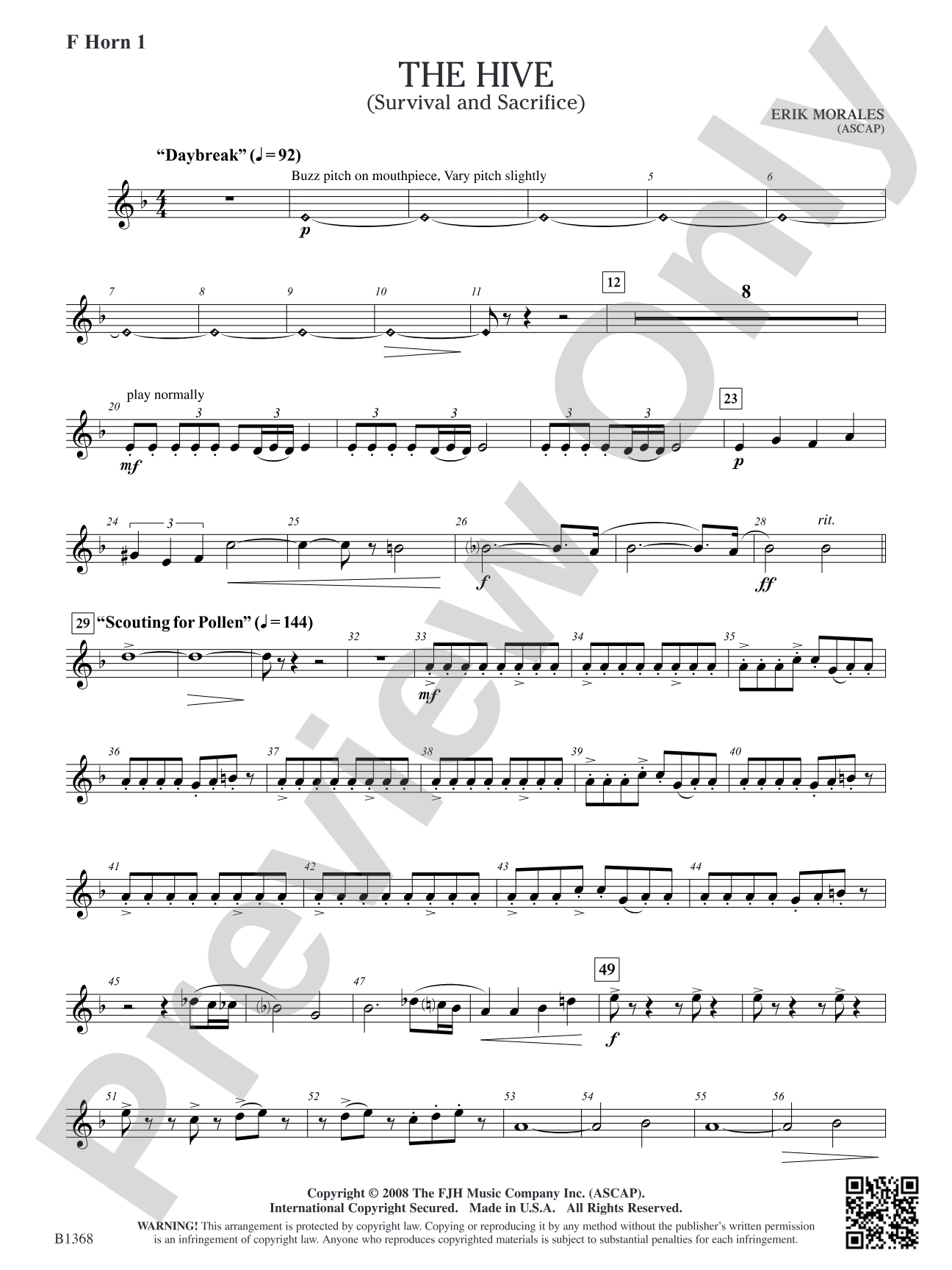

The Hive (Survival and Sacrifice): F Horn 1
Survival and Sacrifice
By Erik Morales
Grade: 3.5;4
Item: 98-PC-DB1368_H1
$7.00
Pickup currently not available
Description
This serious programmatic work depicts a day in the life of a honeybee hive by drawing on various musical effects throughout. The opening section, Daybreak, is tranquil and serene, yet intensifies as the hive becomes active. A flurry of musical activity accompanies the next section, Scouting for Pollen, as forager bees disperse. Other interesting sections include Directional Tango, Her Majesty, the Queen, Hungry Bear (depicting the ransacking of the hive), and New Cycle Begins, during which several of the previous themes come back in a brilliant collage of musical sounds and textures. Experience the full gamut of styles in this brilliant and highly entertaining work!


Discover MakeMusic Cloud: thousands of interactive titles your students can play along with today.
Sample Audio
1
Audio File
--:--
0:00
0:00
Sample Video
No sample videos found.
Additional Details
Series:
FJH Concert Band
Publisher:
The FJH Music Company, Inc.
SKU:
98-PC-DB1368_H1
More about this title
About the Composer: Erik Morales

Erik Morales brings a distinctive harmonic and melodic sensibility to concert band writing that has earned him recognition across multiple musical genres. Born in New York City in 1966, he studied composition at Florida International University and earned his bachelor's degree from the University of Louisiana, Lafayette in 1989. His composing journey began in 1985 when his high school band director commissioned him to arrange marching band music, a pivotal opportunity that launched his career in educational music publishing. Since 2002, his works have been performed and published internationally across wind ensembles, orchestras, jazz groups, and chamber settings.
With trumpet as his principal instrument, Morales has significantly shaped the trumpet repertoire; his ensemble works have earned first place performances at the 2006 and 2008 National Trumpet Competitions, and his Concerto for Trumpet in C and Piano premiered at the 2009 International Trumpet Guild conference. A consortium-commissioned Concerto for Two Trumpets debuted at the 2013 ITG conference in Grand Rapids. In 2016, he was inducted into the Louisiana Association for Jazz Education's Hall of Fame. Across more than 150 published works, Morales maintains a deliberate balance between artistic integrity and pedagogical value, a philosophy that defines his approach to band composition.
Why we love this
The Hive succeeds because it delivers genuine musical storytelling without sacrificing accessibility. Grade 3.5/4 bands encounter real compositional craft here: textural variety, thematic development, and orchestrational sophistication that mirrors advanced literature while remaining within their technical reach. The programmatic arc gives students concrete musical imagery to execute, transforming technical passages into narrative moments rather than abstract exercises.
What to expect
The opening calm dissolves into purposeful motion as the hive awakens. Musical passages dance and swirl with the forager bees' search, shift into rhythmic intrigue during the Directional Tango, and build toward the chaotic energy of the bear attack before resolving into a brilliant mosaic of returning themes that feels simultaneously reflective and victorious.
Who it's for
This work engages Grade 3.5 and 4 concert bands seeking repertoire that combines musical substance with student interest. Performers benefit from clear programmatic context that connects their technical work to storytelling, while conductors gain a piece that sustains audience engagement through varied styles and genuine compositional craft.
How to get the most out of it
- Establish clear character distinctions between sections. Daybreak requires genuine tranquility at the opening; let the music settle before intensity builds. The contrast makes the hive's awakening dramatically effective.
- Shape the Scouting for Pollen section with rhythmic precision and ensemble clarity rather than pure speed. The musical flurry should convey purposeful activity, not panic.
- Balance transparency in the finale. When previous themes return in the collage, maintain individual voice independence so the musical textures layer distinctly rather than blur together.
- Use the recorded accompaniment to lock sectional rhythms during faster passages, particularly where multiple instrumental families carry thematic material simultaneously.
How to use it
Program this as a centerpiece for a concert built around nature-inspired or educational themes. Its variety and entertainment value work equally well in festival settings where judges appreciate both compositional sophistication and audience engagement. The piece also fits effectively as a closer to a concert set, where the finale's thematic collage provides satisfying musical resolution.
Skills your students will build
- Executing programmatic interpretation through deliberate dynamic and textural contrast
- Managing independent thematic material across multiple instrumental sections simultaneously
- Reading and performing varied stylistic material (tango rhythm, dramatic underscore, brilliant finale) within a single work
- Sustaining musical line clarity during rapid passagework and dense harmonic textures
- Responding to conductor's shaping cues that reinforce narrative structure and character development