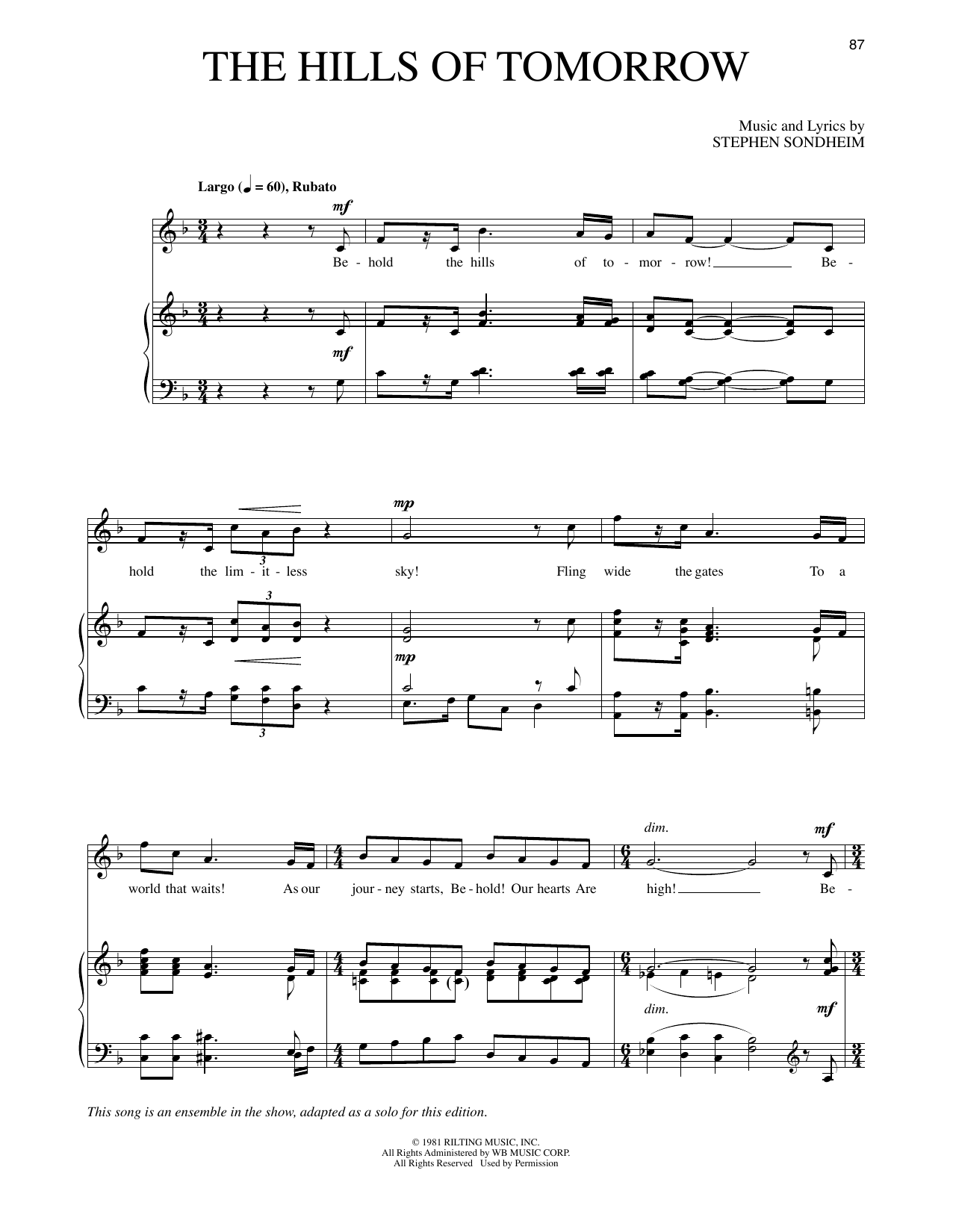
The Hills Of Tomorrow (from Merrily We Roll Along) Sheet Music Preview

The Hills Of Tomorrow (from Merrily We Roll Along): Piano Vocal

By Stephen Sondheim

Item: 35-DS00529298

Digital Download
$5.99
Description

The Hills Of Tomorrow (from Merrily We Roll Along): Piano Vocal isn't in MakeMusic Cloud just yet...but it could be. Let us know you'd like to see it, and you'll help shape what comes next. In the meantime, start a free trial and dive into thousands of interactive titles your students can play along with today.

Sample Audio
No sample audio found.
Sample Video
Additional Details
Publisher: Hal Leonard
Page Count: 3
SKU: 35-DS00529298

More about this title

About the Composer: Stephen Sondheim

Stephen Sondheim revolutionized musical theater by proving that complex, sophisticated songwriting could coexist with emotional depth and theatrical necessity. His work spans five decades of Broadway history, from West Side Story and Gypsy through Sweeney Todd and Into the Woods, establishing him as the composer who elevated the integrated musical to an art form that rewards repeated listening and deep analysis.

In the classroom and rehearsal room, Sondheim's catalog serves as a masterclass in lyrical craftsmanship and harmonic innovation. His melodies sit naturally for singers while his accompaniments demand attention to detail; his lyrics model precision in storytelling and metrical flexibility. For music educators, his work offers pathways into contemporary classical music through a genre students already love.

Why we love this

This song captures a moment of genuine hope and forward momentum, making it surprisingly accessible despite Sondheim's sophisticated harmonic language. The piano part sits comfortably under the voice without ever disappearing into accompaniment; it's genuinely interesting to play while remaining supportive of the singer's storytelling.

What to expect

Optimistic without being saccharine, the song moves forward with quiet confidence. The harmonic language is sophisticated enough to feel grown-up, yet the emotional core stays simple: a character looking ahead with genuine anticipation. There's warmth here, not cynicism.

Who it's for

Advanced high school and college singers performing audition material, repertoire classes, or concert programs; pianists working in music theater contexts who want practice with Sondheim's particular compositional voice; any performer building a contemporary Broadway audition book that goes beyond the obvious standards.

How to get the most out of it

  • Shape the melody with a legit soprano or mezzo voice; the tessitura sits high enough that forcing it lower flattens the character of the song
  • Give the piano part room to breathe between vocal phrases. Sondheim's accompaniment designs silence intentionally, and respecting those spaces keeps the song from feeling rushed
  • Balance technical precision with emotional generosity. The harmonic progressions are elegant partly because they're clean; muddy accompaniment undermines what makes this song work

How to use it

Slot this into a Broadway retrospective concert or a recital exploring Sondheim's approach to character songs. It works particularly well in a set of theater music that spans decades, offering students and audiences a moment of reflection before the program builds to something more dramatic.

Skills your students will build

  • Sondheim's harmonic language (extended chords, chromatic voice leading, modal mixture)
  • Lyric interpretation in contemporary musical theater (specificity over generalization)
  • Sustaining legit soprano tone across a range of dynamic levels
  • Coordination between singer and pianist when melodic phrasing doesn't align with harmonic cadences
  • Reading piano/vocal scores with independence and active accompaniment rather than passive support

You May Also Like