
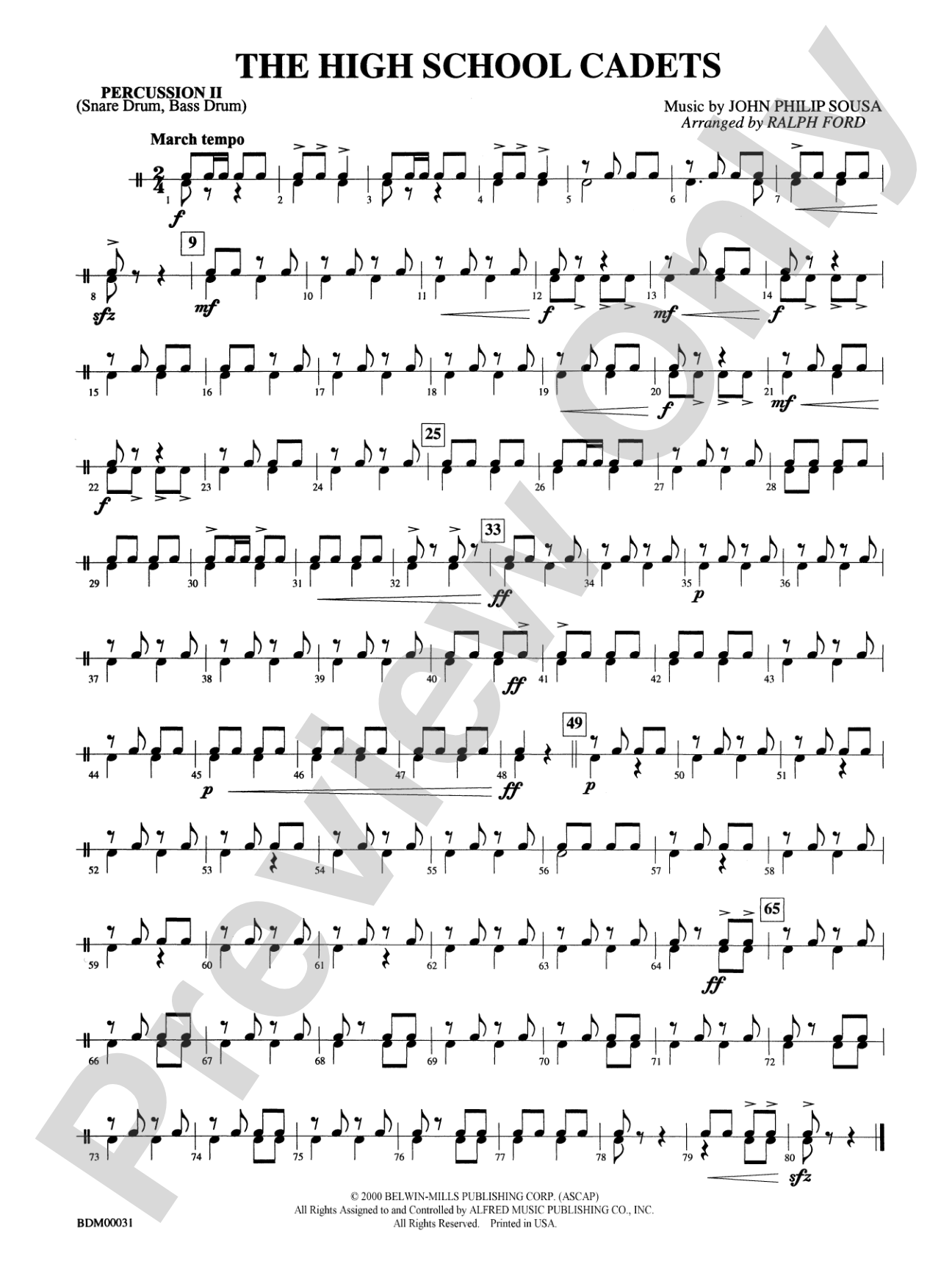

The High School Cadets: 2nd Percussion
By John Philip Sousa / arr. Ralph Ford
Grade: 1 (Very Easy)
Item: 00-PC-0017532_PC2
$3.00
Pickup currently not available
Description
John Philip Sousa's classic march has been scaled to the beginning level. The traditional dynamics are clearly displayed. This is a sure-fire winner. Although manageable by beginners, more advanced ensembles may choose to perform this march with reduced preparation time. Programmed on any concert, used as a warm-up for a competitive performance or simply as an encore, this arrangement will fill the bill.


Don't just read it, hear it, play along with it, and watch your students grow with it. In MakeMusic Cloud, The High School Cadets: 2nd Percussion comes alive with professional accompaniment, adjustable tempo, and built-in practice tools that turn solo practice into real progress.
Open in the Player
Jump straight in and assign it today.
Start Your Free Trial
Open this title and explore the full library in minutes.
Sample Audio
1
Audio File
--:--
0:00
0:00
Sample Video
No sample videos found.
Additional Details
Series:
Belwin Beginning Band
Publisher:
Alfred Music
Page Count:
122
SKU:
00-PC-0017532_PC2
More about this title
About the Arranger: Ralph Ford

Ralph Ford is a composer, arranger, conductor, and clinician whose career spans university teaching, media production, and commercial composition. Over three decades of faculty experience at Troy State University and beyond established him as a mentor to emerging musicians, while his work as staff arranger for the university band program shaped his approach to accessible, performable writing across all ensemble types.
Since 1999, Ford has served as an exclusive composer and arranger for Belwin (Alfred Music), with over 250 published titles for orchestra, concert band, jazz ensemble, and marching band performed by school, university, military, and professional ensembles worldwide. His portfolio extends into broadcast media, where he has composed jingles, news packages, and original scores for television and radio production. His work as a professional arranger began at fifteen in Panama City, Florida, and includes conducting live productions, recording sessions, and video scoring across traditional and digital platforms.
Why we love this
Ford has taken one of Sousa's most beloved marches and created an arrangement that preserves the character and dignity of the original while genuinely meeting beginning-level players where they are. The traditional dynamics are transparent, enabling even inexperienced musicians to understand and execute the intended phrasing. You'll find this works as a quick win on any concert, as a spirited warm-up before a contest, or as a polished encore that doesn't require extensive rehearsal time.
What to expect
Proud, energetic, and purposeful. The march stride remains intact even at this accessible level, giving young musicians the satisfaction of performing a genuine Sousa composition. The clearly marked dynamics add character and sophistication to what might otherwise feel like a reading exercise.
Who it's for
This arrangement is designed for beginning concert bands and developing ensembles that want to perform a recognizable, historically important march without overwhelming their players. Advanced bands and orchestras will also find it valuable as an efficient preparation piece that builds polish in minimal rehearsal time.
How to get the most out of it
- Shape the march's characteristic phrasing by treating each phrase as a complete musical sentence; beginners often play through without breathing, so mark logical breath points and encourage the band to play through them with gentle releases.
- Balance the melodic voices clearly so the main strain emerges from the texture; with a Grade 1 ensemble, this may mean slightly bringing back inner parts rather than pushing the lead melody.
- Keep the tempo steady and march-like; resist the temptation to slow down during dynamic transitions, which can undermine the piece's forward energy and confidence.
How to use it
Open a concert with this march to establish energy and audience connection immediately, or use it as a concluding encore that leaves the audience smiling. It also serves well as a confidence-builder during the warm-up before a competitive performance, giving your ensemble a quick success before tackling more demanding repertoire.
Skills your students will build
- Executing clear dynamic contrast (forte, mezzo-forte, piano) with precision
- Understanding and performing march-style articulation and phrasing
- Reading concert band instrumentation and balancing multiple voices
- Maintaining steady tempo through repeated sections
- Interpreting traditional notation and conductor cues