
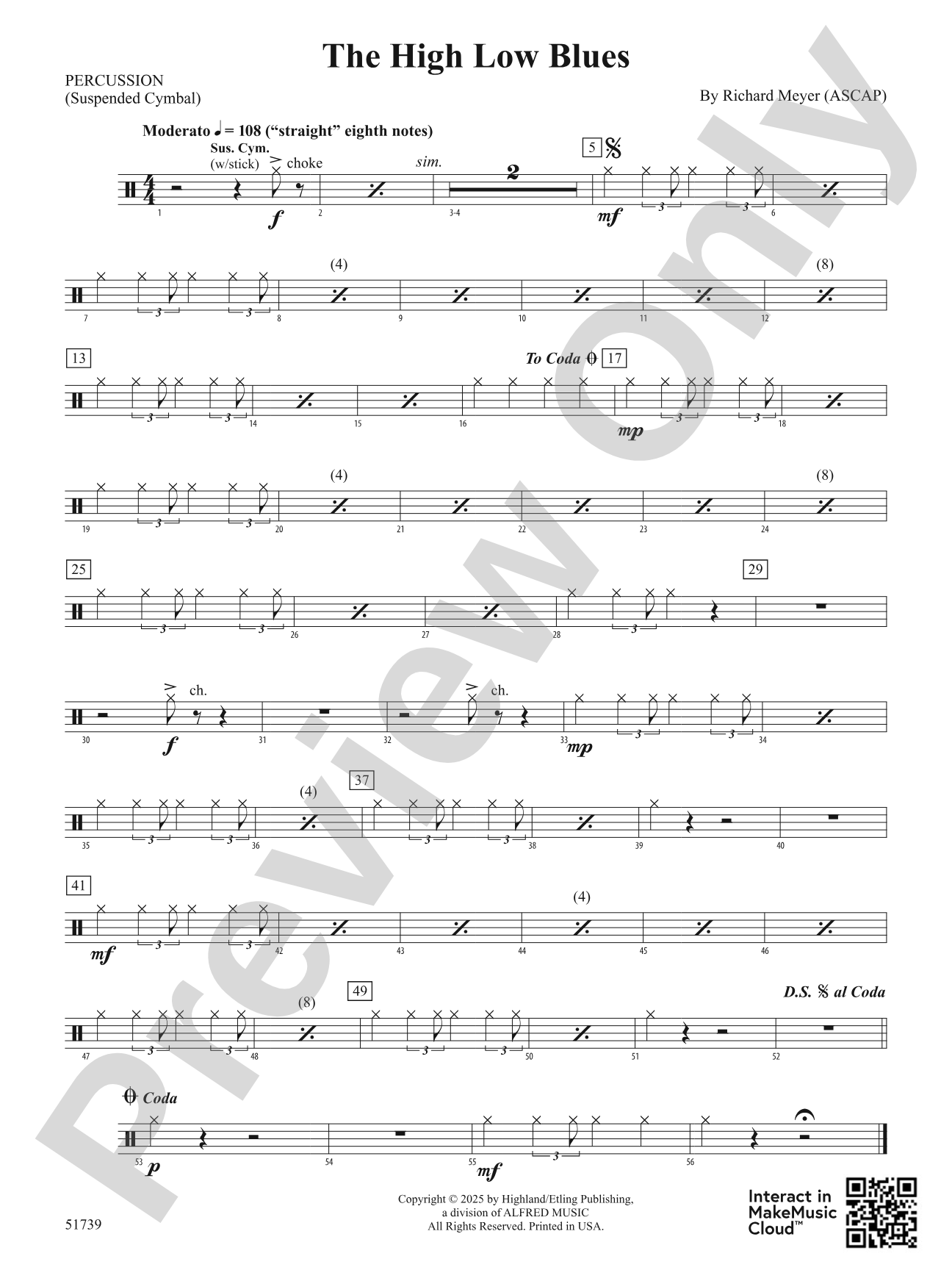

The High Low Blues: 1st Percussion
By Richard Meyer
Grade: 1
Item: 00-PC-0019399_PC1
$3.00
Pickup currently not available
Description
This fun and cool-sounding piece is the perfect way to introduce the difference between F? and F? as well as C? and C? to your young orchestra. The melodies are passed around to all sections, keeping everyone on their toes deciding whether to play their F's and C's "high or low." A simple ride cymbal part adds color and pizazz. A great way to teach standard 12-bar blues form. For an extra challenge, have students "swing" the eighth notes. (2:30) Correlates to Sound Innovations Book 1, Level 4.


The High Low Blues: 1st Percussion isn't in MakeMusic Cloud just yet...but it could be. Let us know you'd like to see it, and you'll help shape what comes next. In the meantime, start a free trial and dive into thousands of interactive titles your students can play along with today.
Request This Title
Tell us you want it.
Start Your Free Trial
Explore everything that's ready to play right now.
Sample Audio
1
Audio File
--:--
0:00
0:00
Sample Video
No sample videos found.
Additional Details
Series:
Sound Innovations Series for Strings
Publisher:
Alfred Music
SKU:
00-PC-0019399_PC1
More about this title
About the Composer: Richard Meyer

Richard Meyer brings three and a half decades of string teaching experience to his work as a composer and clinician. He spent 22 years developing the orchestra program at Oak Avenue Intermediate School in Temple City, California, expanding it from 29 to 200 students while simultaneously directing the city's elementary string initiatives. His impact extends beyond the classroom; in 2009 he created the "Giving Bach" program, which uses interactive concerts to serve special needs and underserved communities throughout Southern California and has earned national recognition for its innovative approach.
Meyer served as music director of the Pasadena Youth Symphony Orchestra for 16 years, leading performances across North America, Europe, and Australia. A prolific composer with over 190 published works, he has also held the position of string editor at Alfred Publishing and co-authored several string method series, including String Explorer and Sight-read It for Strings. He remains an active guest conductor and clinician at major conferences and state-level honor orchestras.
Why we love this
Meyer designed this piece with a specific pedagogical mission: to demystify the enharmonic relationship between sharps and flats on the string staff. By rotating the high and low F's and C's through all sections, every player stays engaged while internalizing this crucial concept. The straightforward 12-bar blues structure gives students a concrete harmonic framework, and the optional swing interpretation adds depth without overwhelming a Grade 1 ensemble.
What to expect
A cool, accessible blues groove that swings with attitude despite its simplicity. The piece feels playful and confident; students hear themselves contributing to a real jazz idiom rather than an exercise, and the rotating melody parts keep the energy moving across the ensemble.
Who it's for
Young string orchestras at Grade 1 level, particularly those ready to encounter enharmonic notation and wanting to explore jazz forms in a beginner-friendly context. Conductors teaching Sound Innovations Book 1, Level 4 material will find this piece aligns directly with that curriculum while adding style and cultural awareness.
How to get the most out of it
- Isolate the enharmonic pairs in sectionals before full rehearsal. Have violins play their F's and C's slowly while you call out "high" or "low" to build instant recognition.
- Let the ride cymbal anchor the groove. Even a light, consistent cymbal part gives the blues its essential flavor and helps younger players feel the steady pulse.
- Introduce swing gradually. Once the piece sits comfortably at a steady tempo, experiment with swung eighths in just the first chorus, then expand. Start with the rhythm section modeling the feel.
- Use this as a sight-reading challenge after students know the piece. Cover up the written F's and C's, call them out by position, and have students find the notes without staff reference.
How to use it
Program this on a Young Musicians Concert or family-friendly winter concert where audiences appreciate seeing students tackle style and form beyond classical repertoire. It works equally well as a festival or contest selection, since its educational value is transparent yet the final product sounds genuinely polished and fun.
Skills your students will build
- Reading and distinguishing enharmonic spellings (F sharp versus G flat, C sharp versus D flat) across all string parts
- Understanding 12-bar blues harmonic structure and form
- Playing with swing articulation and rhythmic feel (optional challenge level)
- Blending melodic lines as melodies pass between sections
- Integrating percussion parts (ride cymbal) into string ensemble texture