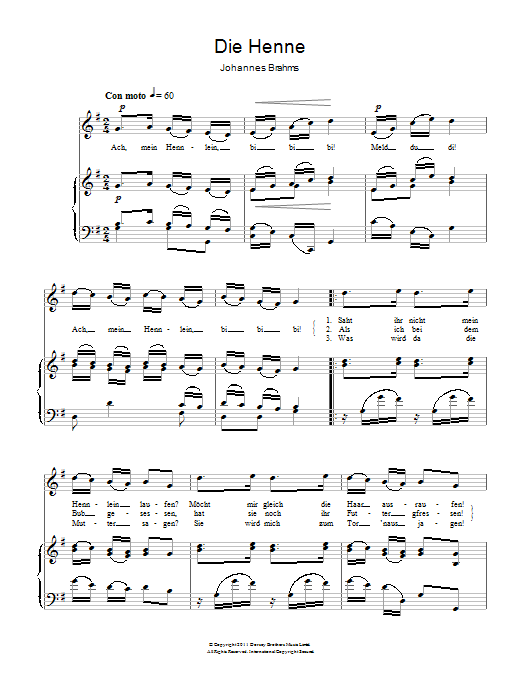
The Hen (Die Henne) Sheet Music Preview

The Hen (Die Henne): Piano Vocal

As performed by Johannes Brahms

Item: 35-DS00202756

Digital Download
$5.99
Description

The Hen (Die Henne): Piano Vocal isn't in MakeMusic Cloud just yet...but it could be. Let us know you'd like to see it, and you'll help shape what comes next. In the meantime, start a free trial and dive into thousands of interactive titles your students can play along with today.

Sample Audio
No sample audio found.
Sample Video
Additional Details
Publisher: Hal Leonard
Page Count: 3
SKU: 35-DS00202756

More about this title

About the Artist: Johannes Brahms

Johannes Brahms (1833–1897) shaped the course of Romantic music by balancing deep respect for classical forms with the expressive possibilities of his era. His three symphonies, concertos, and chamber works remain cornerstones of the standard repertoire, studied by musicians across every performance level.

Brahms also devoted considerable energy to vocal music, including over 200 songs (Lieder) that range from intimate miniatures to substantial narrative works. His gift for melody, harmonic sophistication, and text setting make these pieces essential for singers and pianists seeking repertoire that rewards both technical and interpretive engagement.

Why we love this

This character piece sits at the sweet spot between accessibility and musical substance. The text painting is transparent and charming without condescension, and the accompaniment supports rather than overwhelms the vocal line, making it rewarding for singers still building confidence with Brahms's harmonic language.

What to expect

A moment of gentle observation, slightly wry in spirit. The musical language is warm and grounded, with harmonic inflections that suggest both humor and underlying affection.

Who it's for

Singers preparing art song repertoire will find this a valuable addition to collections of German Lieder, particularly those exploring Brahms beyond his most famous works. It works equally well for students in voice studios, vocal chamber groups, or recital planning.

How to get the most out of it

  • Establish a conversational tone in the melody; Brahms's text setting expects clarity and natural phrasing over dramatic gestures.
  • Balance the piano part so it colors the voice rather than competing for attention. The accompaniment carries harmonic depth that singers should feel supported by, not buried under.
  • Shape phrases by listening to the arc of the text. Brahms rarely marks dynamics extensively, so you'll need to discern where the musical argument calls for emphasis or restraint.

How to use it

Pair this with other 19th-century song cycles or art song sets to build a recital segment that shows stylistic range within the Romantic repertoire. It also serves as a palate cleanser when programmed between weightier works.

Skills your students will build

  • Text painting and interpretation in German Lieder
  • Singing with idiomatic Romantic phrasing and minimal notation
  • Collaborative balance between voice and piano
  • Harmonic listening for understanding accompaniment function

You May Also Like