
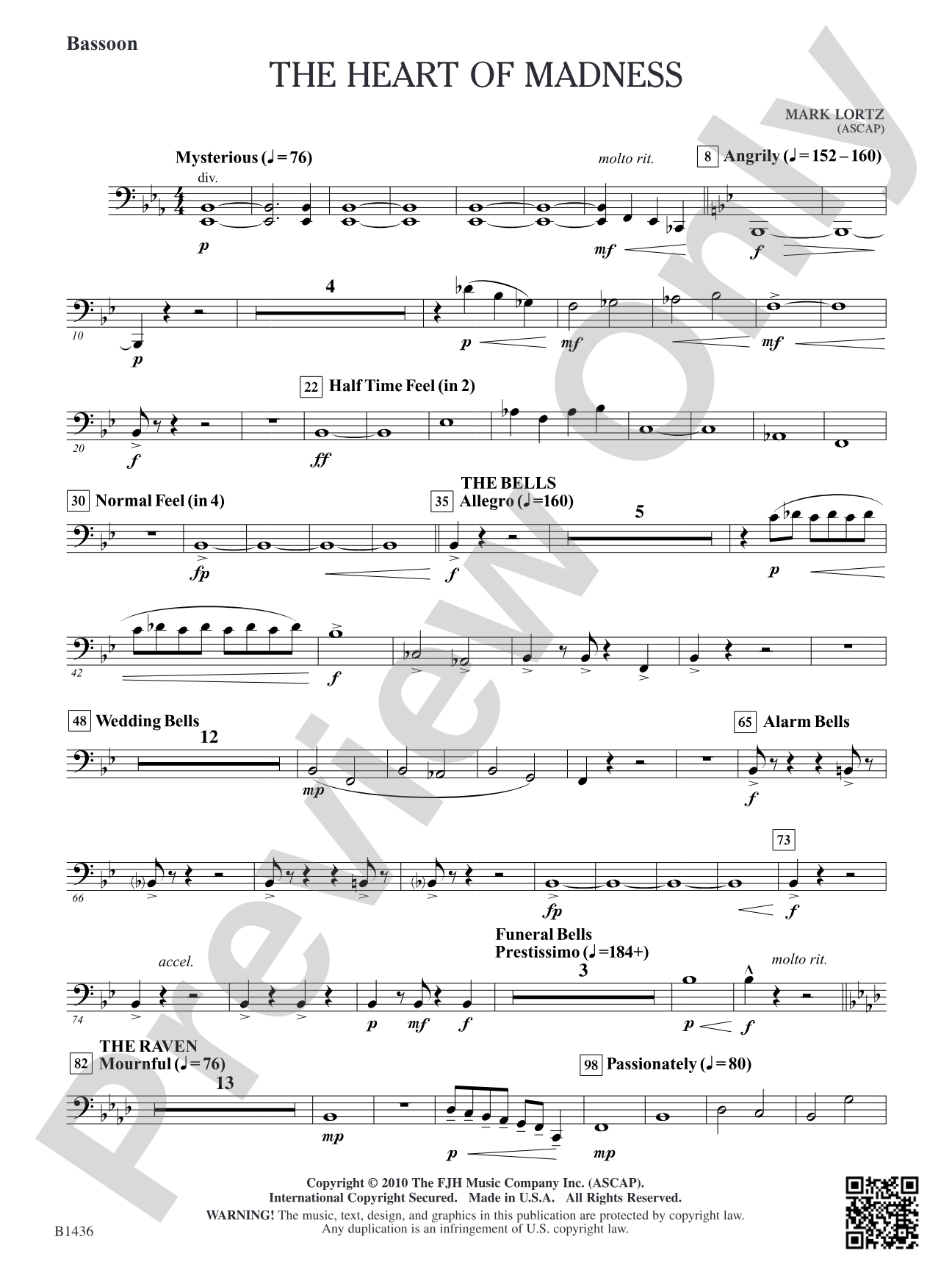

The Heart of Madness: Bassoon
By Mark Lortz
Grade: 3.5
Item: 98-PC-DB1436_B1
$7.00
Pickup currently not available
Description
Celebrate the bicentennial of Edgar Allan Poe’s birth with this spine-chilling work depicting three of Poe’s tales: The Bells, The Raven, and The Tell-Tale Heart. Buyer beware, this piece creates an ominous musical setting that is an adventure in mystery and macabre. An ideal way to have your English and Music departments collaborate, this highly programmatic work is sure to be a tremendous hit with students and audiences!


The Heart of Madness: Bassoon isn't in MakeMusic Cloud just yet...but it could be. Let us know you'd like to see it, and you'll help shape what comes next. In the meantime, start a free trial and dive into thousands of interactive titles your students can play along with today.
Request This Title
Tell us you want it.
Start Your Free Trial
Explore everything that's ready to play right now.
Sample Audio
1
Audio File
--:--
0:00
0:00
Sample Video
No sample videos found.
Additional Details
Series:
FJH Concert Band
Publisher:
The FJH Music Company, Inc.
SKU:
98-PC-DB1436_B1
More about this title
About the Composer: Mark Lortz

Mark Lortz directs the music program at Stevenson University and has established himself as a composer whose works receive performances at prestigious venues including The Midwest Clinic, the Bands of America National Percussion Festival, and the College Band Directors National Association. His compositions have earned ASCAP recognition, critical attention in publications like Gramophone and The Instrumentalist, and selection for curated lists including Bandworld's Top 100 and J.W. Pepper's Editor's Choice.
Beyond composition, Lortz works as a music editor for RWS Music Company and brass arranger for the Reading Buccaneers Drum and Bugle Corps, a multi-world championship ensemble. His conducting and clinical work spans Europe and throughout the United States, and he serves as an adjudicator and lecturer for honor bands, community ensembles, and regional conferences. The Maryland Music Educators' Association recognized him as an Outstanding Educator in 2024. He holds a Ph.D. in Music Education from Temple University and studied percussion performance, composition, and education at the Peabody Institute of Johns Hopkins University.
Why we love this
Lortz writes with theatrical sensibility and structural clarity, creating a piece that respects Grade 3.5 ensemble capabilities while delivering genuine dramatic impact. Programming this work alongside English department materials or during a Poe-themed unit transforms a concert into an educational event; the three-movement arc gives students concrete reasons to study Poe's original texts and students will care deeply about the interpretation because the music makes the stories visceral.
What to expect
The score creates an unsettling emotional landscape where carefully orchestrated instrumental colors evoke the dread and psychological tension of Poe's narratives. Students move through three distinct sonic worlds—the hypnotic repetition of bells, the dark mystery of a raven's presence, and the mounting horror of a heartbeat that cannot be silenced—each movement building its own internal logic and climactic release.
Who it's for
Conductors working with Grade 3.5 concert bands seeking programmatic repertoire that challenges ensemble musicianship without requiring advanced technical chops. This work is particularly valuable for schools where English and music departments can collaborate on a shared thematic program or for directors planning a concert around gothic or literary themes.
How to get the most out of it
- Balance the programmatic content by studying Poe's original texts beforehand; conductors who share key passages with their ensemble will discover that musicians instinctively shape phrases to match the narrative arc.
- Treat the ominous settings as opportunities for dynamic precision rather than heavy-handed effects; Grade 3.5 bands achieve the most convincing atmosphere through clean articulation and intentional silence as much as through volume.
- Use the contest/festival designation as motivation during rehearsal; students recognize that this piece is built for evaluation and will focus their preparation with professional awareness.
- Shape transitions between the three tales distinctly so audiences experience each story as a complete unit before the next one emerges from silence.
How to use it
Program this as a thematic anchor for a concert exploring American literature, partnering with your English department to create integrated program notes or pre-concert discussions. It works equally well as a festival submission that generates conversation among adjudicators and audiences unfamiliar with modern band music that takes its literary sources seriously, or as a mid-year concert feature that holds listener attention through storytelling rather than technical display alone.
Skills your students will build
- Ensemble balance across three contrasting programmatic sections
- Interpretation of musical cues that represent narrative elements and emotional shifts
- Precision in articulation and dynamics to create atmosphere and suspense
- Coordination of thematic material across multiple instrumental families
- Understanding how concert band orchestration can depict concrete imagery and emotional states