

The Headless Horseman: Piano
By Tom Gerou
Level: Late Elementary
Item: 00-PS-0016050
$3.99
Pickup currently not available
Related Items
The Headless Horseman: Piano Sheet |
$3.50
|
View |
Description
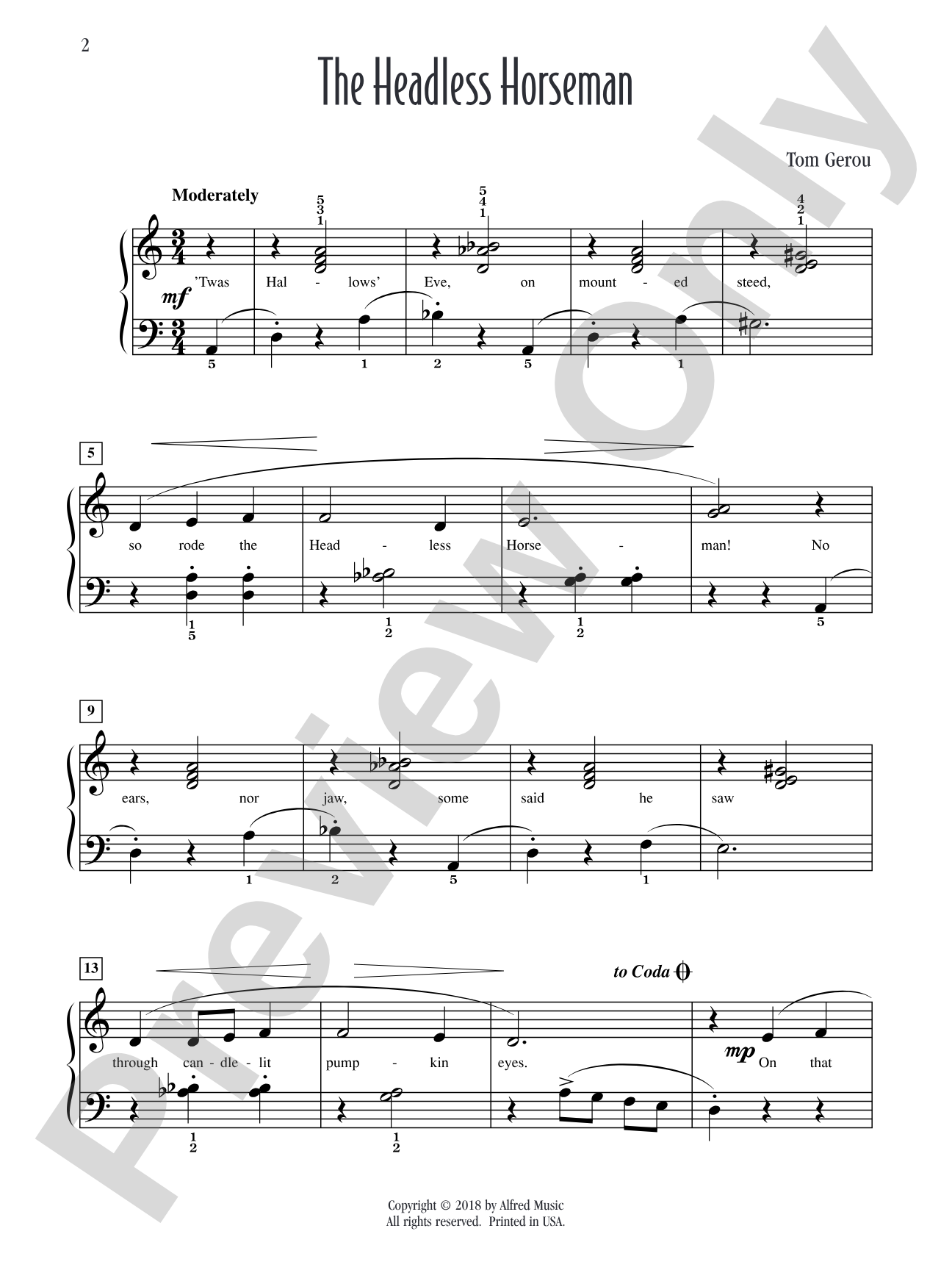
Based on the Sleepy Hollow legend, this lighthearted Halloween solo is in D minor, without the key signature for ease of reading. Clever and appropriate lyrics convey the fun side of the legend. At a moderate tempo, the use of extended-range gestures add color to the clip-clop musical quality, while the melody alternates between the left and right hand. Includes D. C. al Coda.


The Headless Horseman: Piano isn't in MakeMusic Cloud just yet...but it could be. Let us know you'd like to see it, and you'll help shape what comes next. In the meantime, start a free trial and dive into thousands of interactive titles your students can play along with today.
Request This Title
Tell us you want it.
Start Your Free Trial
Explore everything that's ready to play right now.
Sample Audio
No sample audio found.
Sample Video
No sample videos found.
Additional Details
Series:
Signature Series
Publisher:
Alfred Music
Page Count:
4
SKU:
00-PS-0016050
More about this title
About the Composer: Tom Gerou

Tom Gerou has established himself as a prolific voice in music education, with over 160 published works spanning composition, arrangement, and music instruction. His output includes foundational reference texts like the Essential Dictionary of Music Notation and Essential Dictionary of Orchestration, alongside original compositions and arrangements that have become fixtures in piano studios and rehearsal rooms across North America. His piano arrangements appear throughout Alfred's Basic Piano Library collections, and his theatrical works have earned two Los Angeles Drama Critics Circle Awards for best original music.
Educated at the University of Southern California (Bachelor of Music in composition) and Yale University (Master of Music in composition), Gerou has received commissions from the North Dakota Music Teachers Association and the Music Teachers National Association Collaborative Commissioning Project. His accolades include a Morton Gould Young Composer Award, two Rena Greenwald Awards, and a Jimmy McHugh Composition Prize. He has led workshops internationally across the United States, Australia, Canada, China, Indonesia, Malaysia, New Zealand, the Philippines, and Thailand.
Why we love this
Gerou captures the playful spirit of Halloween without resorting to spooky clichés. The decision to write without a key signature makes this piece immediately accessible for late elementary pianists reading in D minor, while the alternating melody between hands adds engaging technical variety that keeps students engaged without overwhelming them. A Halloween recital finally has an option that's genuinely fun rather than just seasonally themed.
What to expect
A playful trot through the Sleepy Hollow legend with a wink and a smile. The clip-clop rhythmic foundation gives the piece a narrative quality, as if the Headless Horseman is galloping across the page, while the alternating melody creates a sense of musical conversation between the two hands. Extended-range gestures paint colorful moments that prevent the piece from settling into predictability.
Who it's for
Late elementary piano students preparing for recital performances, particularly those seeking Halloween-themed repertoire with genuine musical substance. This piece works well for students comfortable with moderate tempos and hand-crossing concepts but still building fluency in reading without key signatures.
How to get the most out of it
- Maintain an even, moderate tempo throughout to let the clip-clop rhythmic quality emerge naturally; rushing undermines the lighthearted character of the piece.
- Pay attention to hand position changes as the melody moves between left and right hands; mark fingerings clearly in rehearsal to ensure smooth transitions.
- Use the extended-range gestures to add expressive shaping rather than dynamic changes; let the wider intervals create their own musical color.
- The D.C. al Coda provides a natural opportunity to refine details on the repeat; use it as a chance to solidify any passages that felt uncertain the first time through.
How to use it
Ideal for a fall recital where you want a Halloween piece that brings levity rather than darkness to the program. It pairs well with more serious repertoire, providing a breathing space that audiences enjoy. Consider programming it mid-recital to shift the mood and keep younger pianists energized during performance.
Skills your students will build
- Reading in minor keys without key signatures
- Hand-crossing technique and managing melody migration between hands
- Maintaining steady tempo in moderately paced material
- Interpreting D.C. al Coda form markings
- Using extended-range gestures and intervals for musical expression