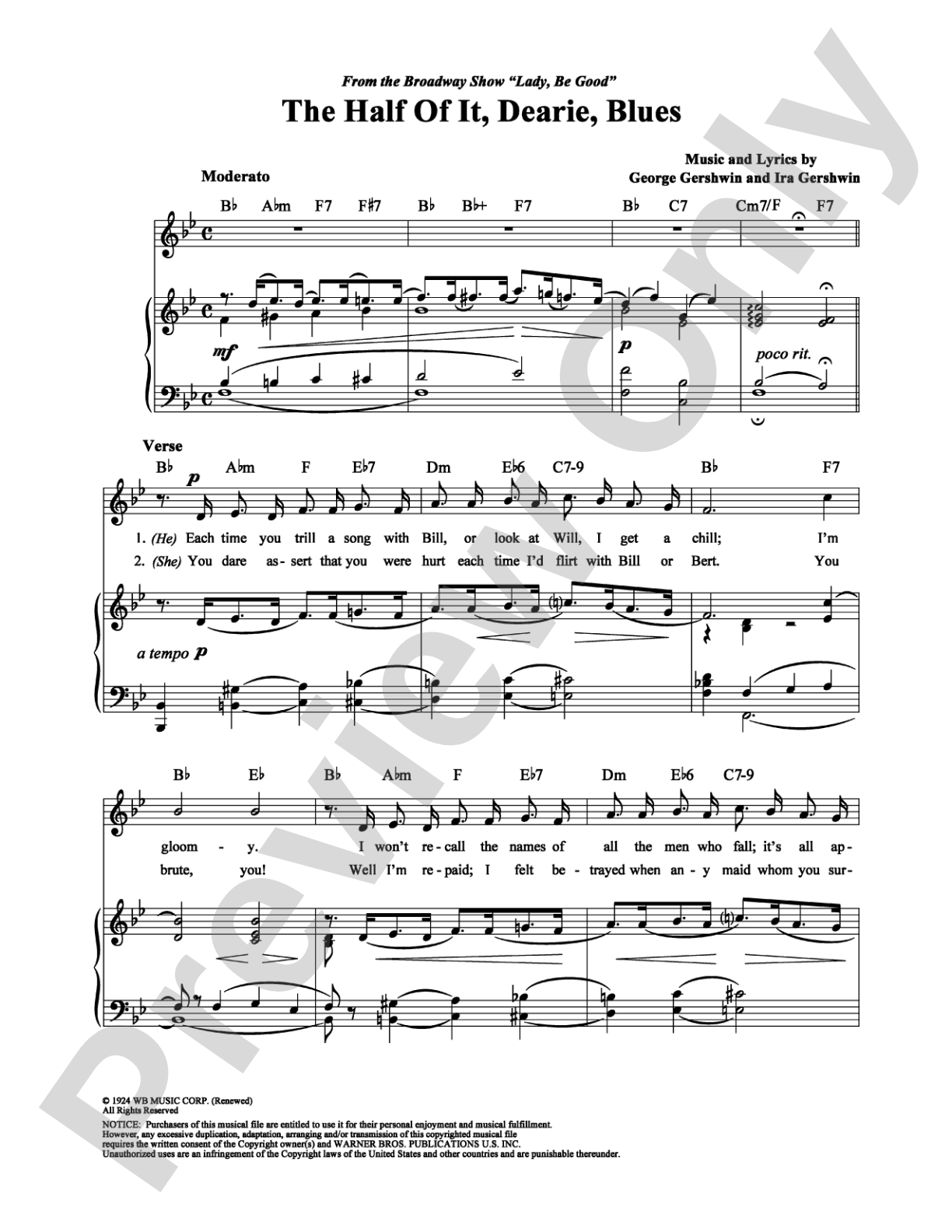
The Half Of It, Dearie, Blues: Piano/Vocal/Chords Digital Sheet Music

The Half Of It, Dearie, Blues: Piano/Vocal/Chords Digital Sheet Music

George Gershwin, Fred Astaire

Item: 00-PS-0005391

Digital Download
$3.99
Description

The Half Of It, Dearie, Blues: Piano/Vocal/Chords Digital Sheet Music isn't in MakeMusic Cloud just yet...but it could be. Let us know you'd like to see it, and you'll help shape what comes next. In the meantime, start a free trial and dive into thousands of interactive titles your students can play along with today.

Sample Audio
No sample audio found.
Sample Video
Additional Details
SKU: 00-PS-0005391

More about this title

About the Artist: Fred Astaire

Fred Astaire (1899-1987) was an American dancer, singer, and actor who defined elegance in musical theatre and film for over seven decades. His influence on American popular song and jazz standards remains profound; his impeccable phrasing, rhythmic precision, and intimate vocal style set the benchmark for interpreting the Great American Songbook. Astaire's recordings and film performances have shaped how musicians approach swing-era standards and continue to inspire vocalists and pianists seeking authenticity in this repertoire.

Why we love this

This standard captures the sophisticated charm that made Astaire a model for vocal interpretation. The piece sits comfortably for singers exploring the jazz standard repertoire while offering pianists a chance to voice chords with the elegance Astaire's style demands. It's an ideal choice for recitals or jazz-focused programs where clarity and understatement matter more than volume.

What to expect

The piece exudes understated charm and wit. There's a conversational quality that invites the listener into an intimate space, neither overly sentimental nor coldly detached. The blues feeling is gentle and sophisticated, suggesting urban cool rather than deep emotional weight.

Who it's for

Vocalists studying jazz standards and the Great American Songbook will find this a rewarding introduction to Astaire's interpretive style. Piano students and accompanists preparing for recitals with singers benefit from the accessible chord notation and the chance to practice supporting a vocal melody with harmonic sensitivity.

How to get the most out of it

  • Study Astaire's original recording to absorb the rhythmic flexibility and legato phrasing that defines this style; the notation alone won't capture his approach to space and breath.
  • Keep the accompaniment conversation-like rather than lush. The piano should support the vocal line, not overshadow it, which means restraint with pedal and careful voicing of the chords.
  • Maintain even control on the eighth-note subdivisions; swing feel here is subtle and relies on relaxation, not exaggeration of triplet rhythms.
  • Shape the melodic line toward the harmonic movements in the changes rather than forcing phrase breaks at bar lines; let the song breathe naturally.

How to use it

Include this in a jazz standards or American songbook recital to showcase your vocalist's clarity and interpretive restraint. It pairs well with other swing-era tunes and works particularly effectively as a contrast to more dramatic or rhythmically complex pieces in the same concert. Consider programming it as an encore or as part of a set exploring the evolution of vocal jazz in the mid-20th century.

Skills your students will build

  • Interpreting jazz phrasing and rhythmic flexibility within a notated melody
  • Voicing seventh chords and extensions with clarity and harmonic awareness
  • Coordinating vocal line and piano accompaniment with rhythmic independence
  • Reading and executing chord symbols in a swing-feel context
  • Shaping lyrical content with understatement and emotional nuance

You May Also Like