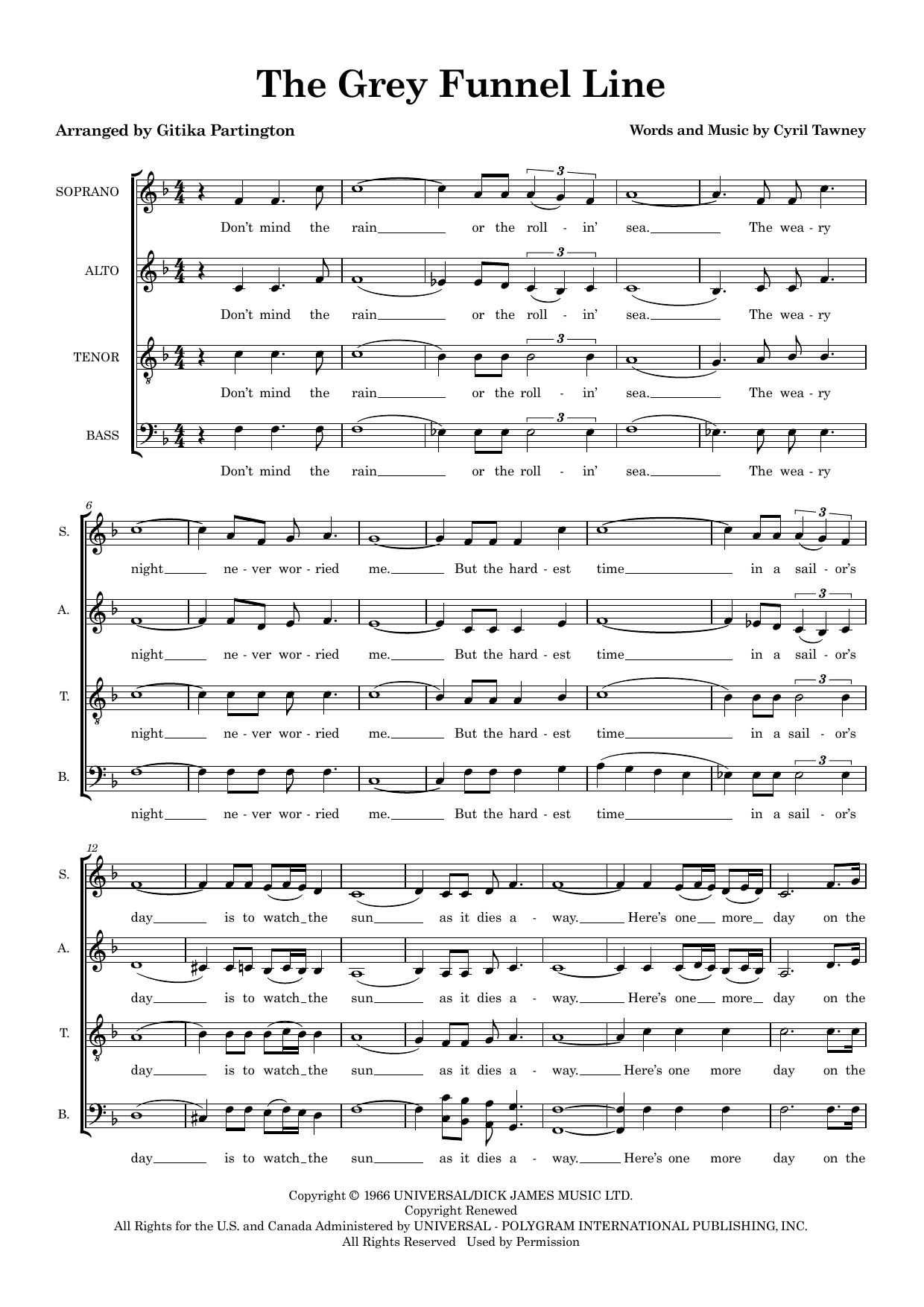
The Grey Funnel Line (arr. Gitika Partington) Sheet Music Preview

The Grey Funnel Line (arr. Gitika Partington): SATB Choral Octavo

By Cyril Tawney / Arranged by Gitika Partington

Item: 35-DS01732729

Digital Download
$1.99
Description

The Grey Funnel Line (arr. Gitika Partington): SATB Choral Octavo isn't in MakeMusic Cloud just yet...but it could be. Let us know you'd like to see it, and you'll help shape what comes next. In the meantime, start a free trial and dive into thousands of interactive titles your students can play along with today.

Sample Audio
No sample audio found.
Sample Video
Additional Details
Publisher: Hal Leonard
Page Count: 3
SKU: 35-DS01732729

More about this title

About the Composer: Cyril Tawney

Cyril Tawney (1923–1979) was a Cornish folk singer and songwriter who drew deeply from maritime traditions and working-class experience. His compositions blend the storytelling clarity of folk music with thoughtful harmonic writing, often capturing the lives of sailors, fishermen, and ordinary people with dignity and specificity.

Tawney's work remains central to British folk revival repertoire, valued by educators for its accessibility, emotional authenticity, and strong narrative content. His songs translate effectively to choral arrangements because they're built on memorable melodies and meaningful texts.

Why we love this

Gitika Partington's arrangement captures the seafaring melancholy of this naval song while opening it up for four-part singing without sacrificing its stark, haunting quality. The three-page format is ideal for singers who want to engage with folk material that tells a real story, not just pass through another unison melody.

What to expect

The piece has the quiet weight of a sea shanty stripped of its roughness. There's melancholy here without sentimentality, a sense of watching something slip away. The arrangement honors the folk melody while giving the harmonies room to breathe.

Who it's for

Choirs seeking repertoire that combines literary substance with accessible four-part writing. This works equally well in community choirs, secondary school ensembles, and collegiate groups that value folk traditions and meaningful texts.

How to get the most out of it

  • Shape the narrative arc carefully. This song documents a sailor's experience with quiet intensity; resist the urge to push volume or tempo. Let the story unfold.
  • Balance transparency in the voice parts so the text remains intelligible. Folk arrangements thrive when listeners can follow what's being sung.
  • Establish a stable harmonic foundation in the lower voices early in rehearsal. Once the bass and tenor lines sit securely, the soprano and alto lines will lock in naturally.
  • Consider how dynamics serve the lyrical content. Subtle changes in volume often communicate more effectively than dramatic swells in material this intimate.

How to use it

Pair this with other maritime or labor-focused repertoire for a thematic concert, or use it as a mood-setting moment in a mixed program where its emotional restraint contrasts with livelier material. It also serves well as a season closer that sends audiences home with something to think about.

Skills your students will build

  • Singing narrative-driven text with emotional clarity
  • Balancing individual voice parts while maintaining transparent diction
  • Phrasing and shaping in music without strong metric or dynamic landmarks
  • Understanding folk music aesthetics and arranging conventions

You May Also Like