The Grey Funnel Line (arr. Ben See) Sheet Music Preview

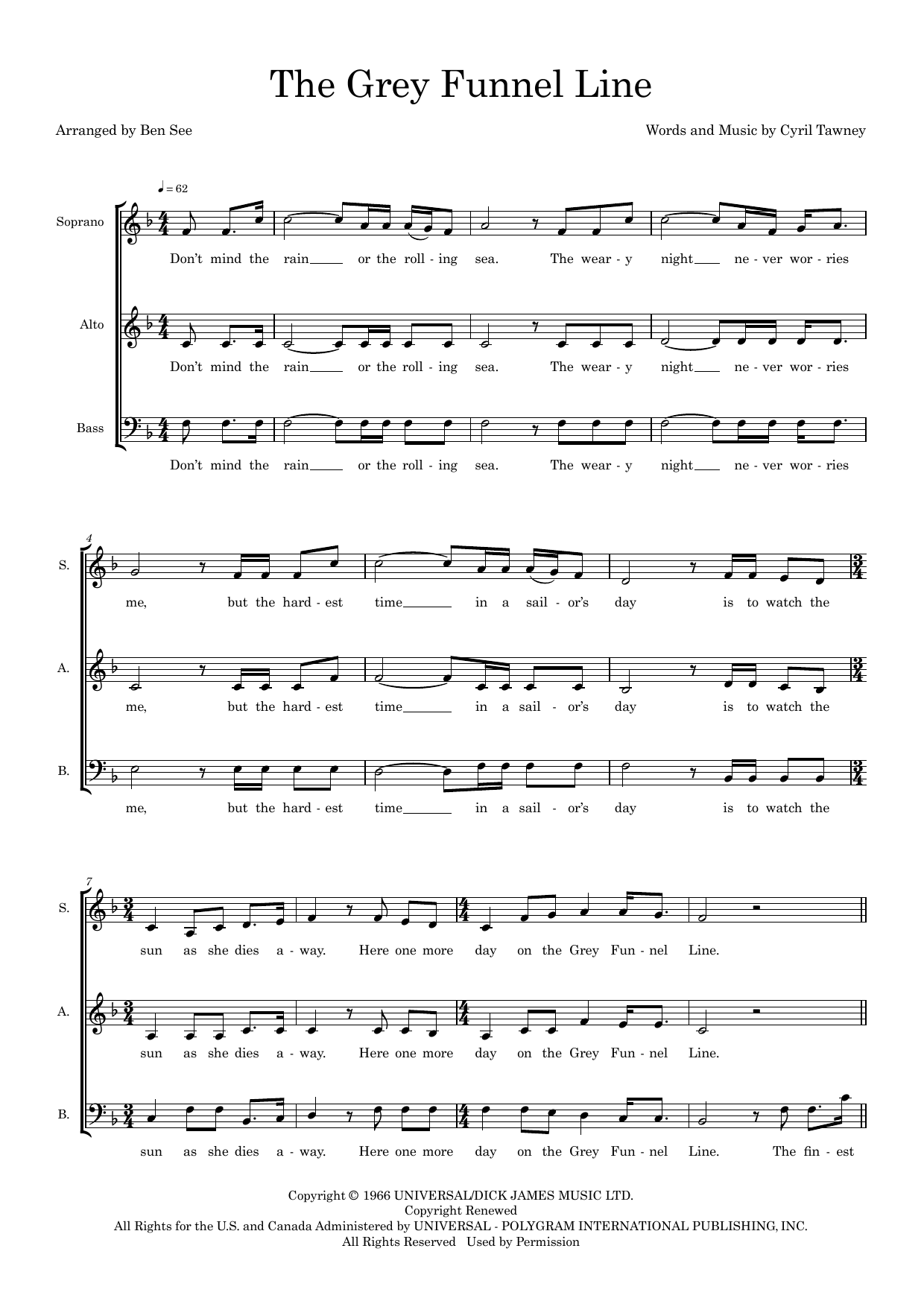
The Grey Funnel Line (arr. Ben See): SATB Choral Octavo

As performed by Cyril Tawney / Arranged by Ben See

Item: 35-DS01644902

Digital Download
$1.99
Description

The Grey Funnel Line (arr. Ben See): SATB Choral Octavo isn't in MakeMusic Cloud just yet...but it could be. Let us know you'd like to see it, and you'll help shape what comes next. In the meantime, start a free trial and dive into thousands of interactive titles your students can play along with today.

Sample Audio
No sample audio found.
Sample Video
Additional Details
Publisher: Hal Leonard
Page Count: 4
SKU: 35-DS01644902

More about this title

About the Artist: Cyril Tawney

Cyril Tawney (1923–1979) was a Cornish singer, songwriter, and folk activist whose work drew deeply from maritime traditions and working-class experience. His songs captured the lives of fishermen, sailors, and industrial workers with unflinching honesty and emotional depth, making him a pivotal figure in the English folk revival.

Tawney's legacy rests on his ability to transform personal observation into universal human truths. His melodies linger; his lyrics cut straight to the heart. For music educators, his catalog offers rare opportunities to engage students with authentic narrative songwriting rooted in social conscience.

Why we love this

Ben See's arrangement honors the stark power of Tawney's original while giving it choral dimension. The four-part writing remains transparent enough for developing ensembles to navigate, yet the stacked voices create the weight this maritime ballad deserves. You get a folk song with real substance, not a cutesy novelty arrangement.

What to expect

Austere and quietly powerful. The Grey Funnel Line carries the salt spray and discipline of naval life, with a melody that sticks in your ear long after rehearsal ends. There is melancholy here, but also dignity and acceptance, the kind of emotional honesty that folk songs do better than almost any other form.

Who it's for

Choirs seeking repertoire with narrative substance and folk authenticity. This works for high school ensembles onward, particularly those interested in exploring non-classical traditions or programming thematic concerts around work, place, or social history.

How to get the most out of it

  • Shape the text with conversational phrasing rather than lyrical legit. This is a sailor's story, not an art song; the narrative drive matters more than sustained tone.
  • Balance the parts so the top line carries the melody without drowning out the harmonic movement underneath. The arrangement likely depends on inner-voice independence.
  • Approach dynamics as storytelling tool. Build through verses to let the drama accumulate naturally rather than staying at one dynamic level.
  • Ground the rhythm section (bass, if accompanied) so the song feels anchored and grounded, matching the weight of the subject matter.

How to use it

Pair this with other narrative folk arrangements or sea shanties for a thematic concert exploring maritime culture and working lives. It also works as a powerful standalone closer if you want to end a program with something contemplative and human-scaled.

Skills your students will build

  • Singing folk melody with period-appropriate phrasing and diction
  • Balancing four-part texture when voices carry equal narrative weight
  • Interpreting lyrics as primary musical material, not secondary decoration
  • Reading and sustaining independent lines in SATB voicing

You May Also Like