
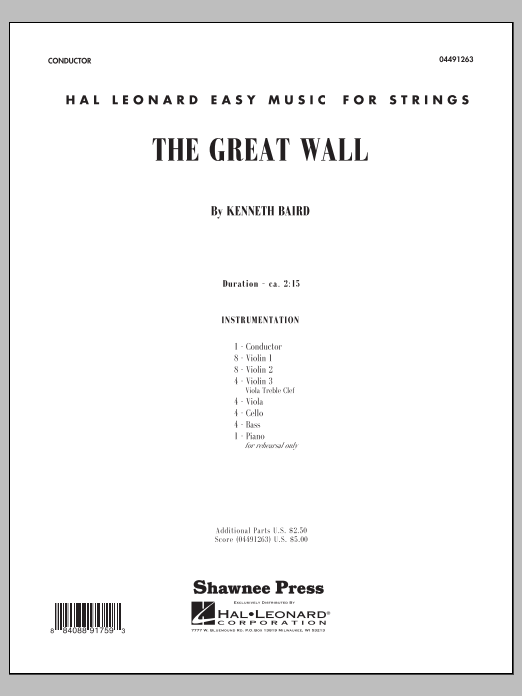

The Great Wall: String Orchestra Conductor Score & Parts
By Kenneth Baird
Grade: 2-3
Item: 35-PK00277866
$40.00
Pickup currently not available
Buy Extra Parts (Digital PDF Download)
| Product | Price | Quantity |
|---|---|---|
| The Great Wall - Conductor Score (Full Score) | $6.00 | |
| The Great Wall - Violin 1 | $7.00 | |
| The Great Wall - Violin 2 | $7.00 | |
| The Great Wall - Violin 3 (Viola Treble Clef) | $7.00 | |
| The Great Wall - Viola | $7.00 | |
| The Great Wall - Cello | $7.00 | |
| The Great Wall - Bass | $7.00 | |
| The Great Wall - Piano | $7.00 |
Parts Added to Cart!
Description
Strong modal melodies and harmonies, clear tempo changes, and melodic sections for all players, "The Great Wall" is teaching and program material at its best for developing groups. Your students will love its bold, dramatic sonorities that makes them sound strong and confident. Dur: 2:15


The Great Wall: String Orchestra Conductor Score & Parts isn't in MakeMusic Cloud just yet...but it could be. Let us know you'd like to see it, and you'll help shape what comes next. In the meantime, start a free trial and dive into thousands of interactive titles your students can play along with today.
Request This Title
Tell us you want it.
Start Your Free Trial
Explore everything that's ready to play right now.
Sample Audio
No sample audio found.
Sample Video
No sample videos found.
Additional Details
Publisher:
Hal Leonard
SKU:
35-PK00277866
More about this title
Why we love this
Kenneth Baird has crafted an orchestration that gives every section real melodic responsibility. The modal language and strategic tempo shifts prevent the piece from feeling static, while the bold sonorities let developing players experience what it sounds like when their collective sound carries genuine weight. This is the kind of work that reminds students why they chose strings in the first place.
What to expect
Powerful and grounded. The modal writing creates a timeless quality while the clear melodic sections give the piece forward momentum and drama. Two minutes and fifteen seconds of music that sits firmly in the players' wheelhouse yet sounds assured.
Who it's for
Intermediate string orchestras in grades 2 through 3 who are ready for more sophisticated harmonic language but still developing rhythmic independence. Directors seeking concert or festival repertoire that builds confidence without requiring soloistic technique.
How to get the most out of it
- Lean into the modal character by encouraging players to sing through phrase shapes rather than race to the next bar line. The harmonic language rewards sustained, intentional tone production.
- Mark the tempo changes clearly in rehearsal and conduct them decisively. Baird uses shift of pace as a structural tool, so ensemble confidence at transition points makes the architecture audible.
- Balance the melodic sections across all parts. Since multiple voices carry thematic material, take time in sectionals to ensure violas and cellos understand their melodies are as important as the violins' lines.
- Record a rehearsal run-through and listen back as a full group. Hearing the composite sonority helps students understand where clarity is needed and where blend deepens the effect.
How to use it
Use this as an opener or closer for a concert where you want to establish ensemble strength early. It pairs well with lighter baroque or contemporary works since the modal sonority and dramatic pacing will anchor a program. The moderate duration also makes it an excellent festival selection that doesn't exhaust younger ensembles.
Skills your students will build
- Sustaining tone quality across phrase lengths in modal harmonic contexts
- Responding to clear tempo changes and conducting gestures
- Executing melodic passages with even intonation across all string parts
- Balancing ensemble sound when multiple sections carry thematic material simultaneously