
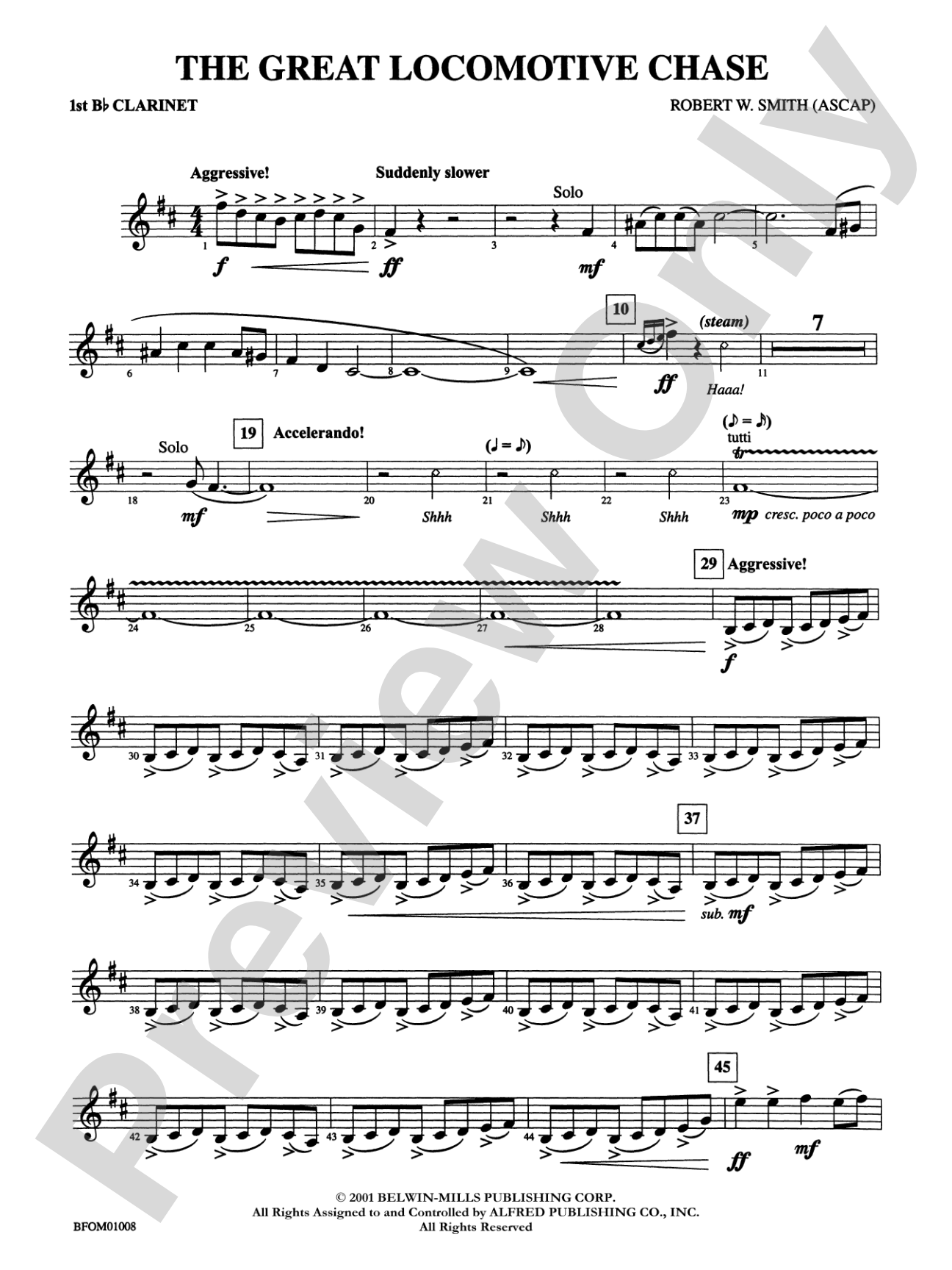

The Great Locomotive Chase: 1st B-flat Clarinet
By Robert W. Smith
Grade: 3.5
Item: 00-PC-0002227_C1
$3.00
Pickup currently not available
Description
Inspired by the events surrounding the railway between Atlanta and Chattanooga during the early years of the Civil War, Robert W. Smith stages the train chase complete with fascinating textures and effects. Listeners become engulfed in the vivid sounds. You can almost smell the smoke. This is an exciting original concert opener or closer. All aboard!


Don't just read it, hear it, play along with it, and watch your students grow with it. In MakeMusic Cloud, The Great Locomotive Chase: 1st B-flat Clarinet comes alive with professional accompaniment, adjustable tempo, and built-in practice tools that turn solo practice into real progress.
Open in the Player
Jump straight in and assign it today.
Start Your Free Trial
Open this title and explore the full library in minutes.
Sample Audio
1
Audio File
--:--
0:00
0:00
Sample Video
No sample videos found.
Additional Details
Series:
Belwin Concert Full Orchestra
Publisher:
Alfred Music
Page Count:
322
SKU:
00-PC-0002227_C1
More about this title
About the Composer: Robert W. Smith

Robert W. Smith stands among America's most performed composers of orchestral and concert band music, with over 400 published works to his name. His training in music education at Troy State University and advanced study at the University of Miami shaped a compositional voice rooted in accessibility and theatrical storytelling. His symphonic works—including The Divine Comedy and The Odyssey—have resonated with musicians and audiences across North America, Europe, Australia, and Asia, establishing him as a standard-bearer in the repertoire.
Beyond the concert hall, Smith's music has appeared in contexts ranging from Olympic ceremonies to major television broadcasts, the Macy's Thanksgiving Day Parade, and Opening Day at Dodger Stadium. His work as a conductor and clinician has taken him throughout the United States, Canada, Japan, Australia, and Western Europe, where he continues to champion new orchestral and band literature.
Why we love this
Smith captures the visceral energy of a historical moment without sacrificing musical sophistication. The programmatic approach here gives your orchestra a concrete dramatic arc to perform, making the technical demands feel purposeful rather than arbitrary. This is the kind of opener that silences a gymnasium the moment the first locomotive sounds emerge.
What to expect
The music rushes forward with rhythmic drive and layered textures that conjure the chaos and momentum of the chase itself. You can feel the steam, the grinding of wheels, the urgency of the narrative unfolding. It's cinematic without being thin; there's real orchestral substance beneath the programmatic effects.
Who it's for
High school and college orchestras looking for a programmatic showpiece with genuine historical narrative and technical substance. Community orchestras and youth orchestras at the Grade 3.5 level will find both the challenge and the musical payoff here. This works equally well as a season opener that commands attention or a finale that sends the audience home energized.
How to get the most out of it
- Balance the percussion effects carefully in rehearsal; those train sounds should enhance rather than overwhelm the melodic writing underneath. Record a rehearsal run to hear the full texture from the audience perspective.
- Establish a steady, driving pulse in the opening. The chase only lands emotionally if your tempo stays committed and the ensemble locks the rhythmic momentum.
- Shape the climactic passages with dynamic clarity. Smith has written peaks and valleys throughout; resisting the urge to play everything forte makes the actual fortissimos land harder.
- Coordinate the conductor score with all section leaders before the first full rehearsal. The parts contain cues and effects that need to be watched and answered precisely.
How to use it
Open your fall concert with this piece to establish excitement and engagement from the first moments. It also works powerfully as a closer, leaving the audience energized and talking. If you're programming around Civil War history or transportation themes, this becomes an anchor point that other repertoire can build from or reflect on.
Skills your students will build
- Maintaining rhythmic precision across large ensemble textures
- Responding to programmatic cues and dramatic shape in orchestral writing
- Balancing percussion effects with melodic content
- Reading conductor cues and ensemble coordination in complex scoring
- Sustaining focused ensemble energy through extended, forward-moving passages