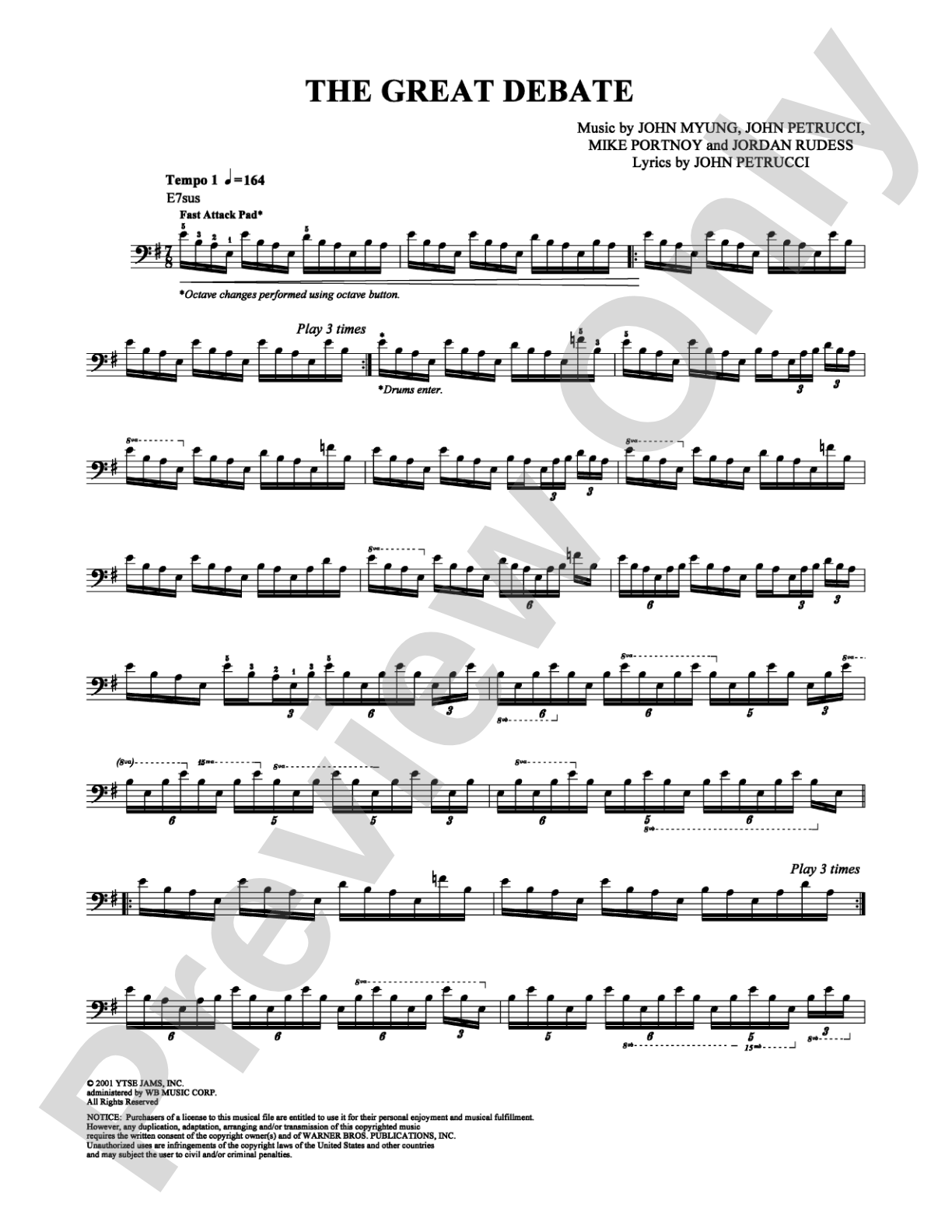
The Great Debate: Piano/Vocal/Chords Digital Sheet Music

The Great Debate: Piano/Vocal/Chords Digital Sheet Music

John Petrucci, Dream Theater, Mike Portnoy, John Myung, Jordan Rudess

Item: 00-PS-0003400

Digital Download
$3.99
Description

The Great Debate: Piano/Vocal/Chords Digital Sheet Music isn't in MakeMusic Cloud just yet...but it could be. Let us know you'd like to see it, and you'll help shape what comes next. In the meantime, start a free trial and dive into thousands of interactive titles your students can play along with today.

Sample Audio
No sample audio found.
Sample Video
Additional Details
SKU: 00-PS-0003400

More about this title

About the Artist: Dream Theater

Dream Theater emerged in the late 1980s as one of progressive rock's defining bands, known for their technical virtuosity, complex song structures, and theatrical arrangements. Their work spans three decades of studio albums and live performances that challenge both musicians and listeners to engage with music on a deeper intellectual and emotional level.

Why we love this

Dream Theater's compositions demand serious musicianship from anyone brave enough to tackle them. This piano/vocal arrangement opens the door for students and teachers to explore progressive rock composition without needing a full band, making it possible to study their harmonic complexity and lyrical sophistication in more intimate settings.

What to expect

The piece carries the intellectual ambition and emotional weight characteristic of Dream Theater's catalog. Expect moments of dramatic intensity, intricate harmonic movement, and a sense that every melodic phrase has been carefully considered within a larger architectural vision.

Who it's for

This arrangement serves singers and pianists who want to perform substantial progressive rock repertoire, as well as music theory students exploring how complex harmonic and rhythmic ideas function in a contemporary context. It works equally well for a vocalist with piano accompaniment in a recital or for a musician studying modern composition techniques.

How to get the most out of it

  • Study the chord chart alongside the melody line; Dream Theater's harmonic language moves quickly and non-functionally at times, so understanding the underlying changes will steady your interpretation.
  • Pay attention to the vocal phrasing marked in the score; their melodies often sit against the piano in unexpected ways that require careful listening to nail the rhythmic relationship.
  • Let the piano part breathe where it's written; there's often compositional intent in the rests and sparse moments that grounds the more elaborate passages.

How to use it

Include this in a recital or concert exploring modern songwriting and progressive rock composition, particularly in settings where you want to demonstrate that rock music can sustain the same analytical rigor and performance depth as classical repertoire. It also makes an effective bridge between traditional and contemporary music for audiences or students encountering progressive rock seriously for the first time.

Skills your students will build

  • Reading complex piano voicings and jazz-influenced chord extensions
  • Singing against piano accompaniment in non-traditional harmonic contexts
  • Interpreting rhythm and phrasing in progressive rock idiom
  • Understanding functional versus non-functional harmony in modern composition

You May Also Like