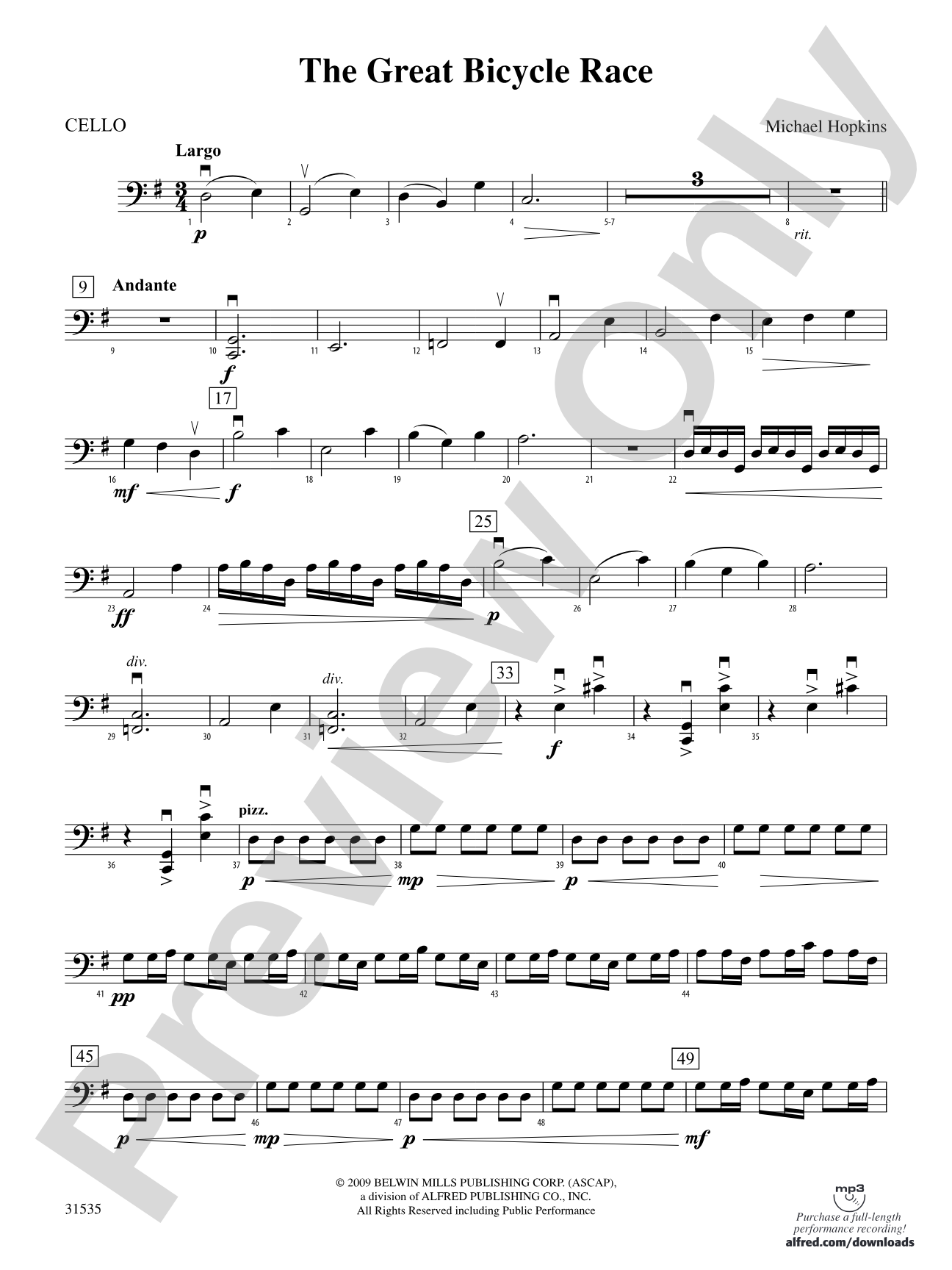
The Great Bicycle Race: Cello
By Michael Hopkins
Grade: 3
Item: 00-PC-0001725_VC1
Pickup currently not available
Description
Don't just read it, hear it, play along with it, and watch your students grow with it. In MakeMusic Cloud, The Great Bicycle Race: Cello comes alive with professional accompaniment, adjustable tempo, and built-in practice tools that turn solo practice into real progress.
Jump straight in and assign it today.
Open this title and explore the full library in minutes.
Sample Audio
Sample Video
Additional Details
More about this title
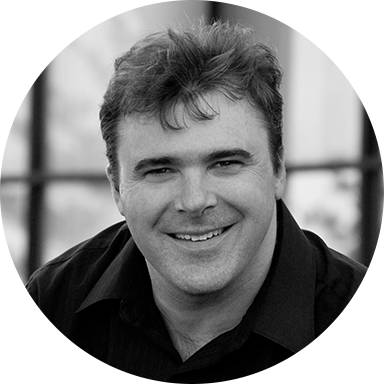
About the Composer: Michael Hopkins

Michael Hopkins leads the music education program at the University of Michigan, where he teaches string techniques, orchestra methods, and music psychology. His career spans decades of conducting, from high school orchestras across Colorado, Michigan, and Vermont to founding and directing the Burlington Chamber Orchestra. He has guest-conducted at over 100 festivals and clinics nationwide.
Hopkins has composed and arranged more than 70 published orchestral works while maintaining an active scholarly presence in music education research. His writing appears regularly in peer-reviewed journals including the Journal of Research in Music Education and American String Teacher. He authored The Art of String Teaching, a foundational resource for string educators at all levels, published by GIA Publications.
Why we love this
This score teaches core string technique through genuine musical storytelling rather than isolated exercises. The programmatic frame of a 100-mile coastal bike race gives students clear imagery to shape their phrasing and dynamics, while the writing systematically builds mastery of crossings, double stops, and bow control without feeling pedagogical. Every part gets melodic material, so no section sits in the background while others do the real work.
What to expect
The energy builds like pedaling into headwind, with rhythmic momentum that pulls the group forward. Descriptive moments (quiet stretches along the coast, the exertion of climbs, the release of descents) create vivid emotional shape, making the experience feel less like a technical study and more like watching real cyclists navigate real terrain.
Who it's for
String orchestras at the middle school through early high school level who are ready for second-position work and multi-part textures but still building foundational technique. Directors seeking a concert or festival piece that holds engagement through story rather than complexity will find this especially useful with younger ensembles.
How to get the most out of it
- Assign bar numbers to each course segment (start, climb, descent, finish) and rehearse them separately so students can internalize the imagery before combining sections. Return to the descriptive language frequently during rehearsals.
- Mark dynamic contrasts in pencil during the first read-through and exaggerate them more than feels natural at first. The piece gains energy from the architecture of these shifts, not subtlety.
- Use the divisi passages as balance-building opportunities. Ask students in divisi sections to listen for blend with the other part, then switch who sits where mid-rehearsal so both groups hear the full sound.
- Slow the tempo during sectional work on bow placement and lifts, even if that feels disconnected from the piece's overall character. Once students own the technique, the full tempo will snap into place with clarity.
How to use it
This works well as a concert centerpiece for a spring or fall program, pairing naturally with either a classical overture or a lighter contemporary work to balance its narrative weight. It also performs effectively in festival settings where adjudicators value pedagogical writing that builds technique without sacrificing musicality.
Skills your students will build
- String crossings in various bow speeds and dynamic levels
- Legato and staccato bowing with clear articulation
- Bow placement and contact point awareness
- Lifts and retakes that connect phrases without interruption
- Double stops with secure intonation
- Divisi writing and independent part playing
- Balance and blend in multi-part textures
- Dynamic contrast and shaping within and across sections
- First-position fluency across all string types