
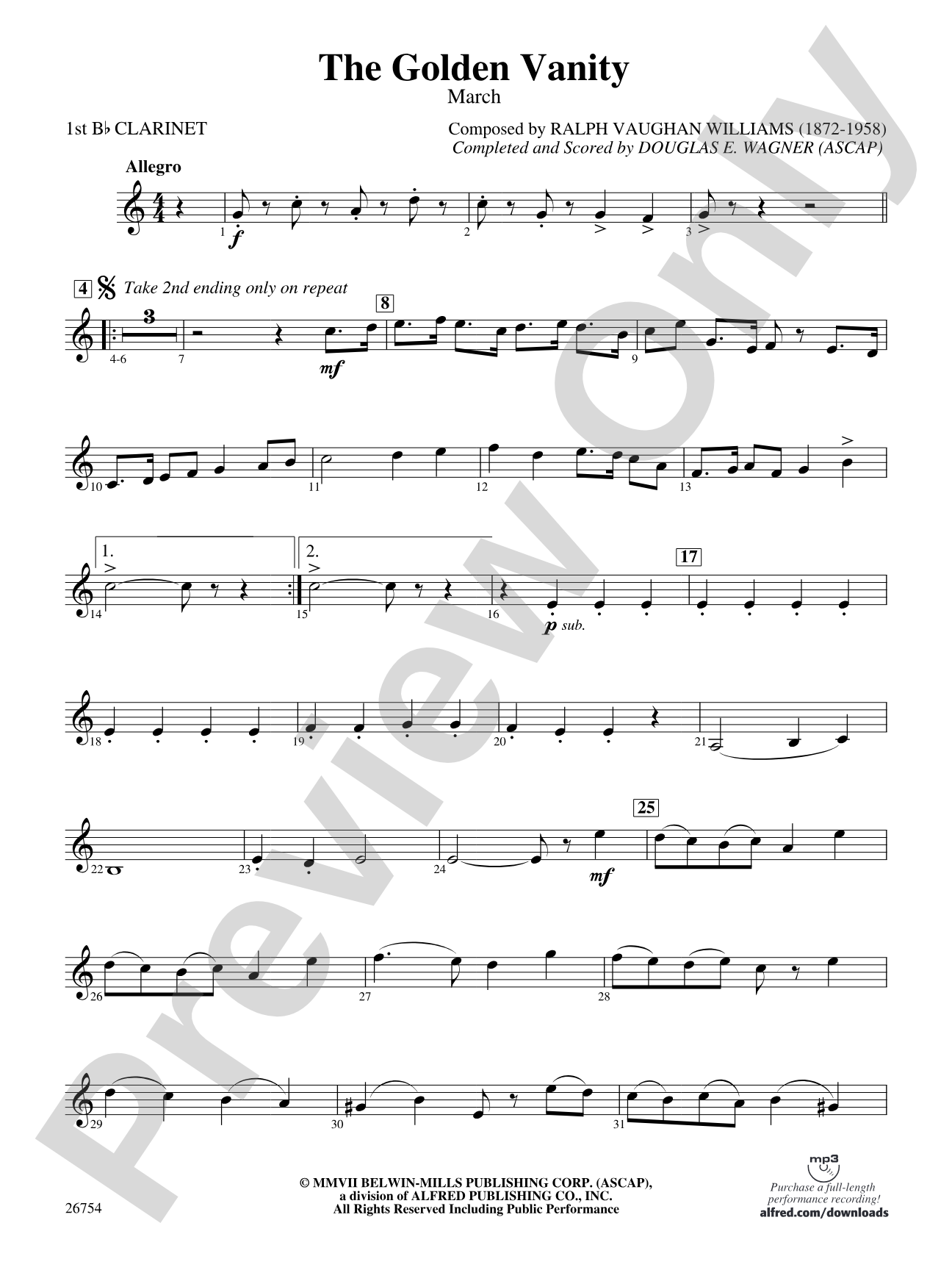

The Golden Vanity: 1st B-flat Clarinet
Composed by Ralph Vaughan Williams / arr. Douglas E. Wagner
Grade: 3 (Medium Easy)
Item: 00-PC-0001215_C1
$3.00
Pickup currently not available
Description
The Golden Vanity by Ralph Vaughan Williams is a military march that remained unfinished at his death. With the permission of his heirs and assistance from RVW Ltd., Douglas E. Wagner has completed it in a manner consistent with Vaughan Williams' characteristic style. A stately new march! This title is available in MakeMusic Cloud.


Don't just read it, hear it, play along with it, and watch your students grow with it. In MakeMusic Cloud, The Golden Vanity: 1st B-flat Clarinet comes alive with professional accompaniment, adjustable tempo, and built-in practice tools that turn solo practice into real progress.
Open in the Player
Jump straight in and assign it today.
Start Your Free Trial
Open this title and explore the full library in minutes.
Sample Audio
1
Audio File
--:--
0:00
0:00
Sample Video
No sample videos found.
Additional Details
Series:
Belwin Concert Band
Publisher:
Alfred Music
Page Count:
90
SKU:
00-PC-0001215_C1
More about this title
About the Composer: Ralph Vaughan Williams
Ralph Vaughan Williams (1872-1958) shaped the sound of 20th-century British music by mining folk traditions and modal harmony while maintaining a distinctly modern voice. His works span symphonies, concertos, operas, and choral masterpieces, yet he remained deeply committed to music education and community music-making throughout his life.
Vaughan Williams composed across every genre with equal seriousness. His gift for memorable melody combined with subtle harmonic invention made his music accessible without sacrificing depth. Band and orchestral arrangements of his work remain central to concert repertoires worldwide because they capture both ceremonial grandeur and genuine lyricism.
Why we love this
This march arrives fully realized through Douglas E. Wagner's thoughtful completion, honoring Vaughan Williams' unmistakable voice while bringing a concert work to life that audiences and musicians deserve to hear. At Grade 3, it's genuinely accessible without diluting the harmonic and orchestrational richness that defines Vaughan Williams' style. The stately character and clean orchestration make it an ideal closer for a concert program or a standout choice for festival competition.
What to expect
The Golden Vanity carries the ceremonial weight of a formal processional, with the warmth and harmonic color that only Vaughan Williams could bring to a military march. Dignified without heaviness, it unfolds with the natural eloquence of folk melody restated through a modern harmonic lens. The completion honors the composer's signature blend of accessibility and sophistication.
Who it's for
Concert band directors programming repertoire at the Grade 3 level who want substance without excessive technical demands. Musicians preparing for festival or contest settings will find a work that's both musically rewarding and achievable.
How to get the most out of it
- Shape the melodic contours with clarity. Vaughan Williams' themes unfold across phrase lengths that reward patient, singing conducting; avoid rushing through structural points that define the march's architecture.
- Balance the inner voices carefully. The completion respects Vaughan Williams' orchestrational style, which often places thematic weight in unexpected places. Listen through full rehearsals to ensure harmonic color comes through without the melody drowning.
- Invest in the march's ceremonial quality without rigidity. This is stately music, but stateliness needs breathing room. Let the ensemble find natural pacing rather than metronomic precision.
- Use the exposed moments to build ensemble confidence. Several passages sit in transparent registers where precision and intonation matter deeply. These moments of vulnerability in the score often become the most memorable in performance.
How to use it
Program this as a concert finisher where you want to leave the audience with stately elegance rather than virtuosic flash. It pairs well with other British concert band classics or alongside contemporary American marches, offering a bridge between tradition and modern concert band writing. The Grade 3 accessibility makes it valuable for building ensemble pride in a mid-season or festival program.
Skills your students will build
- Balancing exposed melodic lines with supporting harmonic voices
- Reading and maintaining ceremonial pacing across longer phrase structures
- Executing precise articulation in modal harmonic contexts
- Responding to nuanced dynamic shaping within a march framework