
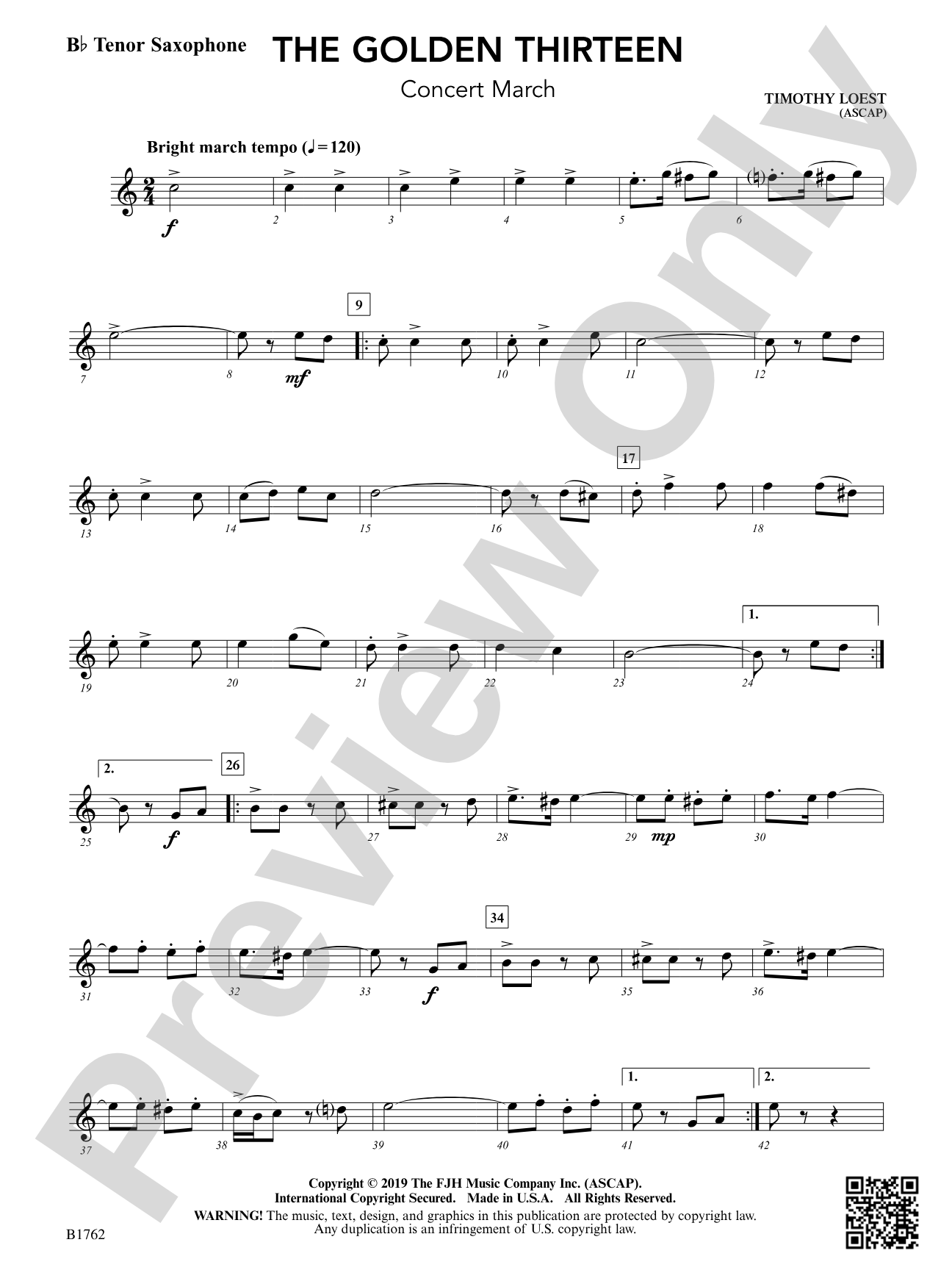

The Golden Thirteen: B-flat Tenor Saxophone
By Timothy Loest
Grade: 2
Item: 98-PC-DB1762_TX1
$7.00
Pickup currently not available
Description
This spirited march commemorates the U.S. Navy’s first African-American officers, known as the Golden Thirteen. While traditional in form, the work cleverly incorporates fragments of Anchors Aweigh while the trio section is based on the spiritual Nobody Knows the Trouble I’ve Seen. A perfect concert or contest march that is equally appropriate for Veterans Day or Black History Month.


The Golden Thirteen: B-flat Tenor Saxophone isn't in MakeMusic Cloud just yet...but it could be. Let us know you'd like to see it, and you'll help shape what comes next. In the meantime, start a free trial and dive into thousands of interactive titles your students can play along with today.
Request This Title
Tell us you want it.
Start Your Free Trial
Explore everything that's ready to play right now.
Sample Audio
1
Audio File
--:--
0:00
0:00
Sample Video
Additional Details
Series:
FJH Young Band
Publisher:
The FJH Music Company, Inc.
SKU:
98-PC-DB1762_TX1
More about this title
About the Composer: Timothy Loest

Timothy Loest brings three decades of classroom experience to his compositions and arrangements, having spent his entire teaching career at F.E. Peacock Middle School in Illinois. His works are performed by young bands worldwide, and his impact extends beyond the concert hall: he received the Illinois Grade School Music Association's Cloyd Myers Memorial Award for Excellence in Music Education in 2017, and his composition Cloud Gate was heard by over 5,000 spectators at Chicago's Millennium Park that same year.
Loest has published with major educational publishers including C.L. Barnhouse, FJH Music Company, and MakeMusic Publications since 1995. He co-authored several widely used band methods, including Measures of Success and the popular Warm-ups and Beyond and Chorales and Beyond series. His original music has also appeared on network television, from The Tonight Show Starring Jimmy Fallon to Good Morning America. In 2022, he founded Fanfare Music Press to focus on high-quality band compositions and arrangements. He holds degrees from Illinois State University and Northwestern University, maintains ASCAP membership, and regularly accepts commissions for band.
Why we love this
Loest captures the dignity and resilience of the Golden Thirteen through a march that respects traditional form while weaving in meaningful musical connections. The clever integration of Anchors Aweigh alongside Nobody Knows the Trouble I've Seen creates a work that tells a story without manipulation, letting young musicians experience how skillful orchestration and musical choices can honor history. At Grade 2, the writing sits comfortably within reach while refusing to condescend.
What to expect
The opening announces itself with straightforward march confidence. As the piece unfolds, listeners discover layers: the subtle appearance of a beloved naval tune, then the shift into the trio's spiritual anchor, which carries weight and contemplation. The return to march form feels earned rather than formulaic.
Who it's for
This march belongs in any Grade 2 concert band that values substance alongside accessibility. It works equally well for concert programs, contest entries, Veterans Day tributes, and Black History Month celebrations.
How to get the most out of it
- Balance the famous naval melody against the band's tutti sections so the Anchors Aweigh fragments register as reminiscences rather than dominating moments. This allows the primary melodic material to hold its own.
- Shape the trio with the reverence the spiritual deserves. Steady tempo and clean articulation from the ensemble support the plaintive quality of Nobody Knows the Trouble I've Seen without dragging or becoming maudlin.
- Give the march its due energy in the first and final sections while maintaining clarity of voice leading. Young bands often rush patriotic material out of excitement; a steady hand from the conductor will let the cleverness of the arrangement shine through.
How to use it
Program this as a standalone feature on a concert celebrating American history, military service, or civil rights achievements. It also pairs naturally with other Grade 2 patriotic selections or serves as an excellent contest choice for ensembles seeking music with genuine historical significance and modest technical demands.
Skills your students will build
- Maintaining steady march tempo and rhythmic cohesion across sections
- Balancing primary melody against accompaniment and counter-melodic material
- Responding to style and character shifts from march to spiritual and back
- Ensemble blend in mixed-voice textures at Grade 2 level