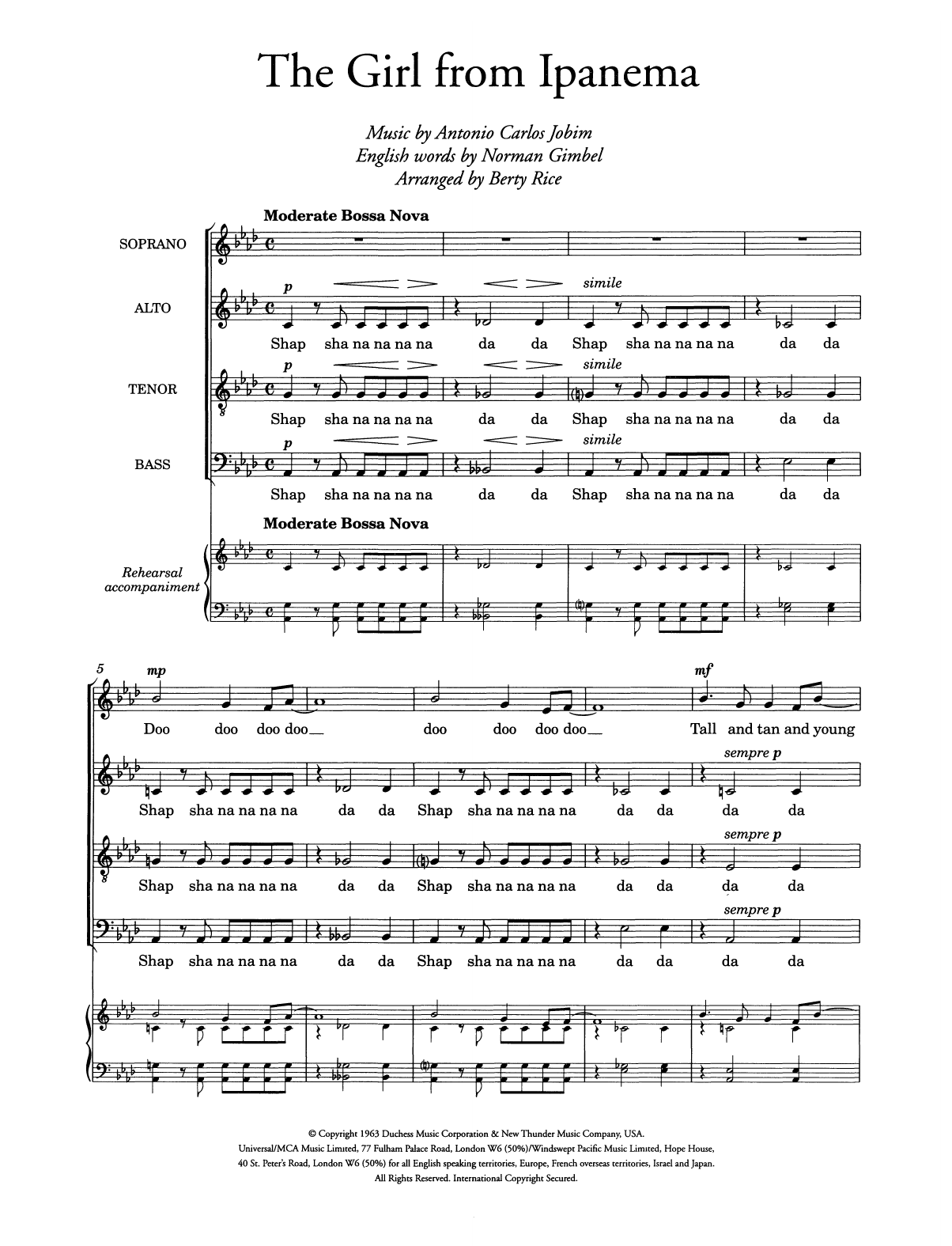
The Girl From Ipanema (arr. Berty Rice) Sheet Music Preview

The Girl From Ipanema (arr. Berty Rice): Choral Octavo

As performed by Antonio Carlos Jobim / Arranged by Berty Rice

Item: 35-DS00337795

Digital Download
$2.99
Description

The Girl From Ipanema (arr. Berty Rice): Choral Octavo isn't in MakeMusic Cloud just yet...but it could be. Let us know you'd like to see it, and you'll help shape what comes next. In the meantime, start a free trial and dive into thousands of interactive titles your students can play along with today.

Sample Audio
No sample audio found.
Sample Video
Additional Details
Publisher: Hal Leonard
Page Count: 13
SKU: 35-DS00337795

More about this title

About the Artist: Antonio Carlos Jobim

Antonio Carlos Jobim was a Brazilian pianist, composer, and songwriter who fundamentally shaped the sound of bossa nova. His sophisticated harmonic language, drawn from both classical training and jazz influence, elevated popular song to art music status. Jobim's compositions became the foundation of the bossa nova movement of the late 1950s and early 1960s, introducing the world to a distinctly Brazilian approach to rhythm, melody, and harmony.

For music educators, Jobim's work offers direct access to jazz harmony and Latin rhythm in an accessible package. His melodies are singable; his harmonies teach voice leading and chromatic movement; his rhythmic concepts expand students' understanding of what popular music can be. Teaching his songs means teaching genuine musicianship, not just entertainment.

Why we love this

Berty Rice's arrangement captures the essence of this jazz standard while making it genuinely singable for mixed choirs. The voicing sits comfortably across a wide range, and Rice maintains the sophisticated harmonic vocabulary that makes this song so rewarding to teach. Your singers will feel the elegance of bossa nova rhythm and hear how elegance and accessibility can coexist.

What to expect

The Girl From Ipanema carries the warmth and sophistication of a Rio beach sunset. There's an effortless elegance to the melody and a gentle insistence in the rhythm that makes you want to move without ever breaking stride. Singing it creates a sense of ease that paradoxically requires real attention and musicianship.

Who it's for

Mixed choirs at the intermediate level and above will find this arrangement both accessible and substantive. If your singers have any jazz or Latin experience, this becomes a perfect vehicle for deepening their understanding of those styles. Directors programming a concert with sophisticated popular music will find this fills a real need without oversimplifying the source material.

How to get the most out of it

  • Keep the rhythm section floating and relaxed rather than metronomic. This is bossa nova, not march tempo. A light touch on the accompaniment lets the singers breathe into the melody.
  • Attend carefully to the rhythmic displacement in the chorus. Rice's arrangement likely features syncopated figures that need clarity without stiffness. Sing through these passages without percussive attacks.
  • Balance the soprano line with the inner voices. The harmonic movement is intricate enough that all four parts need to speak; resist letting the melody completely dominate.
  • Shape the phrase endings with a slight ritardando rather than a dead stop. Bossa nova thrives on forward motion that occasionally relaxes, not on abrupt endings.

How to use it

This arrangement works beautifully as a standalone piece on a pops or jazz-themed concert, or as part of a set exploring Latin music styles. Consider pairing it with other bossa nova or samba arrangements for a program that showcases how deeply jazz and Latin music have influenced contemporary choral writing. It also serves as an excellent teaching piece for understanding how arrangement can preserve a song's character while making it choir-friendly.

Skills your students will build

  • Singing syncopated rhythmic patterns common to jazz and Latin styles
  • Interpreting harmony with chromatic voice leading and jazz chord extensions
  • Balancing melody and inner-voice independence in a complex harmonic texture
  • Maintaining rhythmic flexibility and space rather than metronomic precision
  • Performing with the swing and relaxation essential to bossa nova style

You May Also Like