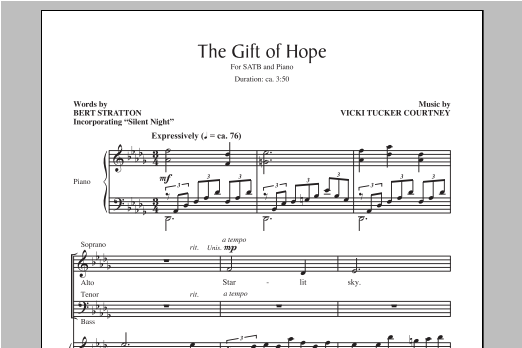
Bert Stratton has built a career on the conviction that melody and lyric must serve each other completely. From childhood piano lessons through his studies in advanced theory and sight singing at Ithaca College, he developed the ear and craft that would define his compositional voice. His trajectory moved swiftly once he began writing in earnest; Pat Boone's recording of one of his songs opened doors that led to hundreds of compositions and four independently produced albums.
Published by major houses including Shawnee Press, Carl Fischer, and Alfred, Stratton brings the discipline of a working songwriter to every piece. As an ASCAP member who has recently relocated to Nashville to pursue music full time, he remains committed to the relentless standard of comparison with the masters that shaped his early listening.
Why we love this
This octavo captures what Stratton does best: setting a text so the words and melody elevate each other without strain. The single page format makes it accessible for even smaller choirs, and the message of hope lands with genuine warmth rather than saccharine sentiment. Sacred programming often asks for pieces that inspire without preaching, and this one achieves that balance.
What to expect
The Gift of Hope invites singers into a moment of quiet affirmation. The music breathes with the kind of sincerity that comes from a composer who spent years studying how songs move people, and the text pairs with melody in a way that feels inevitable rather than constructed.
Who it's for
This piece suits choirs looking for a hopeful, accessible sacred work that doesn't demand extensive rehearsal time. It works equally well for community choirs, church ensembles, and school choirs seeking concert or liturgical repertoire with substance.
How to get the most out of it
Balance the parts so no voice dominates the melody; Stratton's writing distributes the emotional weight across the ensemble.
Shape the text naturally, letting the phrase structure guide your phrasing rather than imposing external dynamics.
Rehearse the parts independently first, especially if your altos and tenors are less experienced, since their line work supports rather than shadows the sopranos.
How to use it
Consider this for a fall or spring sacred concert where you want a centerpiece that's emotionally resonant but doesn't require elaborate staging or production. It also serves well as a closing number for services or community events, offering a moment of collective reflection without overwhelming either singers or audience.
Skills your students will build
Sustaining tone across a full phrase with even breath support
Balancing SATB texture when the melody is not in the soprano
Shaping diction to support text-setting without sacrificing vowel consistency
Finding musicality in a single-page work that demands focused interpretation
You May Also Like
Scan to Complete Your Purchase
Use your phone's camera to scan the code below
You'll log in on your phone and the order will be added to your account