

The Gershwin Mallet Collection: 3rd Vibes
5 Classics Arranged for Marimba and Vibraphone
The music of George Gershwin / arr. Anders Åstrand
Item: 00-PC-0015722_V3
$3.00
Pickup currently not available
Description
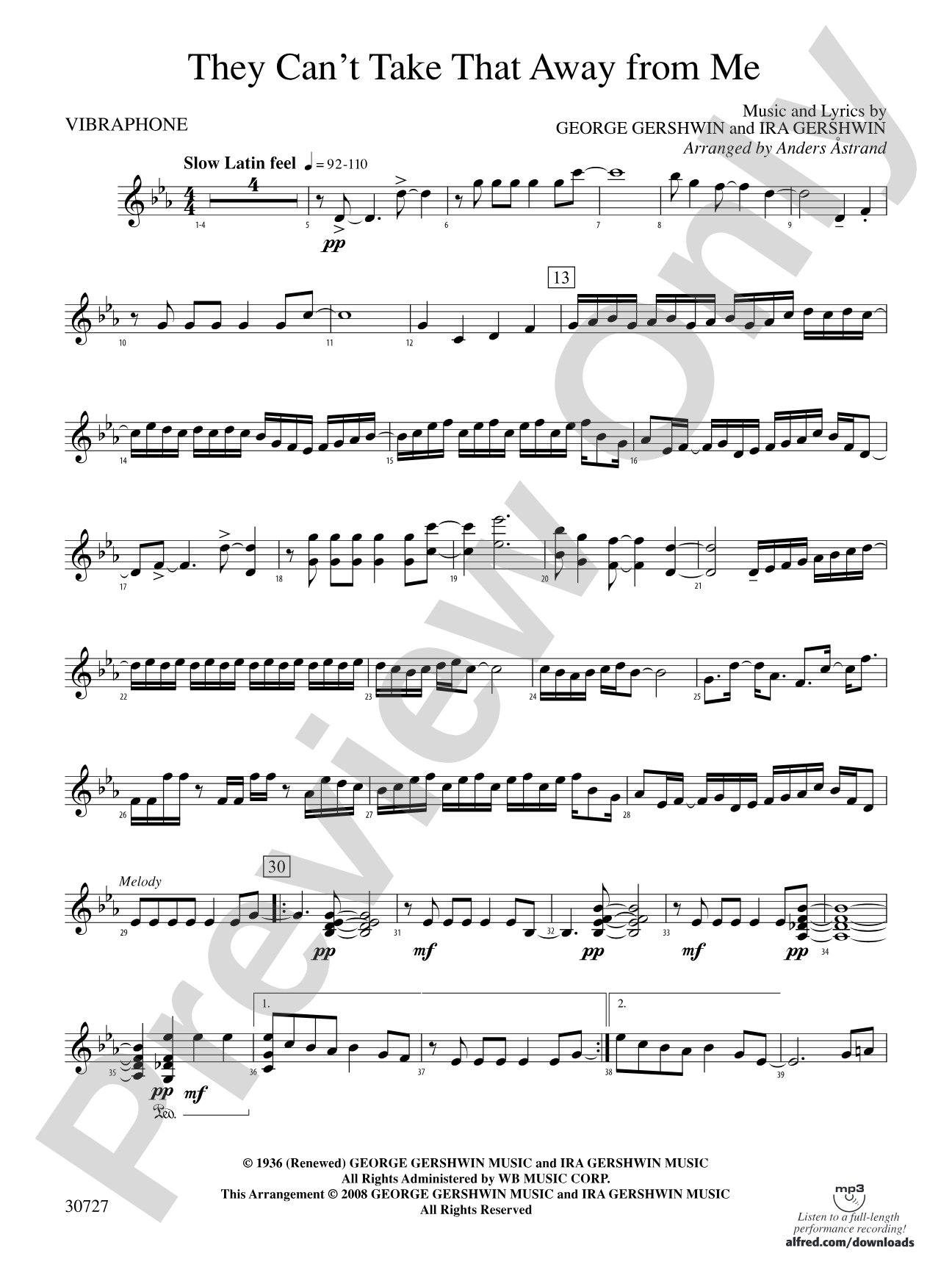
The Gershwin Mallet Collection contains five classics arranged for marimba and vibraphone ("'S Wonderful," "I Got Rhythm," "They Can't Take That Away from Me," "Summertime" from Porgy and Bess, and "Oh, Lady Be Good!"). The pieces in this collection have been arranged to give those with limited improvisational experience the opportunity of playing the melody using chords. The arrangements also utilize interesting bass lines (played on marimba), giving each tune a great rhythmic foundation.


Don't just read it, hear it, play along with it, and watch your students grow with it. In MakeMusic Cloud, The Gershwin Mallet Collection: 3rd Vibes comes alive with professional accompaniment, adjustable tempo, and built-in practice tools that turn solo practice into real progress.
Open in the Player
Jump straight in and assign it today.
Start Your Free Trial
Open this title and explore the full library in minutes.
Sample Audio
1
1 'S Wonderful
--:--
2
2 I Got Rhythm
--:--
3
3 They Can't Take That Away from Me
--:--
4
4 Summertime (from Porgy and Bess)
--:--
5
5 Oh, Lady Be Good!
--:--
1 'S Wonderful
0:00
0:00
Sample Video
No sample videos found.
Additional Details
Publisher:
Alfred Music
Page Count:
48
SKU:
00-PC-0015722_V3
More about this title
About the Composer: George Gershwin
George Gershwin (1898-1937) bridged classical and popular music in ways that few American composers have matched. His gift for melody, harmonic sophistication, and rhythmic vitality made him a defining voice of the jazz age, and his works remain central to American musical identity.
Gershwin's catalog spans concert works (Rhapsody in Blue, An American in Paris), musical theater (Girl Crazy, Of Thee I Sing), and the opera Porgy and Bess. His ability to write for both concert hall and Broadway stage, using vernacular American idioms without sacrificing compositional depth, has ensured his music endures across performance contexts and skill levels. Educators value Gershwin because his music engages students immediately while offering genuine musical substance.
Why we love this
These arrangements give percussionists a genuine reason to engage with melody and harmony, not just keep time. Anders Åstrand has structured each piece so that mallet players with limited improvisation skills can still experience the joy of playing jazz-inflected melody, supported by walking bass lines that anchor the ensemble rhythmically and harmonically.
What to expect
Gershwin's melodies shimmer with wit and warmth. These arrangements capture the sophisticated ease of 1920s and 1930s jazz and musical theater, where catchy hooks live comfortably alongside unexpected harmonic turns. Playing through this collection feels like joining a conversation that's both relaxed and rhythmically alive.
Who it's for
Mallet percussionists (marimba and vibraphone players) who want to explore melody and harmony beyond basic accompaniment roles. This collection works well for intermediate players comfortable with the fundamentals but ready to engage with jazz-inflected phrasing and chord-melody playing. It also suits percussion ensembles looking for accessible but musically sophisticated solo or small-group repertoire.
How to get the most out of it
- Balance the melody (vibraphone or upper marimba) against the bass line (lower marimba) so each voice carries weight. The walking bass is not accompaniment; it's a conversation partner.
- Let the swing feel emerge naturally from the syncopated rhythms rather than forcing it. Gershwin's syncopations work best when they feel conversational and relaxed.
- Shape phrases with dynamics and articulation. These tunes have song-like contours even in instrumental form; treat them as if they were being sung.
- Approach chord voicings cleanly. Since the arrangements provide harmonic support, precision in striking chord tones will enhance harmonic clarity and forward motion.
How to use it
Feature a mallet duet or small ensemble arrangement as a concert opener or intermission piece; the familiar melodies will engage any audience, and the jazz idiom offers a refreshing contrast to classical percussion repertoire. You might also use individual arrangements in percussion recitals, chamber concerts, or jazz-focused ensembles as a bridge between classical and popular styles.
Skills your students will build
- Reading chord changes and playing melody against harmonic support
- Jazz phrasing and articulation (swing feel, syncopation, rubato)
- Walking bass line execution and rhythmic independence between hands
- Balance and voice leading across two or more mallet percussion instruments
- Interpreting standard repertoire with historical awareness of style and idiom