
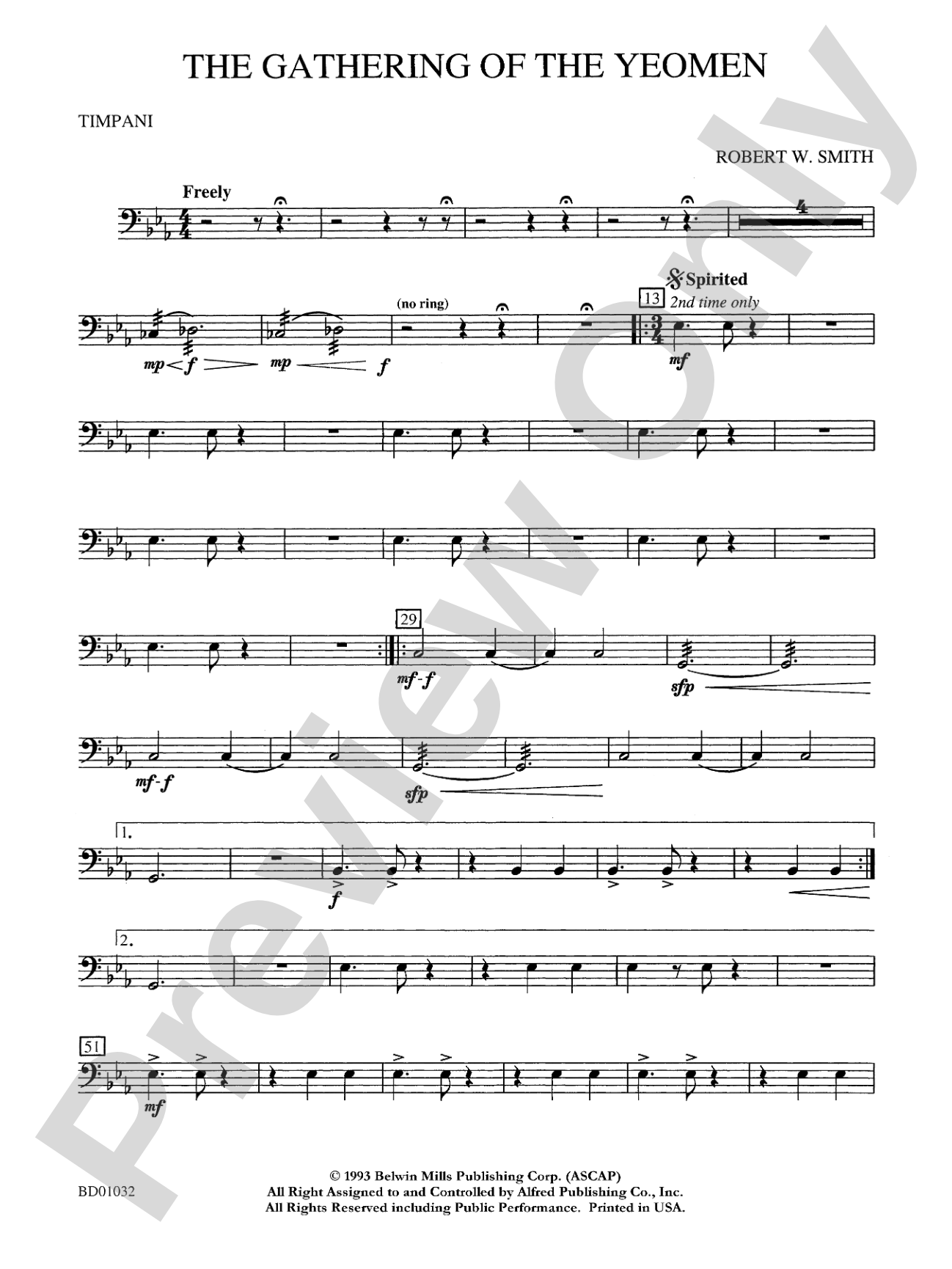

The Gathering of the Yeomen: Timpani
By Robert W. Smith
Grade: 3 (Medium Easy)
Item: 00-PC-0001995_TMP
$5.99
Pickup currently not available
Description
This composition is reminiscent of an early American folk celebration, fashioned with the drive and energy one might imagine as the spirit of a new nation. Robert W. Smith's reputation for composing major musical statements continues to grow. We welcome this new work to our concert band catalog.


Don't just read it, hear it, play along with it, and watch your students grow with it. In MakeMusic Cloud, The Gathering of the Yeomen: Timpani comes alive with professional accompaniment, adjustable tempo, and built-in practice tools that turn solo practice into real progress.
Open in the Player
Jump straight in and assign it today.
Start Your Free Trial
Open this title and explore the full library in minutes.
Sample Audio
1
Audio File
--:--
0:00
0:00
Sample Video
No sample videos found.
Additional Details
Series:
Belwin Concert Band
Publisher:
Alfred Music
Page Count:
272
SKU:
00-PC-0001995_TMP
More about this title
About the Composer: Robert W. Smith

Robert W. Smith stands among America's most frequently performed composers for concert band and orchestra, with more than 400 published works to his name. His education includes a Bachelor's degree in Music Education from Troy State University in Alabama and a Master's degree in Music from the University of Miami. Smith's original compositions have been heard on stages across North America, Europe, Australia, and Asia, with his symphonies The Divine Comedy and The Odyssey gaining particular recognition among musicians and audiences worldwide.
Beyond the concert hall, Smith has worked as both conductor and clinician across the United States, Canada, Japan, Australia, Italy, Austria, and the United Kingdom. His music has appeared in contexts ranging from Olympic broadcasts to major television network productions, presidential ceremonies in Japan, the Macy's Thanksgiving Day Parade, and opening day festivities at Dodger Stadium. Works like The Tempest have become foundational repertoire in the developing band movement, cementing Smith's influence on the standard concert band canon.
Why we love this
Smith captures the spirit and momentum of early American culture without leaning on clichéd melodic formulas. The Grade 3 scoring sits perfectly in that sweet spot where your ensemble can sound substantial and driven while remaining accessible to developing players. The folk-influenced material gives you a concert selection that feels both energetic and grounded, ideal for directors seeking work that audiences recognize as authentically American without sounding derivative.
What to expect
The piece radiates the energy and optimism of a community gathering, with bright articulation and driving rhythmic momentum that recalls early American traditions. Smith builds excitement through strong melodic themes and layered orchestration that feels fuller than the Grade 3 level might suggest, creating a sense of forward momentum and celebration throughout.
Who it's for
This work suits concert bands at the high school level or strong middle school ensembles seeking repertoire that sounds substantial without overwhelming developing musicians. Directors programming a concert or festival appearance will find it performs well and engages audiences with its accessible, celebratory character.
How to get the most out of it
- Establish the opening rhythmic drive early in rehearsal. The forward motion carries the entire piece, so lock in the pulse with your percussion section before fine-tuning articulation in the winds.
- Balance the folk melody across your clarinet and cornet sections when it passes between them. These voicings need clarity without either section dominating the texture.
- Pay attention to dynamic shaping in the secondary phrases. Smith writes moments of relative softness within the energetic passages; these contrasts prevent the piece from feeling one-dimensional.
- Let the lower voices (tubas, trombones, low reeds) feel confident in their harmonic role. They anchor the entire celebration, and confident bass playing makes the whole band sound more mature.
How to use it
Open a concert with this piece to set an upbeat, engaging tone for your audience. Its folk roots and energetic character also make it an excellent choice for festival programming, where it will stand out as both musically solid and crowd-pleasing. Position it early on a concert to capitalize on its driving energy and establish momentum for the selections that follow.
Skills your students will build
- Maintaining rhythmic precision and forward motion in driving ensemble textures
- Balancing melody across multiple sections during thematic exchanges
- Dynamic shaping within energetic passages to create musical contrast
- Supporting ensemble cohesion through confident bass and harmonic voices
- Interpreting American folk idioms in orchestral arrangement