
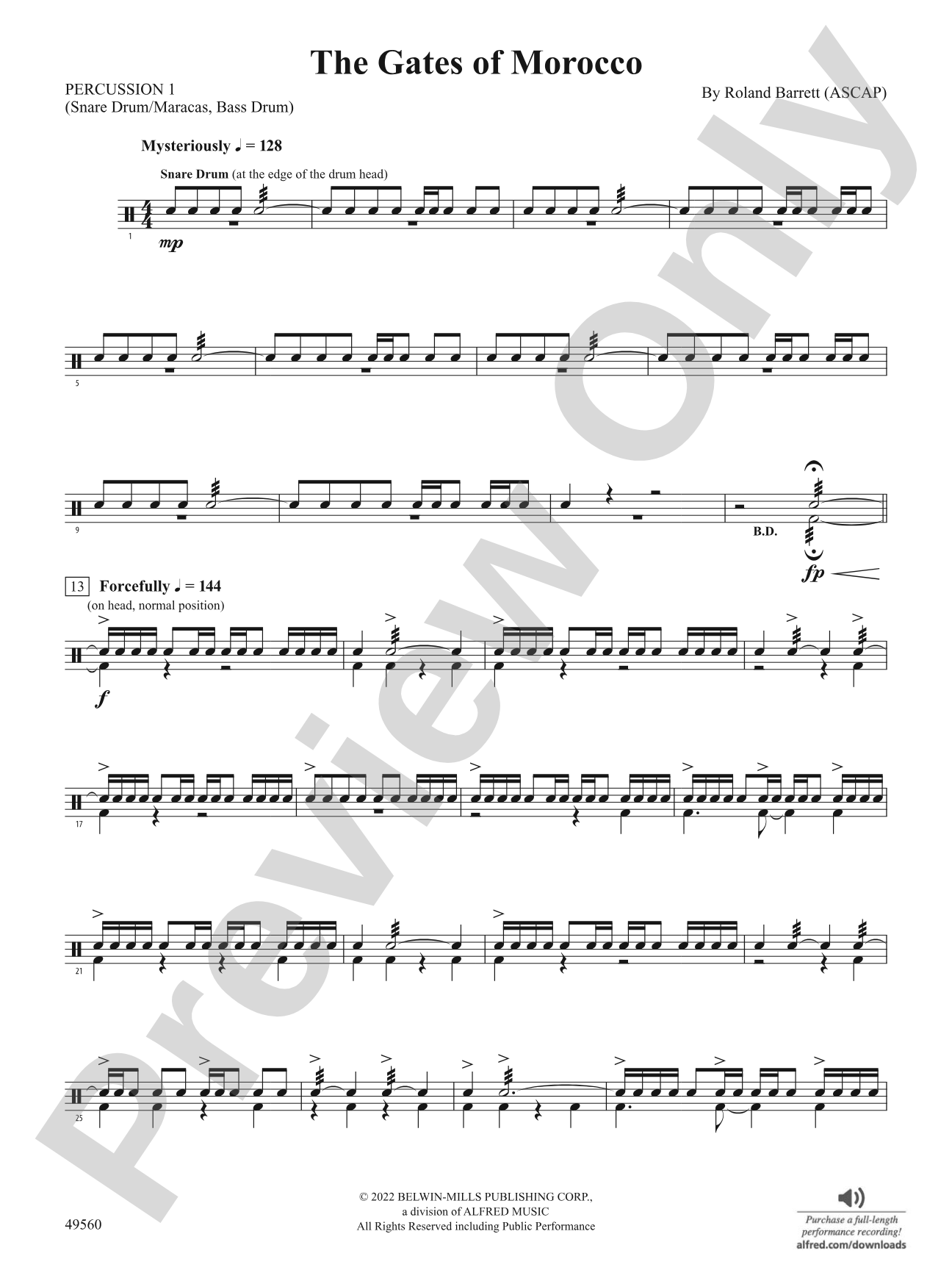

The Gates of Morocco: 1st Percussion
By Roland Barrett
Grade: 3
Item: 00-PC-0018833_PC1
$3.00
Pickup currently not available
Description
The Gates of Morocco by veteran composer Roland Barrett will take your band on a journey to a land steeped in mystery and enchantment. Using a variety of textures, including solo opportunities, creative harmonies, interesting parts for all, and fantastic percussion writing---this piece will be one your students ask to play every day. (5:27) This title is available in MakeMusic Cloud.


Don't just read it, hear it, play along with it, and watch your students grow with it. In MakeMusic Cloud, The Gates of Morocco: 1st Percussion comes alive with professional accompaniment, adjustable tempo, and built-in practice tools that turn solo practice into real progress.
Open in the Player
Jump straight in and assign it today.
Start Your Free Trial
Open this title and explore the full library in minutes.
Sample Audio
1
Audio File
--:--
0:00
0:00
Sample Video
Additional Details
Series:
Belwin Concert Band
Publisher:
Alfred Music
SKU:
00-PC-0018833_PC1
More about this title
About the Composer: Roland Barrett

Roland Barrett has shaped several generations of musicians through his dual career as both educator and prolific composer. Since 2001, he has taught music theory and composition at the University of Oklahoma, where his courses emphasize 20th century techniques at both undergraduate and graduate levels. Beyond the classroom, Barrett serves as the musical arranger for the Pride of Oklahoma marching band, a role that has informed his distinctive approach to wind band writing.
As a composer and arranger, Barrett has produced over two hundred published works spanning symphonic band, chamber ensembles, and marching band repertoire. His music has been performed by the Dallas Wind Symphony, regional and state honor bands, and broadcast on NPR and the USA network. Barrett is a multiple ASCAPlus award recipient whose compositions have been featured at major conventions including the Midwest Band & Orchestra Convention and the International Trumpet Guild.
Why we love this
Barrett writes with real understanding of what intermediate bands can execute and enjoy. The solo opportunities and creative harmonies reward your strongest players while the well-distributed parts keep everyone engaged, which tends to spark genuine enthusiasm for rehearsals. The percussion writing alone justifies selecting this piece; it's inventive without being gratuitous, and it transforms what could be a standard accompaniment role into something your percussionists will anticipate.
What to expect
The piece evokes travel through North African landscapes with mystery and shimmer. Barrett's use of varied harmonic language and instrumental colors creates an atmosphere of discovery, moving between moments of enchantment and energetic forward motion. The orchestration shimmers with intrigue, inviting listeners into spaces both exotic and emotionally accessible.
Who it's for
Concert bands working at Grade 3 level will find this piece both accessible and musically rewarding. It suits groups ready to explore ensemble color and texture while managing solo passages and rhythmic complexity. The work appeals equally to directors seeking festival material with genuine musical substance and to students wanting a piece that feels vivid and memorable.
How to get the most out of it
- Balance the solo voices against the harmonic backdrop so soloists can speak clearly without drowning out the ensemble's color and texture.
- Let the varied instrumental textures breathe independently during transitions; resist over-blending when the writing intentionally isolates specific colors.
- Shape the percussion parts with the same musical intention you'd apply to a melodic line; Barrett's rhythmic and timbral choices drive the piece's character forward.
How to use it
This works beautifully as a contest or festival selection where the five-and-a-half-minute runtime and Grade 3 difficulty present no scheduling complications. Consider pairing it with a contrasting contemporary work or a standard from your concert repertoire to showcase your band's range. The piece's distinct character also makes it an engaging opener for a concert program, setting an imaginative tone before moving into other selections.
Skills your students will build
- Blending and balancing solo passages within ensemble texture
- Executing rhythmic precision in syncopated and mixed-meter sections
- Interpreting creative harmonic language and non-traditional tonal colors
- Responding to varied instrumental textures and their dramatic function
- Sustaining musical momentum through sectional transitions