
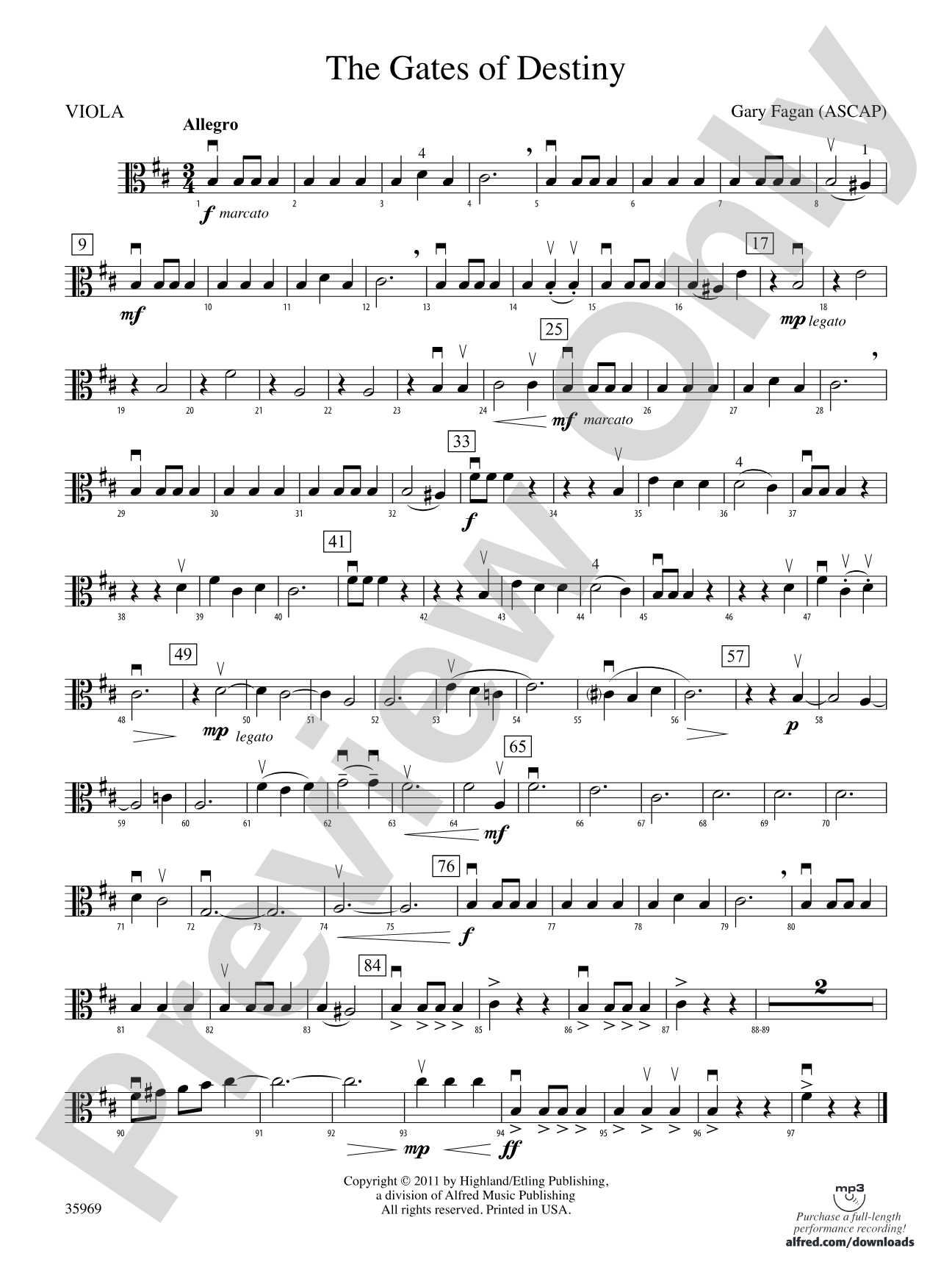

The Gates of Destiny: Viola
By Gary Fagan
Grade: 2
Item: 00-PC-0015044_VA1
$5.99
Pickup currently not available
Description
Unison sections, contrary motion, and a strong rhythmic drive combine to make this exciting piece a sure winner. Provides plenty of opportunities for skill building and aural training.


Don't just read it, hear it, play along with it, and watch your students grow with it. In MakeMusic Cloud, The Gates of Destiny: Viola comes alive with professional accompaniment, adjustable tempo, and built-in practice tools that turn solo practice into real progress.
Open in the Player
Jump straight in and assign it today.
Start Your Free Trial
Open this title and explore the full library in minutes.
Sample Audio
1
Audio File
--:--
0:00
0:00
Sample Video
No sample videos found.
Additional Details
Series:
Highland/Etling String Orchestra
Publisher:
Alfred Music
Page Count:
62
SKU:
00-PC-0015044_VA1
Instrumentation:
string
More about this title
About the Composer: Gary Fagan

Gary Fagan's compositions have been heard across prestigious venues, from the Midwest Band and Orchestra Clinic to the White House and gubernatorial events. A product of Bridgewater College's music education program and James Madison University's graduate studies, Fagan brings both pedagogical insight and compositional craft to his work for student ensembles.
After 36 years directing bands in Albemarle County schools, Fagan transitioned to university supervision and adjunct teaching in arranging at JMU. His contributions to music education have earned recognition including the University of Virginia's Outstanding Middle School Teacher award, honors from the Virginia Governor's School for the Visual and Performing Arts, and distinction in Who's Who Among America's Teachers. Active as a clinician, adjudicator, and current assistant director of the Charlottesville Band, he remains a visible presence in Virginia's music education community and serves as a member of ASCAP and the National Band Association.
Why we love this
Fagan builds this piece on strong compositional bones: unison passages that unify the ensemble, contrary motion that demands attentive part-playing, and a rhythmic pulse that propels the narrative forward. At Grade 2, it delivers genuine musical substance without sacrificing accessibility, making it an excellent choice for orchestras ready to develop beyond simple homophonic textures.
What to expect
Propulsive and purposeful, with the bright energy of young players discovering what unison power sounds like. The contrary motion creates textural interest and dialogue between sections, building a sense of conversation rather than simple melodic statement.
Who it's for
Grade 2 string orchestras with foundational technical skills and enough rehearsal experience to balance multiple musical ideas simultaneously. Directors seeking concert and festival repertoire that challenges ears and rhythm sections without requiring extensive vibrato or advanced shifting.
How to get the most out of it
- Balance the unison sections by asking players to listen horizontally across the ensemble rather than down at their own stands; this unified sound becomes the piece's foundation.
- Isolate the contrary motion passages in sectional rehearsals, asking violins and violas to shadow each other's shapes while keeping energy consistent in both directions.
- Maintain the rhythmic drive through the middle sections by conducting with clarity and counting aloud with the ensemble; let students feel the momentum rather than rush ahead of it.
- Record a rehearsal and play it back during a listening session; students will hear their own ensemble sound and notice places where rhythmic coordination softens or sharpens.
How to use it
Slot this into a concert as a centerpiece piece that shows your orchestra's growing technical control and rhythmic maturity. Its dual appeal in contest and concert settings makes it a natural choice for a tournament appearance, where the combination of structural clarity and engaging character will impress both adjudicators and audiences.
Skills your students will build
- Sustaining ensemble unison through careful listening and blend
- Reading and executing contrary motion between instrumental groups
- Maintaining rhythmic precision during driving tempos
- Responding to conductor gesture for section coordination
- Building aural awareness of texture and harmonic movement