
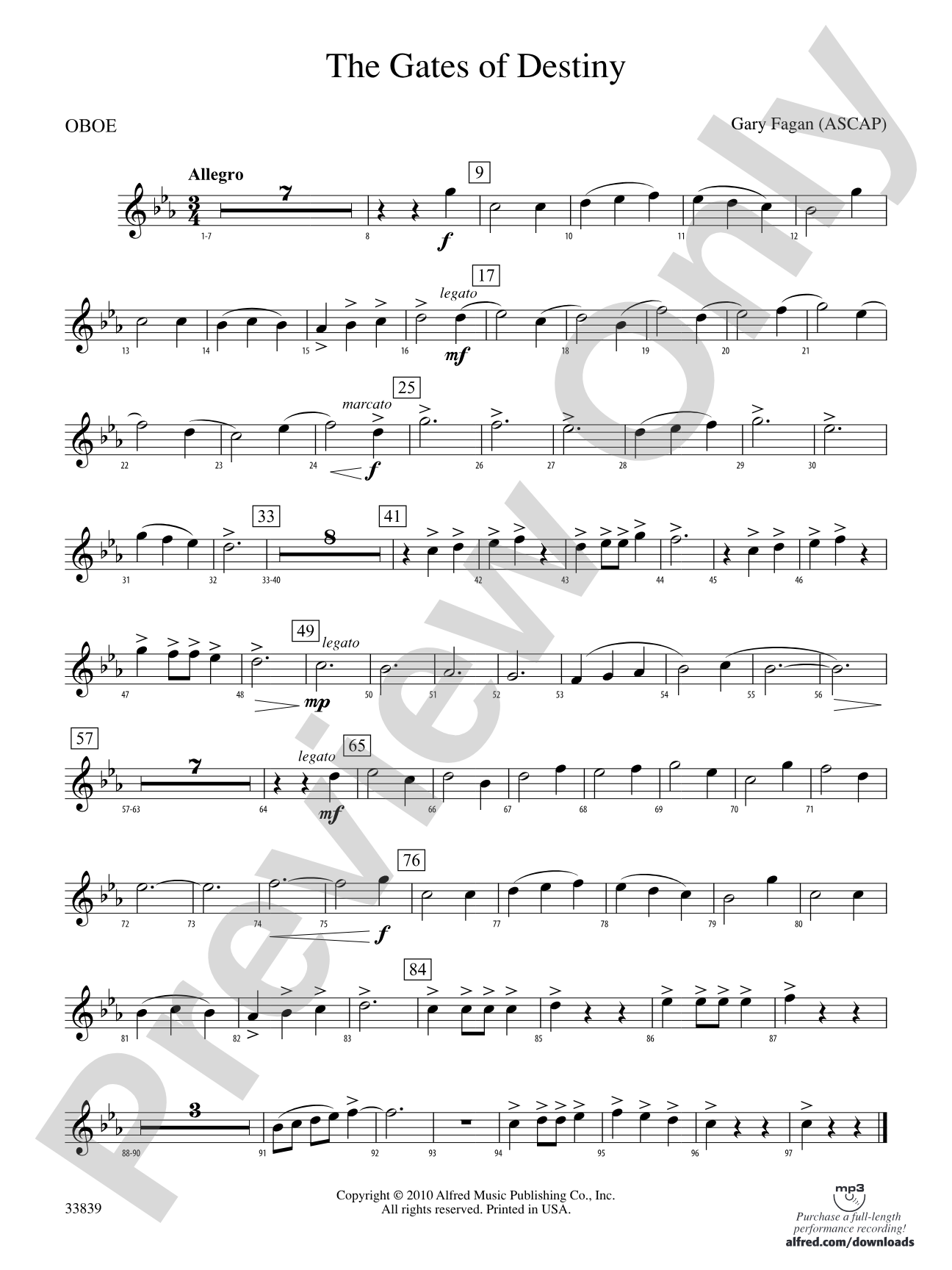

The Gates of Destiny: Oboe
By Gary Fagan
Grade: 1 (Very Easy)
Item: 00-PC-0014570_O1
$3.00
Pickup currently not available
Description
This exciting work for beginning band uses a technique in which primary themes begin on a unison note, and then move stepwise away and back while the other voices remain static or proceed in contrapuntal inversion. This creates chords that expand and contract almost continuously beneath the melody. The percussion section plays an important role providing a rhythmic base which enhances the flow and development of the piece from beginning to end.


Don't just read it, hear it, play along with it, and watch your students grow with it. In MakeMusic Cloud, The Gates of Destiny: Oboe comes alive with professional accompaniment, adjustable tempo, and built-in practice tools that turn solo practice into real progress.
Open in the Player
Jump straight in and assign it today.
Start Your Free Trial
Open this title and explore the full library in minutes.
Sample Audio
1
Audio File
--:--
0:00
0:00
Sample Video
No sample videos found.
Additional Details
Series:
Alfred Debut Series
Publisher:
Alfred Music
Page Count:
120
SKU:
00-PC-0014570_O1
More about this title
About the Composer: Gary Fagan

Gary Fagan's compositions have reached audiences from the Midwest Band and Orchestra Clinic to the White House, establishing him as a respected voice in band music. A Maryland native with degrees in Music Education from Bridgewater College and a master's degree from James Madison University, Fagan spent 36 years directing bands in Albemarle County before transitioning to university work.
His contributions to music education have been recognized with Outstanding Educator Awards from the Virginia Governor's School for the Visual and Performing Arts and the Piedmont Council of the Arts, as well as selection as Central Virginia Outstanding Middle School Teacher by the University of Virginia Chapter of Phi Delta Kappa. Currently a University Supervisor at JMU and adjunct faculty member teaching arranging, Fagan remains active as a clinician, adjudicator, and percussionist with the Charlottesville Band, where he also serves as Assistant Director. He holds memberships in ASCAP, Phi Beta Mu Bandmasters Fraternity, and the National Band Association.
Why we love this
Fagan's handling of harmonic expansion and contraction through stepwise melody movement gives Grade 1 players genuine compositional substance to work with, not just exercise material. The carefully constructed counterpoint in the inner voices teaches voice leading without overwhelming young musicians, and the percussion writing ensures the rhythm section feels equally invested in shaping the piece rather than simply marking time.
What to expect
The music unfolds like breathing, with melodies that drift stepwise away from their starting point and then return while chords shimmer and shift beneath them. There's forward momentum without frenzy, and moments of stillness that invite listening rather than merely filling time.
Who it's for
Grade 1 beginning bands with solid fundamentals and attention span for longer forms. This work suits ensembles ready to engage with harmonic concepts beyond block chords, whether preparing for concert performances or first-time festival appearances.
How to get the most out of it
- Balance the unison entrance carefully; even though the opening statement is unified, listen for slight separation between sections so clarity comes through before the harmonic expansion begins.
- Let the percussion section take ownership of its rhythmic foundation. When the band hears the drum line and bass instruments locked together, the expanding and contracting harmonies above become clearer and more connected.
- Shape the stepwise melody motion with gentle dynamic swells and recessions that mirror the harmonic breathing of the piece; avoid straight dynamic lines that fight the contrapuntal architecture underneath.
- Allow space for the inner voice movement to be heard in rehearsal. Temporarily emphasize the inner voices so students understand how their harmonic function supports the primary theme.
How to use it
Program this as a concert opener or closer where it can anchor a set without overwhelming an audience; its Grade 1 accessibility makes it an ideal showcase of what young musicians can accomplish with purposeful composition. It also works well in festival settings where judges can hear clear fundamentals alongside genuine musicianship.
Skills your students will build
- Reading primary melodic lines that move stepwise in a wider range
- Maintaining harmonic stability while melodic voices shift
- Listening to and balancing contrapuntal inner voices
- Ensemble coordination with a rhythmically active percussion section
- Dynamic control in support of harmonic expansion and contraction