
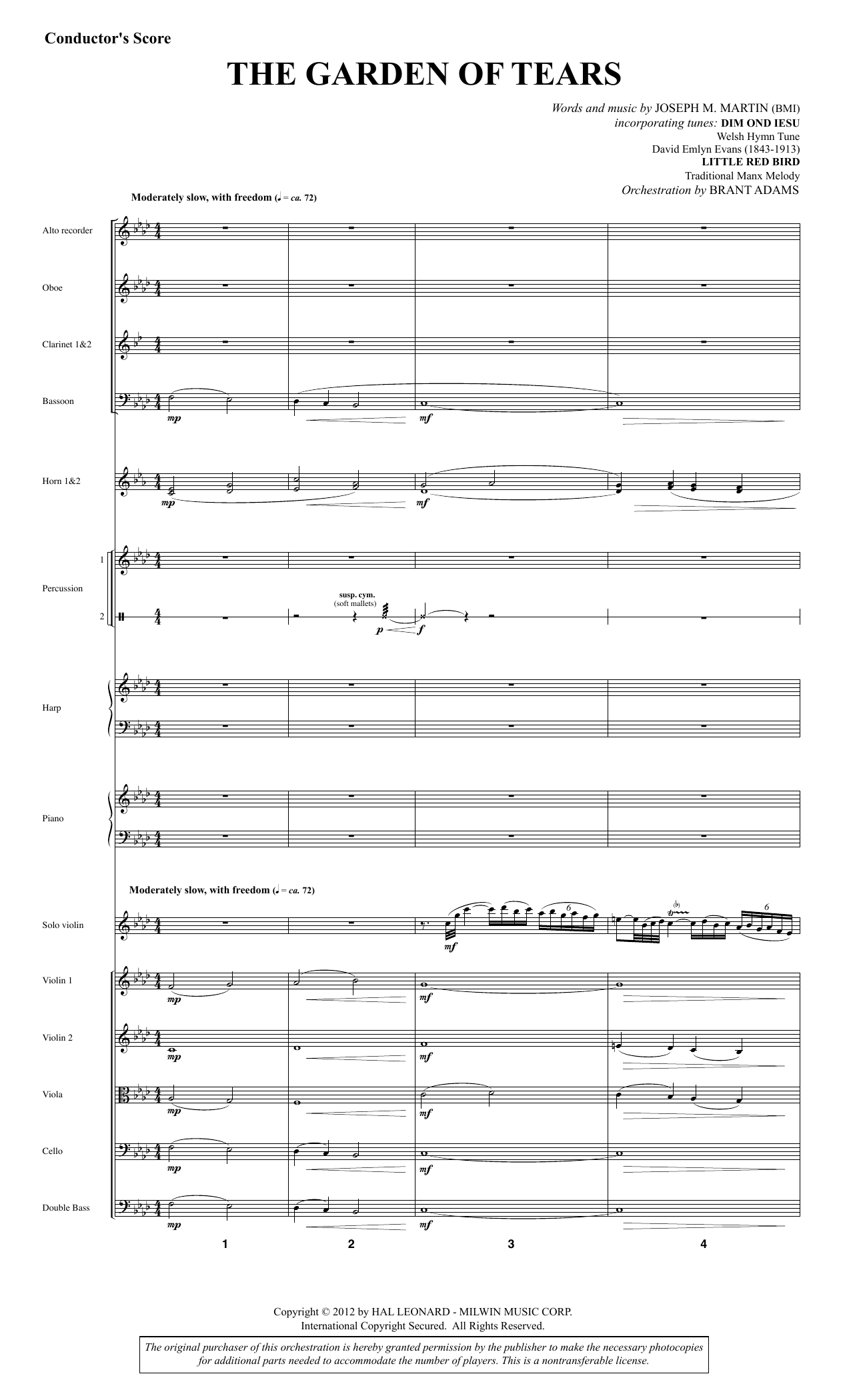

The Garden of Tears: Choral Instrumental Pak
By Joseph M. Martin
Item: 35-PK00399506
$60.00
Pickup currently not available
Buy Extra Parts (Digital PDF Download)
Parts Added to Cart!
Description
Deeply moving music brings to life the sacred soliloquy of the Savior in Gethsemane. Opening with an expressive Welsh hymn tune, the piece then surrenders to the heartfelt prayers of Jesus as He confronts the shadow of His impending arrest and crucifixion. A bittersweet melody rises like a prayer from a text filled with imagery and emotion. The orchestration is restrained yet powerful, and along with the evocative vocals, creates a lush tone painting.


The Garden of Tears: Choral Instrumental Pak isn't in MakeMusic Cloud just yet...but it could be. Let us know you'd like to see it, and you'll help shape what comes next. In the meantime, start a free trial and dive into thousands of interactive titles your students can play along with today.
Request This Title
Tell us you want it.
Start Your Free Trial
Explore everything that's ready to play right now.
Sample Audio
No sample audio found.
Sample Video
No sample videos found.
Additional Details
Publisher:
Hal Leonard
SKU:
35-PK00399506
More about this title
About the Composer: Joseph M. Martin

Joseph M. Martin studied piano performance at Furman University in Greenville, South Carolina, then continued his training at the University of Texas, Austin, where he earned a master's degree. After five years teaching piano pedagogy at UT Austin, he shifted focus toward performance and composition, establishing himself as a versatile musician who has performed solo recitals and appeared as a featured artist with orchestras across the United States and Mexico. His work as a competition winner includes a performance with the Guadalajara Symphony Orchestra, and his solo recital broadcast from Ex-convento del Carman reached national audiences.
Today Martin remains active as both performer and prolific composer, splitting his energy between concert appearances and church music work. His compositions span diverse performance spaces: from Carnegie Hall to regional theaters to countless worship settings across North America. Based in Austin, Texas with his family, he continues to expand the repertoire available to choirs and instrumentalists with music that ranges widely in style and emotional scope.
Why we love this
Martin's setting captures the theological weight of Gethsemane without veering into melodrama. The pairing of a Welsh hymn tune with contemporary choral writing gives the piece both anchor and immediacy, while the restrained orchestration ensures that text and vocal line remain transparent. This is a work that moves choirs and audiences alike because it trusts the material to speak.
What to expect
The piece unfolds like a meditation moving from communal prayer to private anguish. You begin in the familiar comfort of a hymn tune, then gradually surrender to something more vulnerable and searching, as if stepping into the garden itself. The instrumental writing frames the emotion without overwhelming it, creating space for listeners to sit with the spiritual gravity of the text.
Who it's for
This work suits choirs with solid blend and musicianship who can handle text-driven sacred music with nuance. It pairs instrumental ensemble flexibility (the pak format allows for varied orchestrations) with vocal lines that reward careful rehearsal.
How to get the most out of it
- Balance the opening hymn tune so it feels like a refuge before the emotional landscape deepens. The contrast between this moment and what follows depends entirely on the choir's willingness to sing the hymn with genuine simplicity.
- Let the instrumental parts breathe. Restrained orchestration means every accompanying note carries weight; rhythmic precision matters more than volume.
- Attend closely to the text imagery in the prayer section. Singers should understand which phrases correspond to specific moments of Christ's struggle, as this clarity will inform their phrasing and emotional delivery naturally.
- Shape the bittersweet melody as a single arc rather than isolated phrases. Think of it as a conversation with the divine, not a series of pretty moments.
How to use it
This belongs in Good Friday services, Lenten concert programs, or spring services focused on sacrifice and redemption. Program it as a centerpiece rather than filler; its emotional arc deserves an undivided audience and unrushed pacing, so consider pairing it with simpler, briefer works that let this piece stand apart.
Skills your students will build
- Sustained legit singing through extended phrases with text clarity
- Blending voices within a bittersweet harmonic language
- Following instrumental cues and rhythmic precision in ensemble settings
- Emotional maturity and interpretive restraint (avoiding overwrought delivery)
- Understanding how instrumental orchestration supports and frames vocal color