
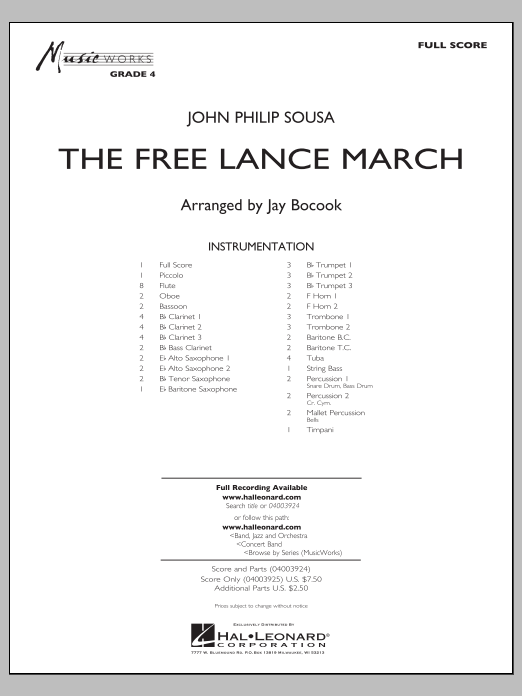

The Free Lance March: Concert Band Conductor Score & Parts
As performed by John Philip Sousa / Arranged by Jay Bocook
Grade: 4
Item: 35-PK00294548
$70.00
Pickup currently not available
Buy Extra Parts (Digital PDF Download)
Parts Added to Cart!
Description
Composed in 1905, this classic and sophisticated march by John Philip Sousa is unique from the standpoint of opening in 6/8, then switching to 2/4 midway. Jay Bocook has skillfully adapted this distinctive march for contemporary ensembles.
Dur: 4:00.


The Free Lance March: Concert Band Conductor Score & Parts isn't in MakeMusic Cloud just yet...but it could be. Let us know you'd like to see it, and you'll help shape what comes next. In the meantime, start a free trial and dive into thousands of interactive titles your students can play along with today.
Request This Title
Tell us you want it.
Start Your Free Trial
Explore everything that's ready to play right now.
Sample Audio
No sample audio found.
Sample Video
No sample videos found.
Additional Details
Publisher:
Hal Leonard
SKU:
35-PK00294548
More about this title
About the Artist: John Philip Sousa
John Philip Sousa (1854-1932) shaped American band music as both a composer and conductor. His marches became the soundtrack of American public life, performed at inaugurations, parades, and concert halls from coast to coast. His gift for melody and orchestration set the standard for the genre and influenced generations of composers who followed.
Why we love this
Bocook's arrangement preserves the harmonic and melodic sophistication of Sousa's original while making it accessible to Grade 4 ensembles. The meter shift from 6/8 to 2/4 gives your students an engaging structural challenge without overwhelming them, and the result sounds authentically Sousa. This is a march that teaches musicianship, not just note reading.
What to expect
The opening 6/8 has an elegant, almost lilting quality before the energy crystallizes into the propulsive 2/4 march we expect from Sousa. There's a sense of refinement throughout; this is not a bombastic parade march but a concert piece with sophistication woven into every section. The transformation feels both surprising and inevitable.
Who it's for
This arrangement suits Grade 4 bands with solid fundamentals who are ready to tackle formal structure and metric complexity. It works especially well for ensembles with strong reed sections and adequate brass depth. Conductors building a spring or summer concert benefit from a march that plays as well as it educates.
How to get the most out of it
- Keep the 6/8 opening section flowing with a gentle pulse; resist the urge to drag. The listener should hear it as one beat per measure, not three.
- Mark the transition to 2/4 clearly in rehearsal so the ensemble understands this is not a speed change but a fundamental shift in how the meter divides. Prepare it well before performance.
- Balance the tutti sections so the melody sings without the harmony disappearing. Sousa wrote for texture, not just volume.
- Shape the counter melodies in the lower voices; they're not filler but essential to the march's character.
How to use it
Pair this with lighter contemporary works to showcase how Sousa's structural innovations still feel fresh a century later. It stands well as a centerpiece for a "March Through Time" concert or as a strong closer that leaves the audience energized without resorting to overly familiar territory.
Skills your students will build
- Reading and executing meter changes (6/8 to 2/4)
- Conducting preparatory beats and metric transitions
- Balancing melodic lines with harmonic accompaniment
- Sustaining phrase shape across structural pivot points
- Recognizing and performing counter melodies