
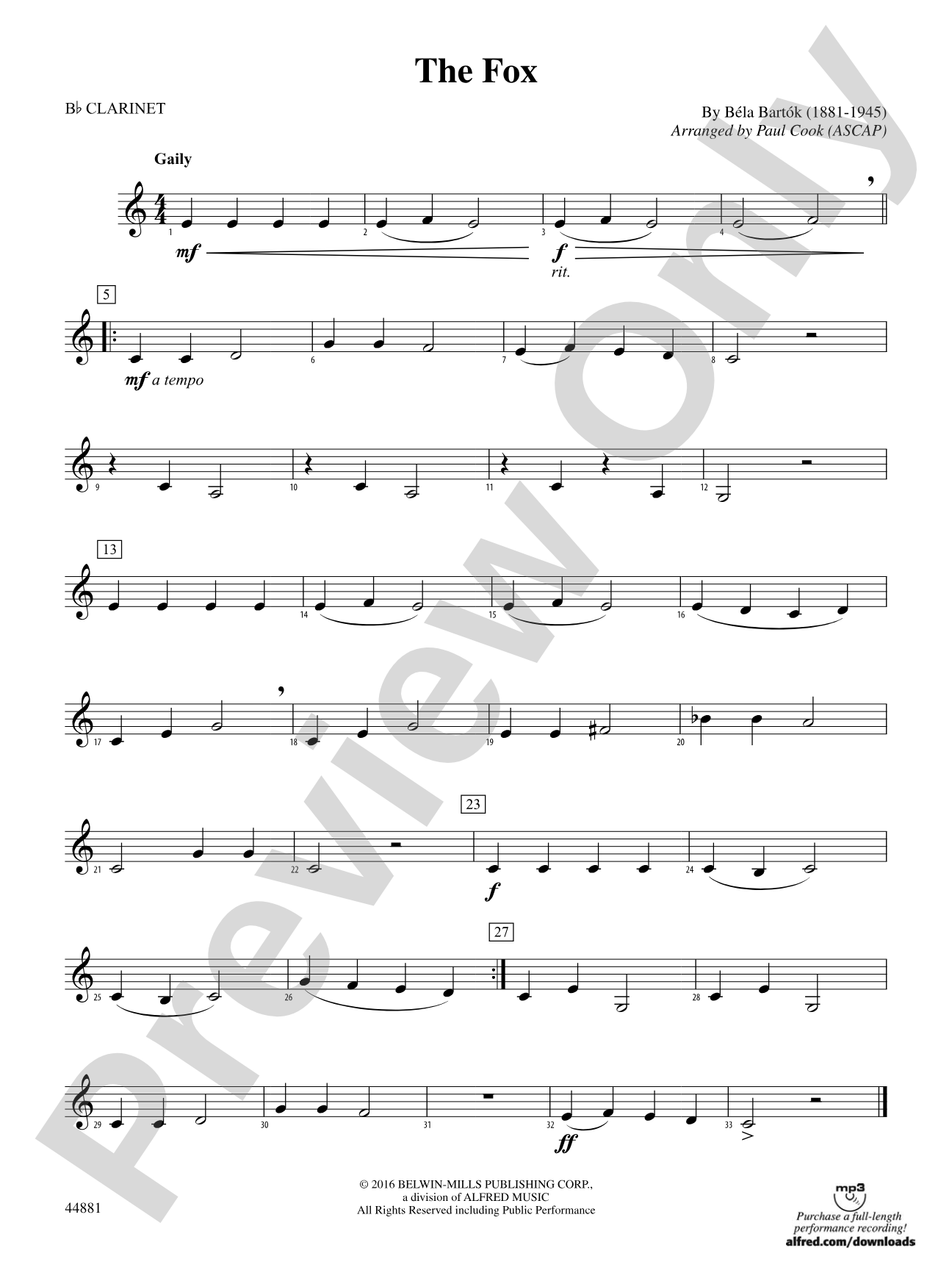

The Fox: 1st B-flat Clarinet
By Béla Bartók / arr. Paul Cook
Grade: 0.5 (Very Easy)
Item: 00-PC-0017378_C1
$3.00
Pickup currently not available
Description
One of the numerous short piano pieces for children that Béla Bartók completed in a four-volume piano collection in 1909. This arrangement for early band students remains faithful to Bartók's intent while comfortably accommodating the skills for first year players. Light and whimsical, you can hear the playful nature of "The Fox" in this solid scoring for your beginners. (1:45)


Don't just read it, hear it, play along with it, and watch your students grow with it. In MakeMusic Cloud, The Fox: 1st B-flat Clarinet comes alive with professional accompaniment, adjustable tempo, and built-in practice tools that turn solo practice into real progress.
Open in the Player
Jump straight in and assign it today.
Start Your Free Trial
Open this title and explore the full library in minutes.
Sample Audio
1
Audio File
--:--
0:00
0:00
Sample Video
Additional Details
Series:
Belwin Very Beginning Band
Publisher:
Alfred Music
Page Count:
134
SKU:
00-PC-0017378_C1
More about this title
About the Composer: Béla Bartók
Béla Bartók (1881-1945) was a Hungarian composer and ethnomusicologist whose work fundamentally shaped twentieth-century classical music. He combined rigorous scholarly research into folk music from Eastern Europe with avant-garde compositional techniques, creating a body of work that bridged popular tradition and modernist innovation. His influence on music education is profound; teachers worldwide use his pieces to introduce students to non-Western scales, unconventional harmonies, and the rich musical heritage of Central and Eastern European cultures.
Bartók's Mikrokosmos and other pedagogical collections demonstrate his deep commitment to music education. He believed that young musicians should encounter genuine artistic merit and cultural authenticity from their earliest studies, rather than watered-down exercises. This philosophy shaped how generations of teachers approach repertoire selection and what they expect from beginning musicians.
Why we love this
Paul Cook's arrangement captures the mischievous character of Bartók's original without asking first-year band students to navigate technical obstacles. The orchestration remains transparent enough that young players hear the melodic line clearly while contributing meaningfully to the ensemble sound. Programming a genuine masterwork at this level signals to your band that serious music-making starts from day one.
What to expect
The fox moves through the forest with quicksilver wit, always a step ahead, never quite settling. Bartók's original character persists here: mischievous, clever, alive with motion even when the notes sit comfortably under young fingers. The piece darts and dances, inviting players to find personality in every phrase.
Who it's for
This arrangement opens the door for first-year concert band students to play authentic twentieth-century music. It works equally well for mixed-ability ensembles or dedicated beginner bands where you want to build confidence without sacrificing artistic integrity.
How to get the most out of it
- Keep the tempo light and dance-like; resist the urge to slow down. The whimsy disappears if you drag.
- Balance the melody across your woodwinds so the fox's character projects clearly even in the softer passages.
- Shape the phrases gently rather than playing all notes at the same dynamic. Young musicians often miss the opportunity to breathe life into simple melodies.
- Listen for the moment the piece shifts character; mark those transitions in rehearsal so players understand the architecture beneath the playfulness.
How to use it
Open a concert with this short, energetic piece to establish an adventurous tone before longer works. Its brevity and accessibility make it ideal for festival programs where you want to showcase genuine repertoire without overwhelming younger students. The whimsical character also balances heavier pieces in a mixed program nicely.
Skills your students will build
- Counting steady rhythms in simple meters (4/4)
- Playing melodies with shape and phrasing rather than mechanical execution
- Listening for balance and blend within an arranged orchestration
- Understanding that beginning-level repertoire can still carry musical substance and cultural weight
- Responding to tempo and character shifts within a short form