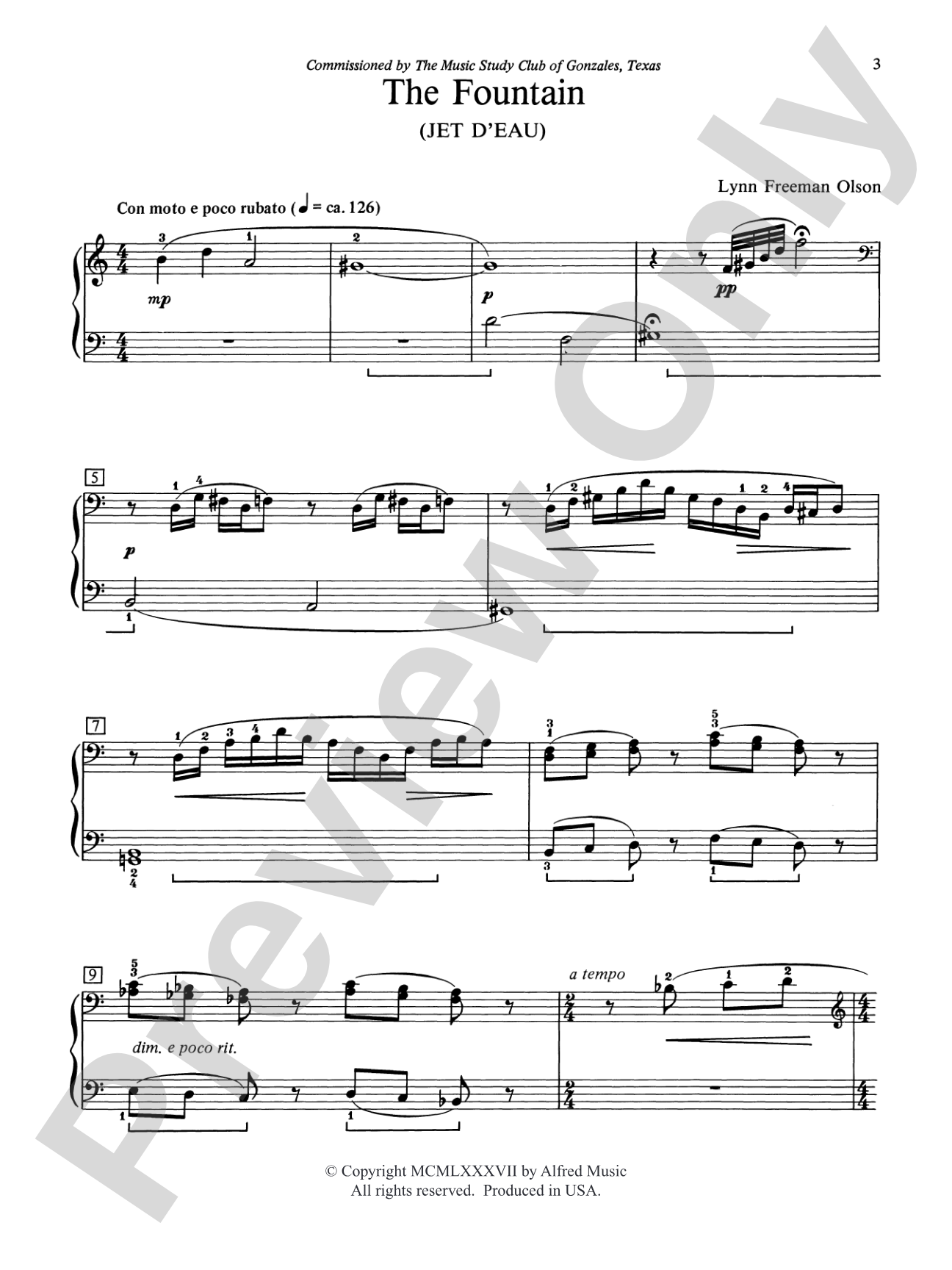
The Fountain Sheet Music Preview

The Fountain: Piano

By Lynn Freeman Olson

Level: Early Advanced

Item: 00-PS-0016223

Digital Download
$4.99
Description
Here is a beautiful, contemporary, Debussy-esque tone painting with great opportunities for creative expression from the artist, played "Con moto e poco rubato", with shifting meters, whole-tone sequences, broken 7th chords, and many refreshing compositional surprises. The Fountain also features a "cantabile" section of beautiful melodies which offset the descriptive running and chordal sequences. A Federation Festivals 2016-2020 selection. A Federation Festivals 2020-2024 selection.

The Fountain: Piano isn't in MakeMusic Cloud just yet...but it could be. Let us know you'd like to see it, and you'll help shape what comes next. In the meantime, start a free trial and dive into thousands of interactive titles your students can play along with today.

Sample Audio
No sample audio found.
Sample Video
Additional Details
Publisher: Alfred Music
Page Count: 8
SKU: 00-PS-0016223

More about this title

About the Composer: Lynn Freeman Olson

Lynn Freeman Olson is a prolific composer and pedagogue whose work spans educational and concert repertoire for piano and other instruments. Known for writing music that balances technical sophistication with musical accessibility, Olson has become a fixture in festival competitions and recital programs across North America, particularly through selections in the Federation Festivals series.

Why we love this

The Fountain captures the impressionistic soundworld of early 20th-century masters while remaining entirely fresh in its compositional voice. It offers early advanced pianists a genuine artistic challenge: the piece demands not just technical facility but genuine interpretive maturity, and the shifting meters and rubato requirements reward thoughtful practice with moments of real beauty and discovery.

What to expect

Water in motion: sunlit, shimmering, sometimes turbulent. The piece conjures the visual dynamism of a fountain through shifting textures, broken harmonies, and melodic fragments that emerge and dissolve. Moments of crystalline calm float against passages of rapid, sinuous motion.

Who it's for

Early advanced pianists seeking substantial solo repertoire that goes beyond the standard festival circuit. This piece rewards students who are ready for genuine interpretive responsibility and who want to develop their sense of contemporary harmonic language without sacrificing musicality.

How to get the most out of it

  • Treat the rubato sections as genuine compositional moments rather than decoration. The "poco rubato" marking invites expressive freedom, but anchor it to the underlying harmonic rhythm so the piece never loses its architectural coherence.
  • Let the whole-tone sequences breathe. Resist the urge to impose traditional tonal logic on these passages; they live in a different harmonic space, and clarity of touch matters more than directional phrasing.
  • Use the meter shifts as structural signposts. Rather than fighting the changes from one metric context to another, let them define new musical territories so listeners hear them as intentional exploration rather than notational complexity.
  • Balance the running figurations with dynamic restraint in the cantabile section. The contrast between descriptive passage work and lyrical melody is the piece's emotional heart; don't let technical momentum carry you through the singing lines.

How to use it

Program this as a contemporary solo on a recital or studio showcase, where it can stand alongside Romantic or Classical works to demonstrate a student's range and modern sensibility. Its selection for consecutive Federation Festivals cycles also makes it a natural choice for competition preparation at the early advanced level.

Skills your students will build

  • Control of rubato and expressive timing in contemporary idiom
  • Reading and executing meter changes (relationships between 2/4, 3/4, and 4/4)
  • Whole-tone harmonic language and non-functional harmony
  • Broken chord voicings and seventh chord inversions
  • Color and texture differentiation between running figurations and cantabile passages
  • Balance between technical display and lyrical restraint

You May Also Like