
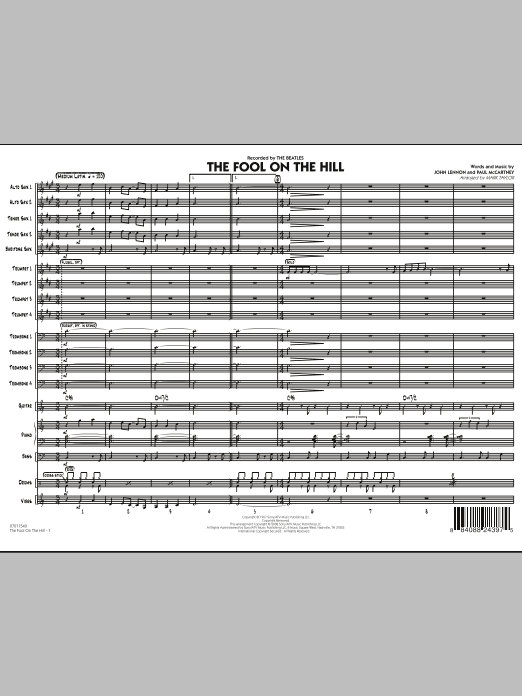

The Fool on the Hill (Flugelhorn Feature): Jazz Ensemble Conductor Score & Parts
By John Lennon / By Paul McCartney / As performed by The Beatles / Arranged by Mark Taylor
Grade: 3
Item: 35-PK00118513
$50.00
Pickup currently not available
Buy Extra Parts (Digital PDF Download)
Parts Added to Cart!
Description
With a smooth Latin feel, interesting harmonies plus a few mixed meters, this Beatles tune is a terrific feature number for your flugelhorn soloist. Tasty ensemble lines contribute to a creative and appealing change of pace.


The Fool on the Hill (Flugelhorn Feature): Jazz Ensemble Conductor Score & Parts isn't in MakeMusic Cloud just yet...but it could be. Let us know you'd like to see it, and you'll help shape what comes next. In the meantime, start a free trial and dive into thousands of interactive titles your students can play along with today.
Request This Title
Tell us you want it.
Start Your Free Trial
Explore everything that's ready to play right now.
Sample Audio
No sample audio found.
Sample Video
No sample videos found.
Additional Details
Publisher:
Hal Leonard
SKU:
35-PK00118513
More about this title
About the Composer: John Lennon
John Lennon shaped modern popular music through his work with The Beatles, blending rock sensibilities with sophisticated harmonic and melodic invention. His songwriting legacy extends far beyond the band's era, offering educators a rich catalog of accessible yet musically substantial material for classroom and ensemble exploration.
Why we love this
Mark Taylor's arrangement strips this tune down to its essential melodic and harmonic bones, then rebuilds it as a genuine jazz vehicle. The flugelhorn gets space to breathe over a groove that's sophisticated enough to hold your ensemble's interest while remaining approachable at Grade 3.
What to expect
Sophisticated grooves underpin a feature that swings with restraint and warmth. The flugelhorn's mellow voice floats over interesting harmonic twists, creating a soundscape that feels both contemporary and timeless.
Who it's for
Jazz ensembles with a capable flugelhorn player looking for repertoire that challenges rhythm section fundamentals without overwhelming younger musicians. This works equally well for directors seeking an intellectually satisfying change of pace that doesn't require pre-college musicianship.
How to get the most out of it
- Anchor the Latin rhythm section early in rehearsal. The pocket drives everything; once your drums and bass lock in, the ensemble lines sit much more naturally.
- Balance the flugelhorn soloist carefully against the ensemble parts. These aren't background textures; they're conversational lines that need to breathe alongside the feature.
- Land the mixed meter transitions cleanly. Mark those spots in your parts and count them aloud during rehearsals so the shift feels intentional, not accidental.
- Shape the ensemble harmonies with attention to voice leading. Taylor's chords move thoughtfully; let that movement breathe rather than playing them as static blocks.
How to use it
Pair this with harder charging material on a concert to showcase your ensemble's range. It's particularly effective mid-program when you want to demonstrate musicality and control before building back to energy.
Skills your students will build
- Latin rhythm fundamentals (clave, tumbao, and coordination with ride cymbal)
- Reading and executing mixed meter passages (transitions between 4/4 and other time signatures)
- Harmonic awareness through ensemble chord writing
- Listening and balancing as an ensemble voice while supporting a soloist
- Jazz articulation and phrasing over a grooved feel