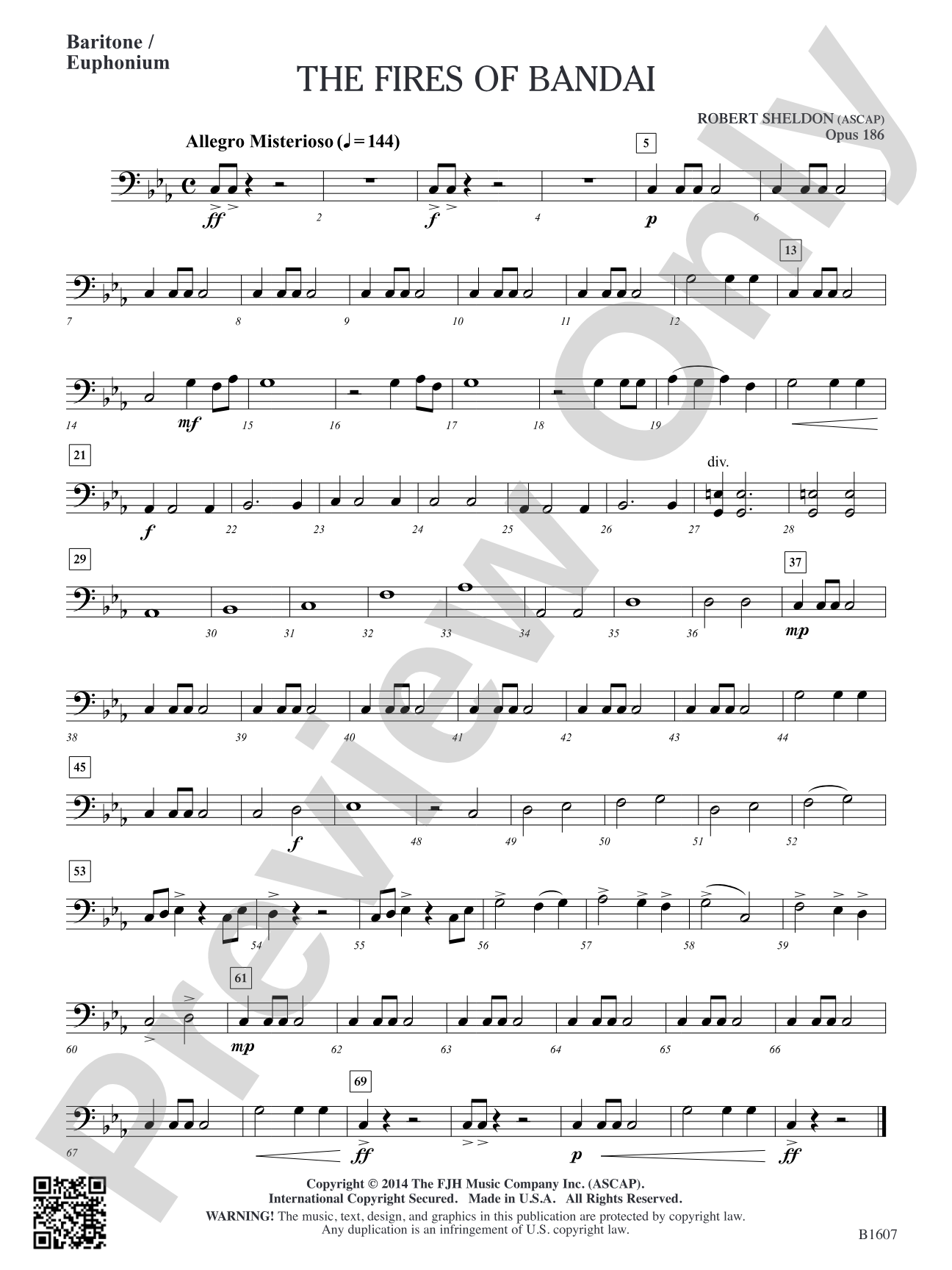
The Fires of Bandai: Baritone / Euphonium Sheet Music Preview

The Fires of Bandai: Baritone / Euphonium

By Robert Sheldon

Grade: 1.5

Item: 98-PC-DB1607_BBC1

Digital Download
$7.00
Description
Inspired by the 1888 eruption of Mt. Bandai in northern Japan, this bold, imaginative work captures the drama and fury of a pyroclastic flow. The driving rhythms in the percussion along with the dark and ominous melodies are sure to get the audience involved in this evocative work for young band.

Don't just read it, hear it, play along with it, and watch your students grow with it. In MakeMusic Cloud, The Fires of Bandai: Baritone / Euphonium comes alive with professional accompaniment, adjustable tempo, and built-in practice tools that turn solo practice into real progress.

Sample Audio
0:00
0:00
Sample Video
Additional Details
Series: FJH MOS Performance
Publisher: The FJH Music Company, Inc.
SKU: 98-PC-DB1607_BBC1

More about this title

About the Composer: Robert Sheldon

Robert Sheldon

Robert Sheldon ranks among the most frequently performed composers writing for wind band today. His works appear on contest and festival lists worldwide, and ensembles from regional honor bands to all-state groups regularly perform his music. He authored Sound Innovations for Concert Band and has received awards from the American School Band Director's Association, Phi Beta Mu, and ASCAP.

Sheldon maintains an active schedule as a guest conductor, clinician, and commission composer. He has led performances at Carnegie Hall, Orchestra Hall, Boston Symphony Hall, the Sydney Opera House, and the Kennedy Center. His conducting and teaching work has taken him across North America, Europe, Asia, and Australia. VanderCook College of Music awarded him an honorary doctorate in 2020.

Why we love this

Sheldon captures visceral dramatic power without demanding advanced technical skills. The piece gives young bands immediate access to evocative storytelling through driving rhythms and dark orchestration, making it a natural selection for groups seeking concert impact at an accessible grade level. Contest and festival adjudicators recognize it as sophisticated musical writing at Grade 1.5.

What to expect

Dark, turbulent, and relentless. The piece captures the primal force of volcanic fury through pounding rhythms and menacing melodies that build from ominous whispers to overwhelming power. You feel the earth shifting beneath you as the music unfolds.

Who it's for

Young concert bands seeking a substantial piece with genuine dramatic character. This work suits bands at the Grade 1.5 level who are ready to engage with evocative storytelling and want repertoire that excites audiences without overwhelming students technically.

How to get the most out of it

  • Establish the percussion foundation early in rehearsal. The driving rhythms in the percussion section anchor the entire piece; lock these patterns solid before layering in the melodic voices.
  • Shape the dark ominous melodies with careful attention to phrase direction. Avoid playing them mechanically; these lines should pull listeners forward despite their somber character.
  • Balance the full sound. Young bands often overplay the dramatic moments; find the restraint that makes the eruption moments land harder when they arrive.
  • Use dynamics strategically to build tension. This work thrives on contrast between ominous build and explosive release, so mark clear dynamic targets in parts during sectionals.

How to use it

This works beautifully as a concert centerpiece for young bands seeking to program something with real dramatic weight. Pair it with lighter, contrasting works to balance the intensity, or open a set with it to immediately engage the audience. The contest/festival designation makes it equally valuable for adjudicated events.

Skills your students will build

  • Sustaining dramatic tension across long phrases
  • Executing driving rhythmic patterns with precision and ensemble unity
  • Shaping lyrical melodies within a dark, minor-key context
  • Responding to significant dynamic contrasts and building to climactic moments
  • Interpreting evocative program music and translating narrative intent into sound

You May Also Like