
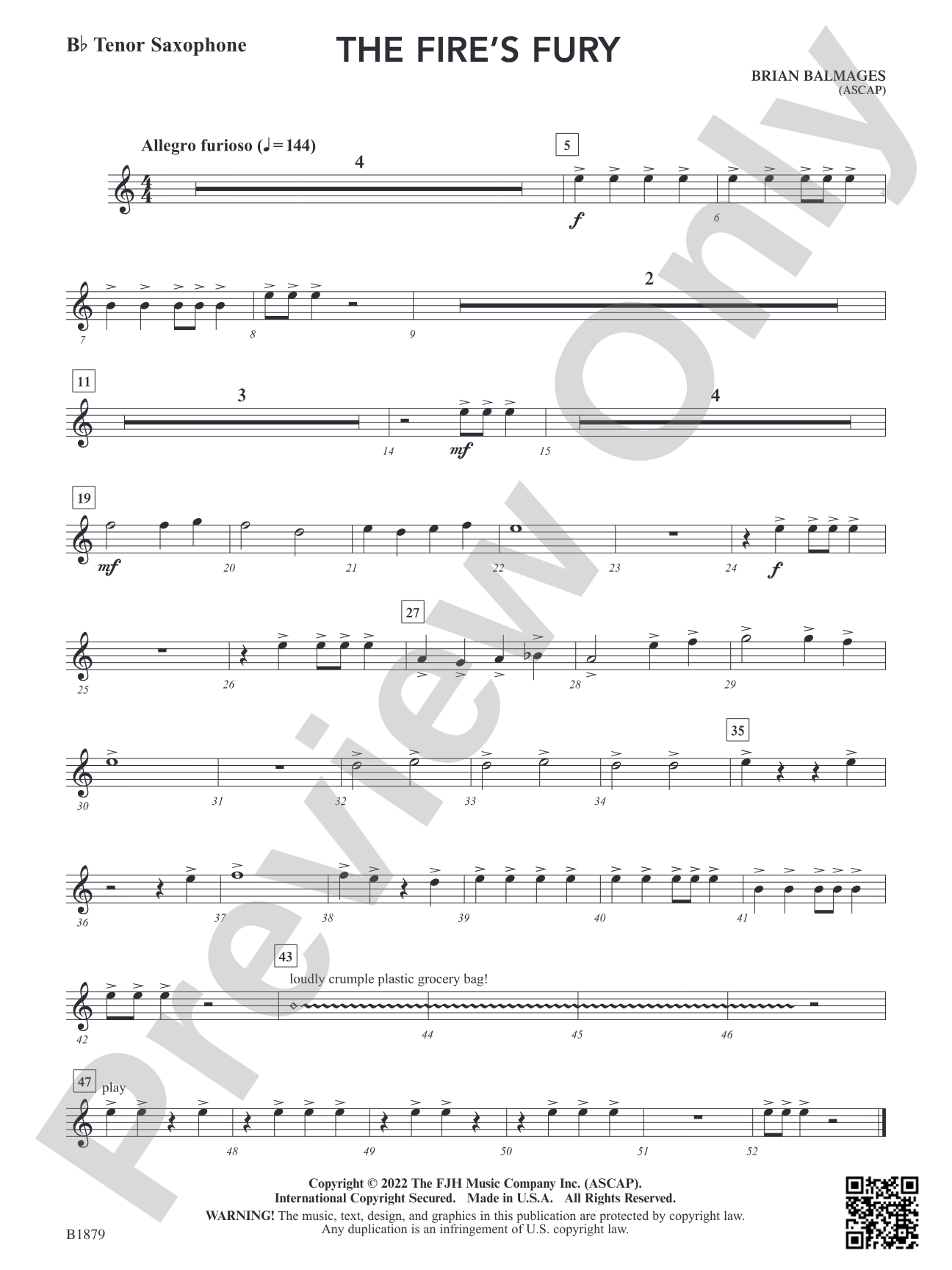

The Fire's Fury: B-flat Tenor Saxophone
By Brian Balmages
Level:.5
Item: 98-PC-DB1879_TX1
$7.00
Pickup currently not available
Description
An event so powerful that it is hard to control, seemingly unpredictable, aggressive, fast moving, and unstable. All these thoughts are explored as powerful percussion elements combine with dissonant intervals in the winds. Complex sounds for a work that is very approachable!


Don't just read it, hear it, play along with it, and watch your students grow with it. In MakeMusic Cloud, The Fire's Fury: B-flat Tenor Saxophone comes alive with professional accompaniment, adjustable tempo, and built-in practice tools that turn solo practice into real progress.
Open in the Player
Jump straight in and assign it today.
Start Your Free Trial
Open this title and explore the full library in minutes.
Sample Audio
1
Audio File
--:--
0:00
0:00
Sample Video
Additional Details
Series:
MOS Performance Series
Publisher:
The FJH Music Company, Inc.
SKU:
98-PC-DB1879_TX1
More about this title
About the Composer: Brian Balmages

Brian Balmages has built a reputation as a composer and conductor whose work spans orchestral, band, and chamber music with equal fluency. His compositions have been performed by ensembles ranging from professional symphony orchestras to elementary school groups in prestigious venues including Carnegie Hall, the Kennedy Center, and the Sydney Opera House.
Balmages is an elected member of the American Bandmasters Association and received the A. Austin Harding Award from the American School Band Directors Association. He won the 2020 NBA William D. Revelli Composition Contest and was commissioned by the University of Miami to compose music for the inauguration of the institution's president. His work has been performed at the Presidential Inaugural Prayer Service and at major conferences worldwide. Currently, he serves as Director of MakeMusic Publications and Digital Education for Alfred and MakeMusic.
Why we love this
Balmages delivers visceral, contemporary sound without requiring your students to master avant-garde notation or incomprehensible harmonic language. The piece pairs aggressive percussion writing and dissonant wind textures in ways that grip audiences while remaining genuinely playable at this accessible level. This is music that sounds sophisticated and feels powerful in performance.
What to expect
The Fire's Fury captures the raw, overwhelming sensation of an unstoppable force. Percussion pounds relentlessly while the winds clash in intervals that feel destabilized and volatile, creating a soundscape that is thrilling rather than gentle, sharp rather than mellow.
Who it's for
This work suits developing concert bands that want to program something contemporary and impactful without repertoire that demands virtuosity. Players benefit from exposure to modern compositional language and the challenge of ensemble balance when dissonance is the primary storytelling device.
How to get the most out of it
- Establish a clear pulse with your percussion section early in rehearsal. The stability of the timpani and battery directly affects how the winds land their dissonance; sloppy rhythmic foundation will muddy the piece's impact.
- Shape the dynamic arc of aggressive passages deliberately. Push your students to differentiate between "loud" and "controlled intensity"; unrelenting fortissimo flattens the drama.
- Balance the dissonant intervals in the winds so individual lines remain audible. This isn't about sweetening the sound, but about letting listeners track what makes the writing so unsettling.
- Rehearse transitions between high-energy sections and any moments of relative rest with care. Abrupt shifts are often more effective than gradual decrescendos when depicting unpredictability.
How to use it
Program this as a concert opener or a centerpiece in a set devoted to contemporary band music. It pairs effectively with older standard repertoire as a statement of where band music can go stylistically, and works especially well in programs exploring orchestration, texture, or modern composition.
Skills your students will build
- Balancing independent harmonic lines in dissonant contexts
- Maintaining rhythmic precision during fast-moving, complex textures
- Playing with dynamic control and nuance in aggressive, high-energy passages
- Ensemble listening across mixed timbral colors (winds, brass, and percussion interacting)
- Interpreting and executing contemporary compositional language and notation